Something I have always loved about Daiei, a Japanese film studio founded in 1942, is that they found initial success making so-called jidai-geki period films of feudal society and the age of samurai. When television entered Japan in an aggressive and popular fashion, it was harder to make period drama work in cinemas because they were so easy to replicate on TV. To keep their films profitable, Daiei shifted into making monster movies and horror films as well. Since they were, by that point, so adept at making period dramas, they simply never stopped. Instead they started to deliver an incredible range of period monster and horror films, such as Yasuda Kimiyoshi’s Daimajin (1966) and Tanaka Tokuzo’s The Snow Woman (1968).
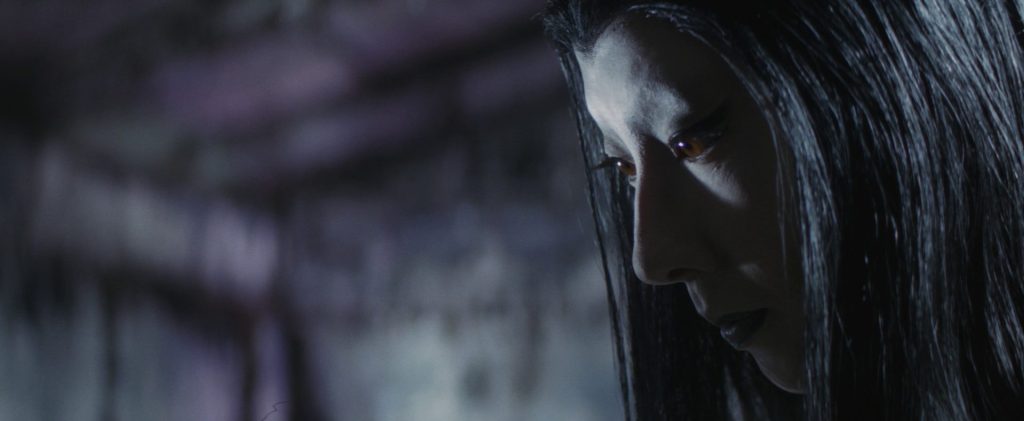
A wood-carver and his apprentice (Ishihama Akira) climb a mountain to find the tree with which the carver will make a temple statue. While taking shelter from a storm, they witness a cursed demon – the “snow woman” (Fujimura Shiho) – who kills the carver but leaves the apprentice unharmed. As the apprentice prepares to take his master’s place, he falls in love with a beautiful young woman – unaware she is the same demon he saw before.
Tanaka presents an evenly-balanced mixture of period drama and supernatural horror here. He was a former assistant to Japanese great Kurosawa Akira, so it is not a surprise to see him bring such a strong handle on setting, culture, and character. One of the elements that demonstrates the strength of his film is that, were one to remove all of the ghostly elements from the narrative, there would still be a well-plotted and intriguing historical drama left behind. The apprentice Yosaku retains his master’s commission to carve a statue of Kannon – a Bodhisattva of mercy and compassion – but in doing so earns the ire of a local aristocrat. That lord forces the temple to turn the commission into a contest between Yosaku and a veteran artist of his own choosing. The same lord also begins to covet Yosaku’s new wife Yuki, unaware of her true demonic nature.
There is a clever narrative contrasts here, between the compassion and mercy espoused by Yosaku’s statue and both the cold brutality of the snow woman and the machinations of Lord Jito. While there could be a story told without the supernatural elements, it is those elements that enrich and deepen the central plot. It is wonderfully realised as well, with Fujimura adopting one of cinema’s all-time great death stares when in her monstrous form.
The Snow Woman adapts the same folk story as one of the segments in Kobayashi Masaki’s popular Kwaidan (1964). Both adaptations are excellent. What The Snow Woman might lose in impact it gains in depth and character, as well as a sensational musical score by Ifukube Akira – better known for his iconic soundtrack to Godzilla (1954). Combined with its rich period detail and strong performances, Tanaka Tozuko’s creepy and effective ghost story is one of the very best examples Japanese folk horror cinema.



Leave a Reply