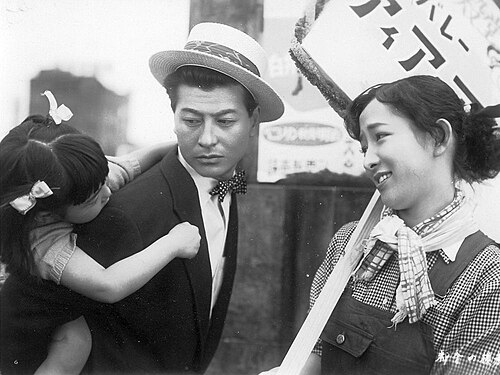
Five-year-old Michiko gets lost in Tokyo’s famous shopping district of Ginza, leading shoe-shine girl Toshiko (Arima Ineko) and sign walker Ueda (Ikebe Ryo) to help her reunite with her mother. Meanwhile her mother (Kogure Michiyo) finds searching for her daughter difficult when her companion is more interested in shopping than hunting.
Shimizu Hiroshi remains one of Japan’s most prolific filmmakers, with a career than stretched from silent cinema to the late 1950s and encompassing well over 150 films in the process. He was never more famous than he was from the 1930s with a string of classic feature comedies including Mr Thank You (1936), The Masseurs and the Woman (1938), and Ornamental Hairpin (1941). His work following the Pacific War, when he abandoned studio Shochiku to partly self-produce his own work, lacks the longevity of his famous films but remains a regular delight desperately in need of rediscovery.
Tokyo Profile, also known as Profile of a Town and released by Toho in 1953, feels a hugely representative work of his style, subject matter, and tone. It blends comedy with light drama, has a partial focus on children, and portrays day-to-day life among working class Japanese. It is striking that Shimizu sets his film in as famously wealthy a district as Ginza; his ensemble of characters are all markedly poor in comparison to the monied shoppers strolling by.
One of Shimizu’s common stylistic techniques was to shoot his films on location. Here the characters are buoyantly drawn and the dialogue quite heightened and theatrical, but at the same time it is all set in the actual Ginza. It lends his film a sense of immediacy and realism that they otherwise might lack. It also provides an opportunity for modern-day viewers to get a sense of what Ginza looked like in 1953 – just eight years after Tokyo had been as good as levelled by American fire-bombings.
Indeed there is a benefit to viewing Tokyo Profile not as a discrete film work but as part of an ongoing post-war conversation about Japan’s economic recovery. Kurosawa’s One Wonderful Sunday (1947) depicts an impoverished romantic couple going on a date in Tokyo’s ruins. Naruse Mikio’s Ginza Cosmetics (1951) showcases the famous suburb in perhaps better physical shape, but still struck by ongoing poverty and fiscal troubles. Here Shimizu offers a Ginza of the ‘haves’ and the ‘have-nots’. As noted, his protagonists are all poor people trying to make a living among the rich. Michiyo’s mother has come to Ginza to purchase her daughter shoes that are barely affordable to her, before her unsympathetic companion orders expensive drinks in a cafe and then stiffs her with the bill. Her financial woes form the most serious plot thread of the film. Even through the brighter and more amusing subplots – there is a hilarious English-language class for sex workers and young woman seeking American sugar-daddies – the spectre of wealth and of not having any remains a steady, consistent under-current.
Tokyo Profile is a delicately composed, pleasant film. It offers amusing scenes and delightful characters, little moments of everyday life and even an unexpected pair of musical numbers. It is perfectly shaped to please a crowd, but there is also meat to the bones. It is sweet, heartfelt, wonderful cinema.






Leave a Reply