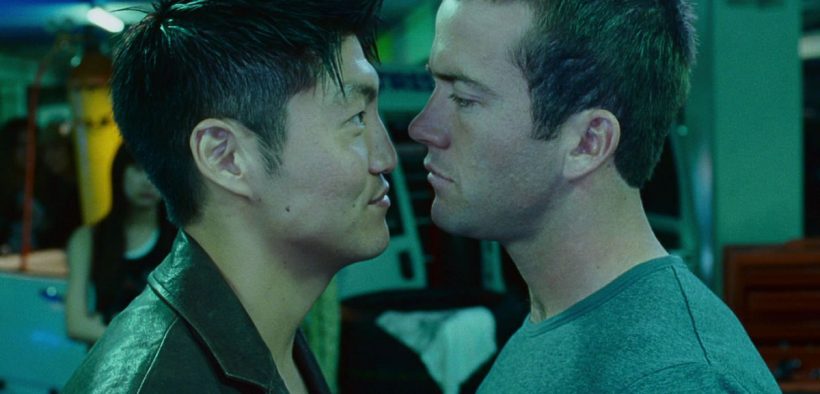
It is amusing that the third Fast & Furious feature would set itself in East Asia, because it take a very Asian approach to being a sequel. Chinese-language action cinema in particular has a tendency for its protagonists to die nobly during a film’s climax. It is great for generating drama but not so great when it comes to making a follow-up. Sequels, typically, are more difficult when your lead character is dead. A common solution, then, is for the same production team – and sometimes even the same cast – to make an all-new movie with a fresh story and characters, but retaining the same general setting and subject matter. Overheard is one key example, where three films have been made with entirely unrelated stories but sharing a common theme of surveillance and corruption.
So here is Tokyo Drift, which does not share a character with either of the previous two Fast films, but which bases itself around people street racing in souped-up sports cars. While the story does involve organised crime and criminal behaviour, its focus is very much on the racing rather than the crime. Its characters are also intended to be younger: rebellious teenagers taking the place of maverick twentysomethings. Lucas Black plays high schooler Sean Boswell, sent by his mother to live with his father in Japan after an illegal street race goes awry. Struggling in his new school and mocked by his Japanese peers, he finds a fresh outlet in Tokyo’s street racing scene – a scene dominated by the seemingly magical skill of ‘drifting’ around corners.
This is a surprisingly low-stakes outing for Fast & Furious. It is almost egregiously post-colonial: a white American enters an exoticized ‘Oriental’ environment, is initially confused by its unfamiliar ways, but then rapidly assumes an unexpected talent and skill that by film’s end renders him superior to the best and most challenging of the locals. It is also wilfully sexist as well, even by the lax standards of the first two films. There is one victim-like and passive named female character, played by Nathalie Kelley, and there is an anonymous wave of scantily-clad pretty Japanese girls.
Lucas Black is a 24-year-old playing a 17-year-old, but in the context of the film he honestly looks about 30. Everybody looks older than they are supposed to be. One well-discussed highlight is Sung Kang as Korean driver Han Lue. He manages to bottle up the film’s only reserve of charisma, and oddly he is not even a character original to Tokyo Drift: director Justin Lin brought him over from his 2002 feature debut Better Luck Tomorrow. Another high point for the film is an appearance by Japanese action cinema legend Sonny Chiba as a local yakuza boss. He is dignified in the role, and a welcome sight, but really he deserves a much better movie.
This ‘in-name-only’ sequel may capture some of the flavour and tone of its Japanese setting, but it never successfully avoids its odious American attitudes. While it has, over the years, discovered its own bespoke fanbase, it is easily the least interesting Fast & Furious movie that Universal ever made. It is no wonder the studio went back, cap-in-hand, to original stars Vin Diesel and Paul Walker for the fourth instalment.




Leave a Reply