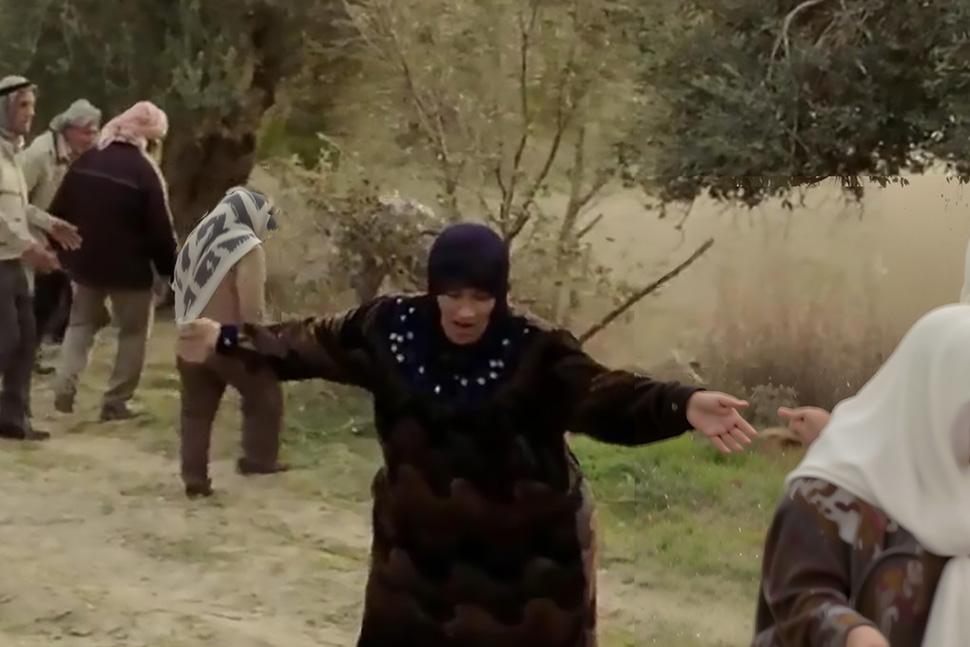
There is a very good chance that I am not the best audience for The Road to Jericho, a new documentary feature by Israeli filmmaker Amos Gitai. ‘This is a poem about people,’ states an opening caption, which does at least accurately represent the ensuing 76 minutes. It lacks a clear narrative line for one thing, and is almost wilfully obtuse. Despite its broadly non-fictional nature, it feels less like prose and more like poetry: Gitai provides plenty of different elements, but stops far short of assembling them into a cohesive thesis.
The film ostensibly concerns itself with the small Bedouin community of Khan El Ahmar Al Kurshan, which lies on the road from Jerusalem to Jericho in the Jerusalem governate of the West Bank. It is a village with a long history, but which is now being threatened with eviction by Israeli settlers. It is an important time for such situations to be discussed through documentary, given the current state of affairs within both Israel and Gaza, the actions of both the current Israeli government and the Hamas terrorist organisation, and the rising tide of Islamophobia and antisemitism around the world. It is laudable of Amos Gitai to focus on such issues, and it is laudable of the Biennale de Venezia to give it its world premiere. I only wish it was a more purposeful and driven documentary in the spotlight.
Despite some key sequences depicting the village itself and interviewing its inhabitants – and they are both effective and interesting – the bulk of The Road to Jericho comprises scenes pulled from other Gitai productions. In one early scene the American film director Samuel Fuller reads aloud from 1st-century historian Flavius Josephus – this is taken from Gitai’s Metamorphosis of a Melody (1996). A later scene features Jack Huston and Arthur Miller in Gitai’s 2001 drama Eden. At the film’s centre, archival footage sees Gitai interview former Israeli Prime Minister Yitzhak Rabin about the latter’s hopes from peace between Israel and Palestine (Rabin was later assassinated).
There are some provocative moments, but on the whole The Road to Jericho seems a shapeless, listless thing. Despite a comparatively short running time, the film regularly tests one’s patience with long, lingering takes on ancient ruins or scenes lifted from Gitai’s back catalogue. Even scenes that do work tend not to sit comfortably next to those before and after it. The cumulative sense is one of self-indulgence. It is a film composed of other bits of film, ruminating on issues of human right but also spending at least as much time simply ruminating in general. Perhaps in the context of Gitai’s works it has a deeper significance. Without having seen any of those films, it is simply a frustrating exercise.
The Road to Jericho premiered at the Biennale de Venezia. For more information on the film, click here.



Leave a Reply