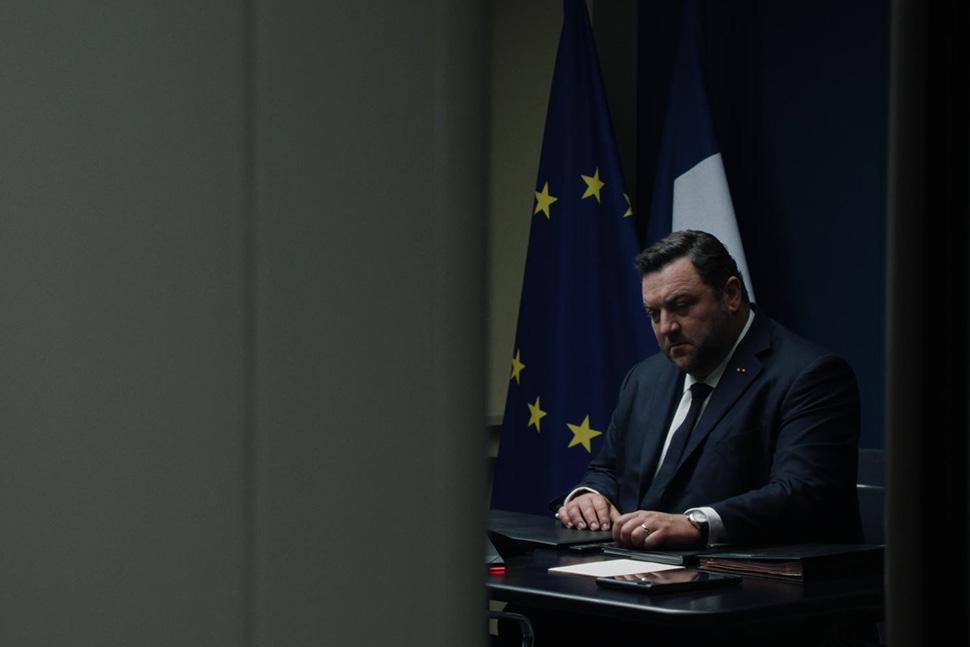
Alexandre Smia’s Jupiter is a hell of a thing. This new French drama stars Denis Menochet as Paul Archambault, a newly elected President facing his first major international crisis. War between Russia and Ukraine has reached a tipping point: an assassination attempt on the Russian President has occurred, and in a furious response he demands Ukraine’s unilateral surrender with the threat of a nuclear strike. From the secure “Jupiter” bunker in Paris, Archambault is left to negotiate with both leaders, the American President, and his NATO allies to pull the world back from the brink of annihilation.
I am immediately keen to know Smia’s age. Those of us of a certain generation, who were children during the early 1980s, will remember the overarching dread of growing up during the tail-end of the Cold War. Back then the idea of nuclear Armageddon and the threat of mutually-assured destruction (MAD) was deeply infused into our popular culture. The prevalence of nuclear anxiety – your word of the day is “nucleumitophobia” – among white children of the middle classes was well-documented. If Smia is not from our generation, basically that last few years of Gen-X, then he has somehow managed to capture our childhood fears with a disturbing level of insight. Social anxieties have shifted in the 21st century into culture wars, fear of the new right, and the “frog in a pot” developing climate dread. In Smia’s hands it is 1983 again, and we are justifiably terrified of the nuclear question.
There is a particularly theatrical style and tone to Smia’s film – which he co-wrote with TV writer Thomas Finkielkraut. Cut one or two sets and it could easily be a play. It has the immediacy and intimacy of live theatre. The audience is barely allowed to leave the claustrophobic confines of the fictionalised command centre invented for the film. We witness the other players on video screens, or simply hear them on speakerphone. It some ways it is reminiscent of Sidney Lumet’s 1964 thriller Failsafe – and its live broadcast remake in 2000, but in greater ways it echoes Gustav Möller’s sensational thriller The Guilty, in which an entire string of activity is perceived entirely from behind a police officer’s telephone. Both films share a growing intensity. Both reach a crescendo that seems unbearably tense.
The film follows Denis Menochet through an increasingly tight set of sweaty close-ups as the newly appointed President suffers greater stress and more difficult moral choices. He cuts a striking, deeply uncomfortable figure, as if his suit does not quite fit him. His Presidential authority seems badly styled for him as well, and he doubts every step while continuing to reel from a largely unspoken personal tragedy. It is a superb performance by Menochet, and he is well supported by some exceptional talent including André Dussollier, Reda Kateb, Dominique Blanc, Ella Rumpf, Frédéric Pierrot, and Céline Sallette.
An initially frustrating climax leads, on reflection, to admiration of Smia for concluding his film in such a bold, inescapable fashion. After all, what other finale would suffice? This is a powerful indictment of the world’s ongoing nuclear state, and a tragedy at the crossroads of morality and politics. If this is what Alexandre Smia can achieve in his feature directing debut, one can only imagine what exceptional works he can provide in the future.
Jupiter is screening out of competition at Le Biennale di Venezia. For more information click here.



Leave a Reply