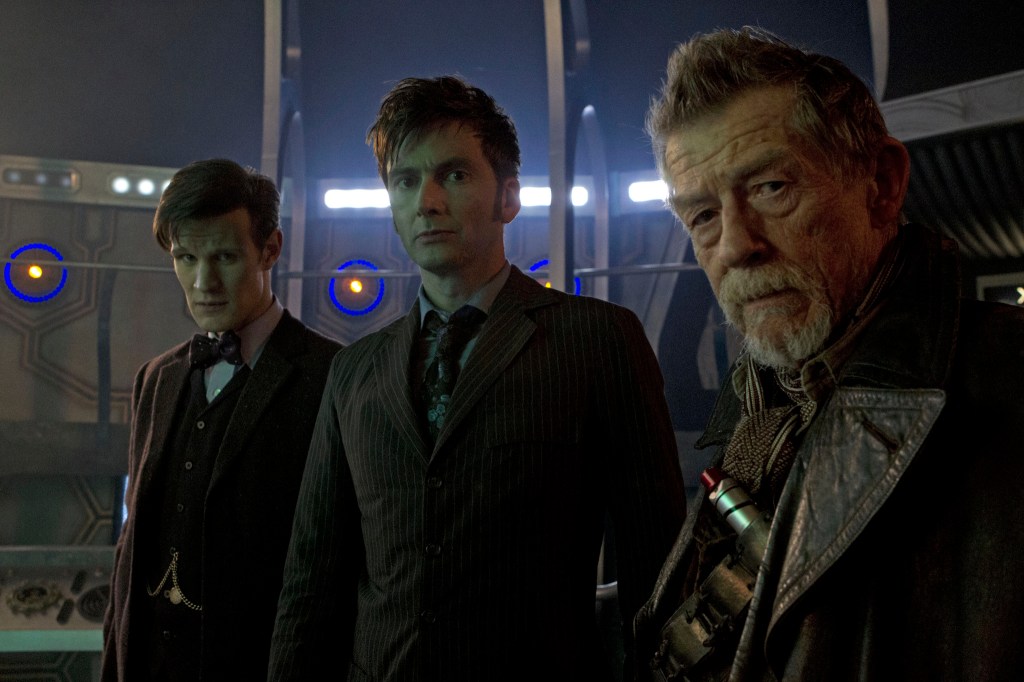
First broadcast 23 November 2013.
Honestly I feel like Steven Moffat’s “The Day of the Doctor”, produced by the BBC to celebrate Doctor Who‘s 50th anniversary, is not only a better episode than anybody expected but a better episode than we all deserved. It successfully put a spin on the classic anniversary stories “The Three Doctors” and “The Five Doctors”, brought back perhaps the last great old-school monsters from the series history, told a brilliant self-contained story with them, and spun out the core themes to resolve the Doctor’s genocide of his own people that had been motivating the character since 2005. If you have never seen the episode, be aware I am going to spoil nearly everything.
Underneath London’s National Portrait Gallery the Doctor (Matt Smith) and Clara (Jenna Coleman) investigate a mystery by the long-held invitation of Elizabeth I. More than 400 years ago another Doctor (David Tennant) fights to defend the same Elizabeth I from an alien invasion. And on the final day of the Time War, yet another Doctor (John Hurt) prepares to active the ultimate weapon and wipe out the Daleks and the Time Lords forever.
Uniting multiple Doctors in the one story is an anniversary tradition I suppose, in that science fiction fans saw it happen twice for the 10th and 20th year celebrations. Even by the time of “The Five Doctors”, bringing back all previous Doctors proved impossible: William Hartnell’s First Doctor was recast, while Tom Baker’s Fourth Doctor only appeared via archival footage. Honestly the smartest creative choice that Steven Moffat makes with “The Day of the Doctor” is limit the number of returning Doctors to a minimum: just David Tennant as the 10th Doctor, and John Hurt standing in for an understandable reticent Christopher Eccleston. This leaves room for a story that quite honestly would not have had time to play out were there more Doctors in play during the episode. Eccleston’s immediate predecessor Paul McGann got his own short film to act as a prologue to this, and it was a master stroke to do so.
Adding a previously unknown Doctor into the “wilderness years” between McGann’s 1996 television film and Eccleston’s 2005 season is a genuinely wild idea, and I adore it because the idea only works in the context of Doctor Who. Casting that character with John Hurt is brilliance on top of brilliance, because he was such an accomplished, talented actor, and absolutely nails his character within a remarkable short time frame. It is honestly only the brevity of his tenure that stops him from becoming my favourite 21st century Doctor.
It is great to see the Zygons back. They only appeared once before, fighting Tom Baker’s Doctor in “Terror of the Zygons”, but their iconic design and a great script back in 1975 guaranteed they would be remembered for decades. I was very happy to see that the new design held very close to the original – generally when a 20th century monster gets redesigned I am disappointed, whether it is the Daleks, the Silurians, or even the Macra. In this case the production team do a subtle and faithful job of recreating them.
There is obviously a fair bit of money and care thrown into the mixture as well, with Nick Hurran keeping the pace up and the visuals exciting despite a slightly unusual narrative structure. At the time the episode was produced in 3D for cinema audiences, and while I’m not a fan of the format it is laudable that the effects were actually incorporated into the story via the striking three-dimensional paintings included.
What is particularly interesting coming back to “The Day of the Doctor” is how much future potential is squeezed into one episode that never quite gels together. The most satisfying element of the episode comes in its climax, which features a superb moment of redirection: two future Doctors standing alongside the War Doctor, giving him emotional support and reassurance as he presses the button that will wipe out the Time Lords forever – and then changing their collective minds, and saving them instead. It is an excuse for a dizzying scene of every previous Doctor returning in archive footage cameos – and a brief shot of future Doctor Peter Capaldi – and a pitch-perfect emphasis on who the Doctor is and what he does. Of course he finds a way to save everybody: that’s what the Doctor does. Include an unexpected cameo in the epilogue, and this episode actually manages to squeeze in fourteen Doctors.
The episode ends with an inversion of the series premise: instead of running from Gallifrey, the Doctor is now running towards it instead. ‘I’m going home,’ he declares, ‘the long way round’. In retrospect that moment – which felt so emotionally strong in 2013 – feels decidedly weaker. The Time Lords were effectively back by Christmas anyway, in “The Time of the Doctor”, and the 12th Doctor was arguing face-to-face with them by the end of 2015. By 2020 they were dead all over again, thanks to a particularly weird plot twist by subsequent showrunner Chris Chibnall.
That is the fault of later episodes and creative choices, of course. Taken on its own “The Day of the Doctor” is a spectacular anniversary episode and a strong climax for the previous seven seasons of Doctor Who.


Leave a Reply