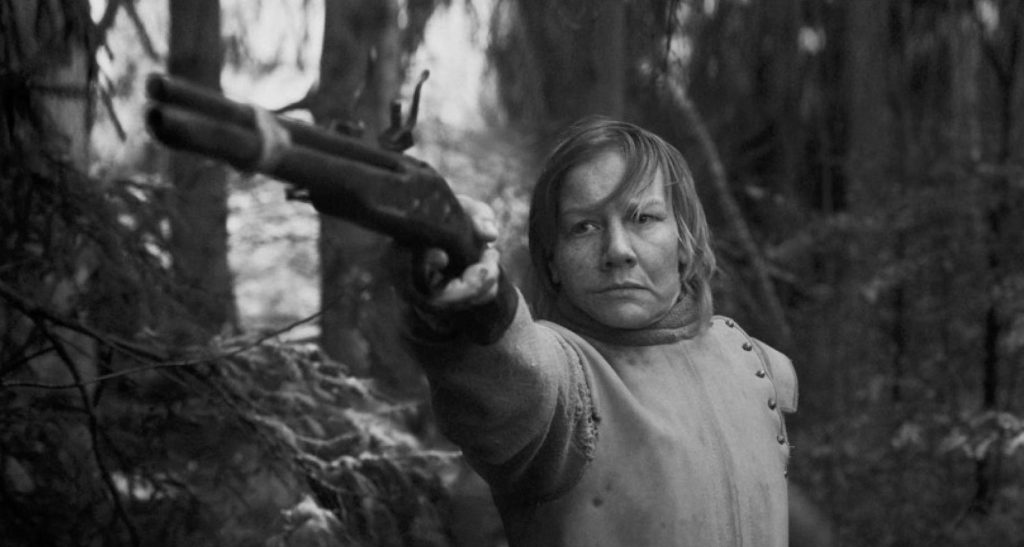
Markus Schleinzer’s Austrian historical drama Rose is well-written, handsomely shot, and driven by another superb performance by Anatomy of a Fall‘s Sandra Hüller. At the same time its dogged fidelity to some clear creative influences and inspirations do have a limiting effect: it is superbly crafted cinema and well worth watching, but at the same time it never quite manages to break free with its own invention or originality. Excellent filmmaking, but only to a certain – albeit high quality – extent.
Rose (Hüller) is a woman in 17th century who has disguised herself as a man. Returning from the Thirty Years’ War, scarred both emotionally and physically, she masquerades as a fallen comrade to secure their inheritance: a much-neglected and roughshod farm. When one of the wealthier villagers pushes Rose to marry one of his daughters (Caro Braun), it raises the personal risks facing Rose and jeopardises her new-found position in society.
Many people watching Rose will be familiar with the historical case of Martin Guerre, a peasant farmer who left home to fight in a war only to be replaced some years later by an imposter claiming to be Guerre returned from the fighting. The alleged scandal, which occurred in 16th century France, was turned into a 1982 French film The Return of Martin Guerre by director Daniel Vigne, and subsequently adapted into Jon Amiel’s 1993 film Sommersby. In Rose there is an obvious gender-flip rolled into the mix – with a palpable effect of raising the emotional stakes and personal risk – but ultimately it is the Martin Guerre story through-and-through.
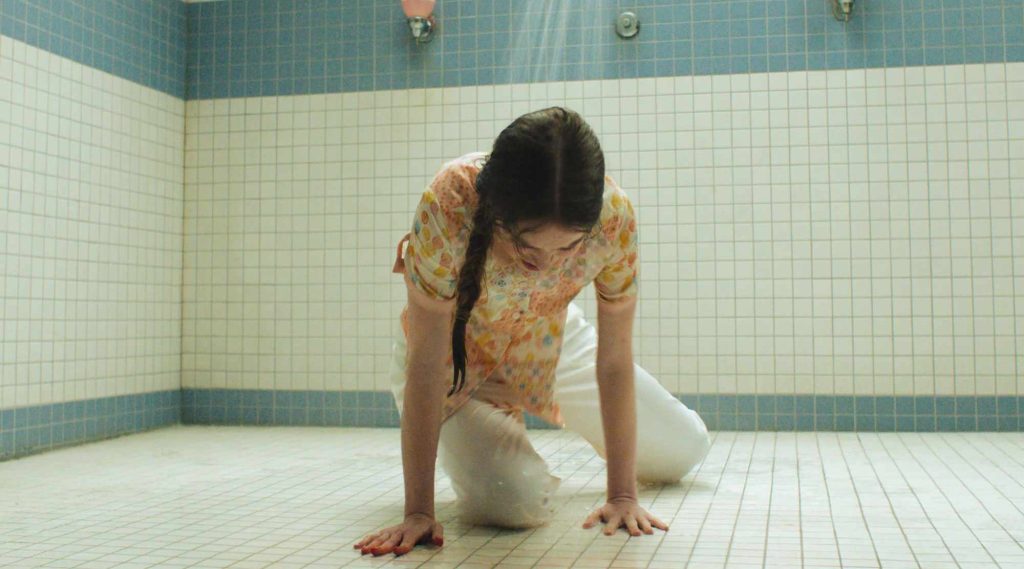
The film, which is heavy on narration and shot in a stark black-and-white, clearly resembles an array of earlier European films and filmmakers. There is a matter-of-fact style to the characters and the actors’ delivery of them. Gerald Kerkletz’s cinematography is purposeful with limited camera movement. The generally dry, serious tone of the picture is punctuated with surprisingly little comedic details. It is easy to draw a line back from Schleinzer’s film to work by Ingmar Bergman, for example, and particularly fellow Austrian Michael Haneke (indeed, Schleinzer was casting director on Haneke’s The White Ribbon in 2010). While Schleinzer is clearly leaning on other filmmakers in developing this film’s style and cadence, it is fair to note that he echoes their work remarkably well. A tight 95-minute running time also keeps events dramatically interesting, with Schleinzer and co-writer Alexander Brom not resorting to resolve plot elements that hardly need explaining.
Sandra Hüller is, of course, outstanding, and she has become one of those rare actors for whom strong performances are not just admired but expected. It is also worth acknowledging the tremendous work done by co-star Caro Braun as Rose’s unsuspecting young wife Susanna. She showcases just as ably the challenges and limits faced by all women of the period, and experiences the longest journey in terms of development and growth. Hüller delivered as expected; Braun was a delightful surprise.
Rose may be chained a little too closely to its inspirations, but it also represents impeccable talents employed on a clear, satisfying result. This is effective, high quality cinema.
Rose is screening at the Melbourne International Film Festival. Click here for more information.


Leave a Reply