While this review does not spoil the plot of the film, it does discuss the content of the film in a manner more direct than usual for this website. You may wish to watch this slightly challenging, likely rather divisive Iranian documentary cold.
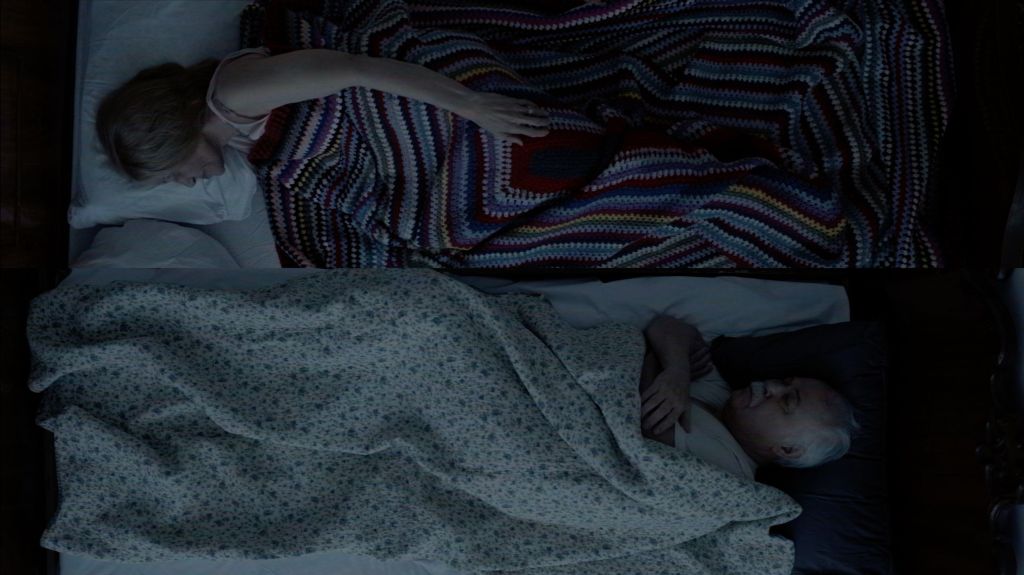
An Iranian woman, who has fled her country for the USA, has security cameras installed across her parents’ Tehran home. She hopes that by seeing them go about their daily activities, it will bring her comfort. Instead it brings her stress, tension, and misery.
Past Future Continuous is a 2025 Iranian film – produced with Italian and Norwegian backing – directed by Morteza Ahmadvand and Firouzeh Khosrovani. It purports to be a documentary, although as viewers will discover the film’s approach to facts and fiction are somewhat more complicated. It is dominated by the surveillance footage of the protagonist’s parents, and incorporates old home movies and archival footage of Iran’s turbulent past four decades. There are also voiceovers by the daughter, named Maryam, and an unnamed male co-narrator.
Once the strangely invasive nature of the cameras is established, the film turns into an unusually poetic and heartbreaking narrative about conflict and family separation, and no small amounts of anguish and regret. The ongoing welfare of Maryam’s elderly parents becomes an increasingly worrying thing. I read somewhere an observation that if English language cinema is derived from prose, then Iranian cinema is derived from poetry – and the combination of lyrical narration, cut-aways to trapped birds, and nostalgic flashbacks certainly bears that observation out. It is an artful, emotionally resonant documentary.
That is, of course, if it is a documentary at all. There is something off-putting and unbelievable about the film’s basic set-up, and the scenes of the parents captured by the automatic cameras seem far too crisp and precisely blocked out. The narration is deliberately poetic to the point of being obtuse, and the male narrator’s identity once it becomes clear pushes the film entirely out of a realistic documentary format.
The closing credits list a pair of screenwriters and four actors. I think it is critical to understand the artificiality of Ahmadvand and Khosrovani’s film to acknowledge this from the outset. Taking the film at the word of its publicity, and letting the expectations of a documentary shape one’s viewing experience, runs a serious risk of feeling cheated by the filmmakers. Worse still, one might overlook the strong, artistically valid process that is really going on.
Past Future Continuous reflects a widespread and relatable experience for families in places like Iran, where if it is not war disrupting their lives it is the conservative and controlling government. Separation is common, and for prolonged periods of time. Simply doing what makes someone happy is not often an option, and the pain of such a situation is real and palpable. The film reminds us of that: it posits itself not as a comfortable work of fiction but as documentary fact. By masking itself as a non-fiction work it strips away those guard rails that make fictional narratives so cathartic, and instead can be something more actively painful and arguably more meaningful.
I do not think this approach is entirely successful. For one thing the limited presentation via fixed cameras with high depth of field has a tendency to make the entire film feel longer than it is. There is a risk of outlasting the audience’s patience, particularly if they begin to feel suspicious or cynical about its documentary claims. At the same time it is a fascinating approach, and it centres on what I think is an interesting idea. Sometimes a provocative idea does not need to result in a completely successful result. Sometimes the experience of experimentation is enough.
Past Future Continuous is screening at the Melbourne International Film Festival on 10 and 14 August 2026. Click here for more information.



Leave a Reply