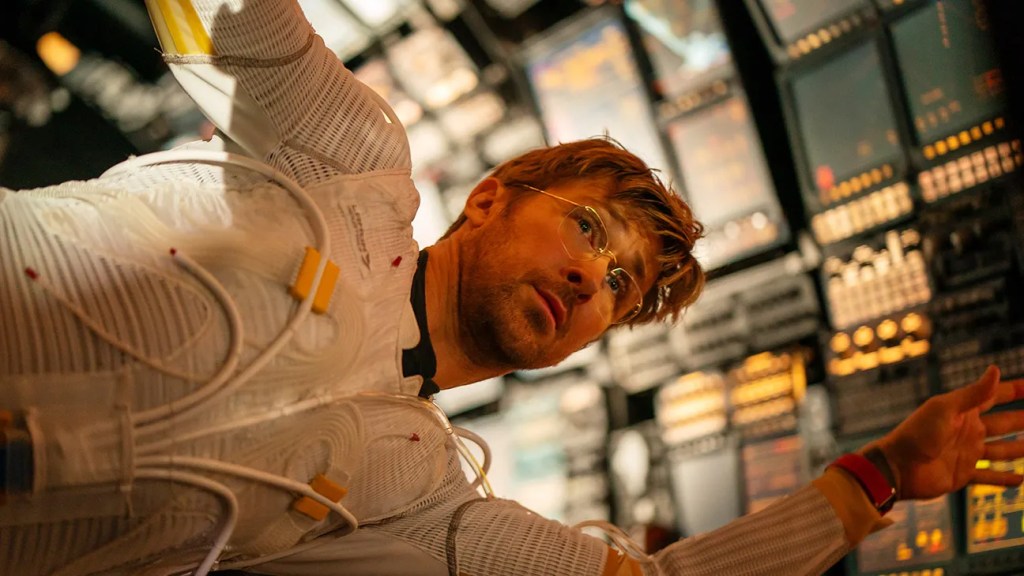
It is quite a feat to feel slightly hollow and a little bloated at the same time, but Phil Lord and Chris Miller’s Project Hail Mary somehow achieves the feat. Coming to this amiable, crowd-pleasing science fiction film after its theatrical run means missing the hype of one of 2026’s most popular motion pictures, but it also means avoiding the risk of being caught up in it. This is highly enjoyable populist entertainment, but it is far from flawless.
Ryan Gosling plays scientist-turned-school teacher Ryland Grace, who wakes up the sole survivor on an interstellar spacecraft with a crippling case of amnesia. In his present he experiences an alien encounter and works to solve an urgent scientific puzzle. Flashbacks tell his past, and the journey that took him from the classroom to a top-secret international taskforce, and finally into deep space.
The film is adapted from the novel by Andy Weir, author of The Martian, and of course that immediately draws comparisons between that book’s adaptation – directed in 2015 by Ridley Scott – and this. Despite differences in story, they share a general situation – a plucky isolated man using science to survive an impossible astronautical crisis – and with Weir’s Crichton-esque combination of pop science and thin characters dominating both films there is more than a little deja vu the second time around.
Of course older or better viewed filmgoers will recognise Project Hail Mary‘s greater similarities to Douglas Trumbull’s 1972 film Silent Running, in which a plucky isolated man faces a deep space crisis of his own. The earlier film teams its protagonist with robots, and the later one with an alien nicknamed “Rocky”, but there seems an even stronger connective tissue between them than between Hail Mary and The Martian.
The film places enormous weight on Ryan Gosling, who spends the majority of the film either on his own or performing against an elaborate alien puppet. Luckily Gosling is more than up to the task, and his scenes opposite the crystalline Rocky are a regular delight. The film goes a long way in making Rocky a genuinely alien character, and the manner in which he and Grace collaborate is well-considered and intriguing. The use of a physical puppet delivers strong dividends: Rocky feels more authentic than an entirely computer-generated creation, and Gosling’s reactions to him help sell the reality of his character.
The film’s flashbacks are less successful, both in terms of developing the character of Ryland Grace and in sustaining the audience’s interest. Its critical flaw is in showing two different Graces: one in the present, one in the past, one showing a particular drive and boldness and the other showing the exact opposite. On the one hand it shows the change in behaviour. On the other it makes them feel like different characters. It is hard to find an emotional through-line when the film keeps bouncing from one personality to the other. There is also not enough important information expressed in each flashback to justify its existence. They stretch the film to an abnormal length, and quite honestly you can feel it. Given the intimate, modest nature of the core plot, Project Hail Mary is easily a solid half-hour too long for its own good.
The good parts of the film are honestly quite wonderful. The bad parts are not egregious as to overweigh the good. This is strong science fiction filmmaking, but the fuzzy narrative structure needed a rethink and the flashbacks desperately need pruning.
Project Hail Mary is now streaming on Amazon Prime. It is coming out on physical media in most markets this August.





Leave a comment