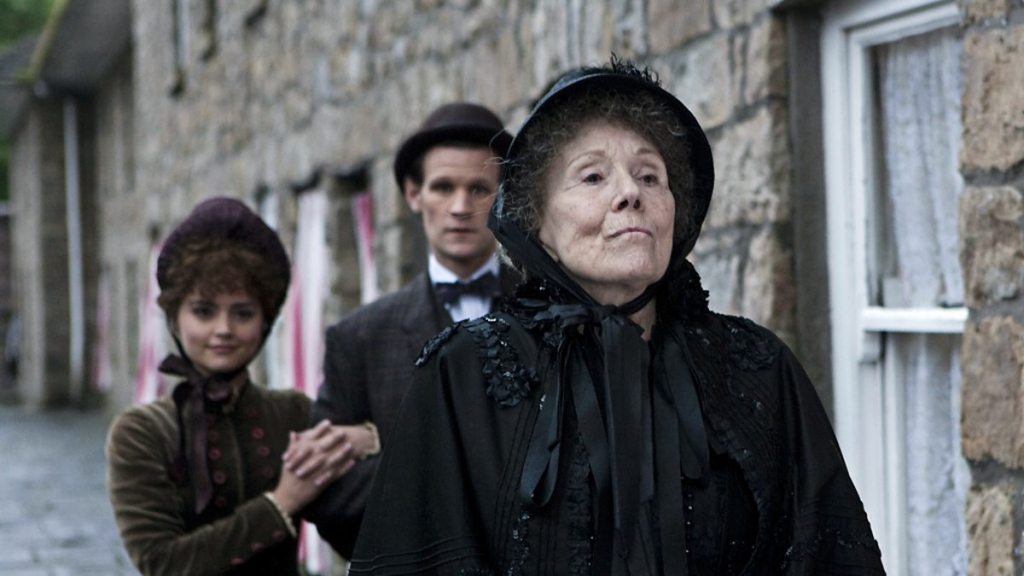
First broadcast 4 May 2013.
It is kind of strange that, despite 31 seasons of television since 1963 and regular waves of huge commercial success, Doctor Who has rarely generated much in the way of spin-off shows. There was a one-episode K9 and Company special in 1981, and Russell T. Davies spearhead Torchwood (2006), The Sarah-Jane Adventures (2007), and The War Between the Land and the Sea (2025) during his two tenures and executive producer. Stephen Moffat, during his producing tenure from 2010 to 2017, managed only one: the underwhelming and quickly forgotten high school drama Class (2016).
Honestly with the ideas flying around each season, you would think there would be more. Perhaps the most obvious missed opportunity was the 19th triple act of private detective Madame Vastra, her wife and maid Jenny, and their Sontaran butler Strax. This absurd set of characters were created during Doctor Who‘s sixth season in 2011, made their return in the 2012 Christmas special “The Snowmen”, and returned again here at the end of the seventh. It is not just a set of recurring characters this time: here the entire episode is wrapped around their point of view with the Doctor (Matt Smith) effectively a guest character in his own series.
Could there have been a series? Perhaps – but as this episode shows, a little of “the Great Detective” goes a long way.
1893. Madame Vastra (Neve McIntosh), the “Great Detective”, is drawn to Northern England when the eyes of a corpse appear to reveal the image of the Doctor in them. What is “the Crimson Horror”? What diabolical plans does Mrs Gillyflower (Diana Rigg) and the elusive Mr Sweet have for the future of the human race? And where on Earth is the Doctor?
Something happens to me every time that I reach the climax of “The Crimson Horror”: I stop caring. I suddenly realise that I am not even slightly invested in the action, and don’t have any curiosity as to what is going on or how the adventure will be resolved. Now obviously all Doctor Who is essentially a confection: we generally know how it will end, and we know good will triumph and the villain will be defeated. The quality of the series comes from how it is written and presented to temporarily fool us into thinking something else might happen, or to confound us with not working out how the Doctor will inevitably win the day in the end.
Here, instead, we spend a lot of time with set-up and supporting characters before the Doctor and Clara (Jenna Coleman) even arrive. Once they do enter the equation, there is not a huge amount of time left for story. As a result what the audiences does get is fairly short and superficial, and despite so interesting ideas and an evocative Victorian England setting it all rather feels like a waste of time.
Mark Gatiss, who wrote both this and the earlier Season 7 episode “Cold War”, simply doesn’t seem capable of developing strong plots. A quick glance over his previous Doctor Who scripts reveals the same problems that lie in “The Crimson Horror”. He is a gifted sketch writer, as borne out by his sterling work in The League of Gentlemen. He lacks, however, the gift for stringing those sketches together into a sensible plot. That is what a lot of his Doctor Who work feels like: a string of sketches, each informed by an encyclopedic knowledge of science fiction and horror, and Doctor Who‘s own history. He can recognise why each individual element of an episode works, but he can’t string them together in any interesting fashion. As a result you always get brilliant concepts from a Mark Gatiss episode (Charles Dickens versus alien ghosts, an Ice warrior loose on a submarine), but without exception they feel two-dimensional and cliched.
There are many good bits in “The Crimson Horror”. Madame Vastra and Jenny (Catrin Stewart) are a lovely old-school double act with a contemporary twist. Television legend Dame Diana Rigg and her daughter Rachael Stirling both deliver exceptional performances. The period setting and vaguely steampunk-like technology both suit the series incredibly well. The episode itself is utterly boring and eminently missable. It looks decent, but that’s due more to director Saul Metzstein.
As for the promise of The Great Detective as a spin-off? I am not sure it would have worked. The humour here is dreadfully awkward and clumsy, and the broad style of Strax (Dan Starkey) chafes very badly against the other characters. Of course audio spin-off merchants Big Finish went to town on what they titled The Paternoster Gang – but they’ll spin off anything.


Leave a Reply