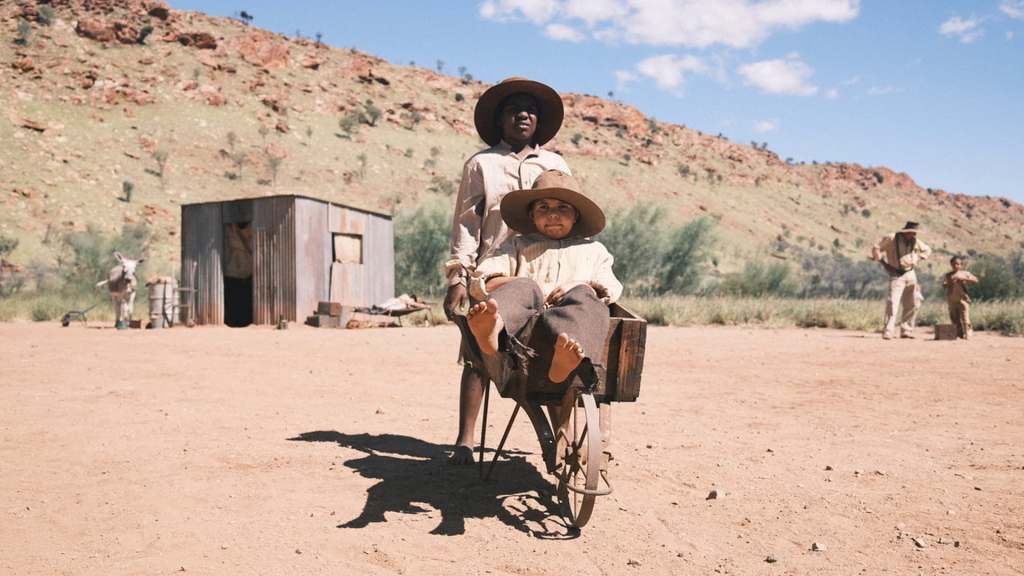
The first thing I noticed about Wolfram were the flies. I grew up in northern Australia, and the flies were everywhere. Stay still for too long, like when riding on horseback, and they would settle across your back like a shiny black patina. There are many key elements of the Australian wilderness that stick in the mind – the colour of the dirt, the dust, the quality of the light – but for me at least what I most viscerally recall are the flies.
Warwick Thornton, who with the retirement of Peter Weir is almost certainly Australia’s best living director, has a palpable understanding of the Australian bush. Through films like Samson and Delilah (2009), Sweet Country (2017), and now Wolfram, his work is infused with a tremendous sense of place. Through images and sound, he transports the viewer in a way that few other Australian filmmakers have managed. He does not simply tell stories; he invites us into worlds.
In this case the world is that of Australia’s Northern Territory in 1932. Two indigenous children, forced to work in a dangerous tungsten mine, go on the run when their master is murdered by a pair of white prospectors (Erroll Shand and Joe Bird). Their path coincides – as does their pursuers’ – with a broken-down property, its broken-down owner Mick Kennedy (Thomas M. Wright), and his stockhand Philomac (Pedrea Jackson).
Meanwhile the children’s mother Pansy (Australian national treasure Deborah Mailman) travels the wilderness with her Chinese husband (Jason Chong), endlessly searching for those she was forced to leave behind.
Wolfram tells an elegant, four-act storyline with an ensemble of characters. While the film is located in the same place as Sweet Country, and shares several characters, it would do both films a disservice to claim one was a sequel to the other. Instead they work beautifully as companion pieces. While the former film is a blunt, harsh, deeply miserable work, the latter allows an element of hope to run alongside the often harrowing events and sequences. To an extent they act as mirrors, sharing closely similar events and emotions, but using similar elements to reach different conclusions.
As a result it would be easy to overlook or underrate Wolfram, since it repeats many of Sweet Country‘s best tricks and largely exists as a follow-up to it. Such a perception of the film would be a shame, since despite being a derivative work it is a positively outstanding one and more than stands up on its own great merits. In many ways it arguably feels necessary; a means of balancing the scales after the relentlessly grim and hostile events of the earlier film.
Much the praise to be heaped on Wolfram can be as good as taken for granted. Of course it looks and sounds amazing, with Thornton again acting as his own cinematographer and effective soundscapes replacing a more prescriptive musical score. Of course the performances are top-notch, with a combined ensemble of established screen legends and fresh talent.
What is more, the addition of Wolfram to Sweet Country turns a singular masterpiece into a hugely satisfying duology. There is going to need to be something amazing on the horizon for this not to be the year’s best Australian feature. It is must-see cinema.
Wolfram opens in Australian cinemas this Thursday 30 April 2026. Check your local cinema for session times.




Leave a Reply