It is never foreign languages that are the biggest barrier to understanding international film, it is foreign cultures. Ilya Muromets, a 1956 Soviet fantasy directed by Aleksandr Ptushko, brings to life the exploits of its titular folk hero. Of course while its story derives from medieval Rus’ culture, it is filtered through the state-funded Soviet Union film industry. It espouses the state’s own mindset and propaganda. Rus’ culture was partly influenced by earlier Norse culture, of course, making this something of a viking epic retold as medieval drama and filtered through the communist state. Get your head around that, and the English subtitles are just a minor inconvenience.
The Tugars – a fictional Mongol-like horde – lay waste to medieval Russia. After receiving a magical sword from the dying giant Svyatogor, a group of pilgrims bestow it up the crippled villager Ilya Muromets (Boris Andreyev). Its power cures his disability and transforms him into a powerful warrior. He then sets about to save the city of Kiev from a Tugar invasion.
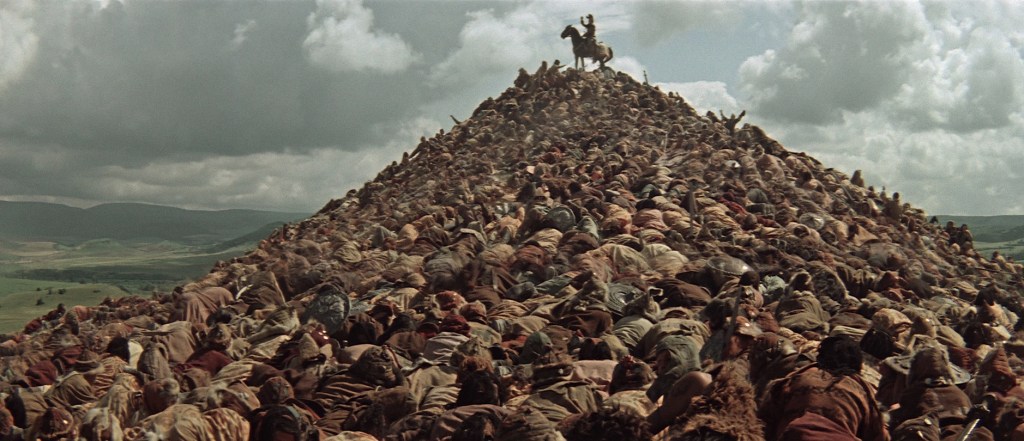
Ptushko’s film excels at scale, and comes brimming with an often-wonderful painterly aesthetic. At its best it contains some marvellous fantasy imagery. A giant dies and transforms into a mountain. A thief with billowing cheeks can flatten an army. A three-headed dragon is realised via macro-puppetry and genuine flames. At the same time it is empty of humour and painfully earnest. It seems produced on an assumption that its audience will be highly familiar with its characters.
It has absolutely no sense of realism. Actors perform as if in children’s theatre. Middle-aged men play teenage boys without irony. Characters are represented via grotesque make-up and prosthetics. One of them, a treacherous hook-nosed courtier, is egregious enough that you would swear he is directly anti-Semitic. Only by following the dialogue does it become apparent that the narrative stretches over decades. There is no visible passage of time at all.
Most perplexing is the manner in which the film is photographed and framed. Important characters are foregrounded in each shot to appear larger than they actually are. It takes a while to realise they are not giants – a difficult task when giants actually do show up in the film from time to time. Instead it seems akin to a Francisco Goya painting, where a condemned prisoner on his knees can appear to be the same height at the standing soldiers preparing to execute them. It is full-blooded expressionist cinema in a manner rarely seen since the days of European silent cinema.
It is also clearly Soviet propaganda, depicting a united Rus’ peoples against outside aggressors. The film’s message is clear: united, the Rus’ people can defend themselves and their cities, but separated they will be destroyed. It is the sort of nationalist message that echoes Russian politics today, with Vladimir Putin’s government going to war with neighbouring Ukraine to bring it back into the Soviet-era fold.
This is such a strange film to watch in the 21st century. It is simultaneously dreadfully old-fashioned yet strangely relevant to present-day pressures. It seems amateurish and masterful in turn. It is epic in scope yet so primitively put together. ‘The past is a foreign country,’ wrote L.P. Hartley. Another country is also another country. Ilya Muromets is, for those of us in its future, a strange thing.


Leave a Reply