It is difficult to imagine that William Shakespeare, when writing the playscript for Hamlet around 1600, could imagine it would still be getting fresh stagings and adaptations 425 years later – let alone in Japan. Certainly he would have been aware of Japan, but the idea of his work being adapted or even known there must have seemed a fanciful notion.
Goodness know how you would even explain to him how his play has turned up as an anime feature with a gender-swapped protagonist, a modern-day Tokyo paramedic standing in for Hamlet’s best friend Horatio, and a narrative that tracks Hamlet beyond death and across the underworld on a revenge mission against King Claudius.
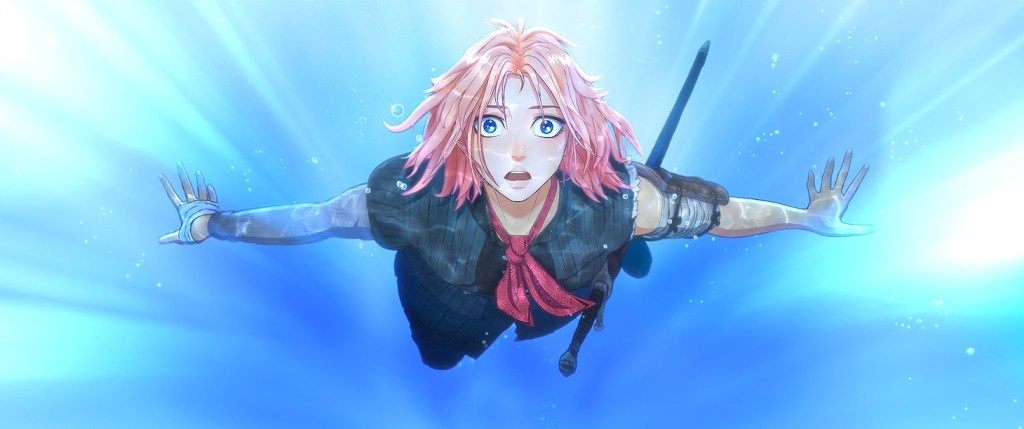
Scarlet is the latest film from director Hosoda Mamoru (Summer Wars). It is a striking and ambitious work, and one that contrasts starkly with his earlier films. Its titular protagonist is a 16th century Danish princess who, after attempting to take revenge on her uncle for her father’s murder, finds herself pursuing him across the afterlife instead. Obviously some significant liberties have been taken with Shakespeare’s play, but one of the most impressive elements of Hosoda’s film is how it still manages to snake its way back to hitting key scenes anyway. It is also impressive how Shakespeare’s characters are aggressively remixed to suit their new context. Queen Gertrude, for one, is rendered much less sympathetically, while Hijiri – the contemporary paramedic standing in for Horatio – exists as a knowing pastiche of the popular isekai genre, where modern-day characters find themselves trapped in fantasy realities, the past, or even inside videogames.
The film adopts a stunning new visual technique that blends hand-drawn anime characters with detailed computer-generated images. In combination they form an aesthetic unlike anything else on the market. In many respects it delivers the best of both worlds: the fine detail enables Hosoda to portray rich and delicate emotions in his characters, while the sheer scale enabled by the CGI inspires some immense and epic moments. While the unusual aesthetic may take a little while to be accepted by some viewers, it certainly serves Hosoda’s needs perfectly.
The animation style does raise the question of what qualifies an animated film as anime. Is it purely a statement of nationality – if your films is animated in Japanese, is it anime? – or are there aesthetic assumptions that must be adopted to satisfy the fan base? It is fascinating that Hosoda directs the “real world” scenes at the film’s beginning in a far more conventional, two-dimensional style, thus marking out the Otherworld as something distinctly unreal. Several times during the film I was reminded of Yamamoto Eiichi’s 1973 anime Belladonna of Sadness, which also told a story of a young woman in the Middle Ages seeking revenge, and which challenged viewers with a relatively unique, avant-garde animation style. Did one influence the other? Perhaps not, but if it did I would not be surprised.
There is more than a hint of Dante’s Inferno about the so-called Otherworld where the dead assemble. Jumbles of history lie ruined all around, in crumbling buildings and rusted-out empty suits of armour. Scattered communities huddle together, defending themselves from bandit raids, all the while aspiring to journey to the true afterlife beyond. It is tremendously evocative, and brilliantly realised. Scarlet herself is a fantastically designed character, and acts as an eye-catching, dynamic focus for the entire picture. She is well performed by Ashida Mana. It is a generally decent Japanese language dub all round, including performances by Okada Masaki, Yakusho Koji, and Saito Yuki.
The plot may seem thin to some viewers, although in being so simple it leaves plenty of room for Hosoda’s astonishing visuals. The action is well choreographed and exciting, and the narrative is peppered with all manner of surprises and unexpected moments. An improbable dance scene just might be the film’s finest moment, but it is honestly inspired from beginning to end. It does feel in keeping with Hosoda’s more recent films, such as Mirai and Belle, in how the story has been so loosely assembled. It lacks the formal clarity of earlier works like The Girl Who Leapt Through Time and Summer Wars, perhaps due to the absence of co-writer Okudera Satoko.
If the film’s overall result does not quite meet its grasp, it is because Hosoda has grasped so far and with such ambition. This is bold, innovative filmmaking, and one of Japan’s most interesting anime films in years.
Scarlet is currently screening in Australian cinemas.

 FictionMachine.
Leave a reply to John Samuel Cancel reply