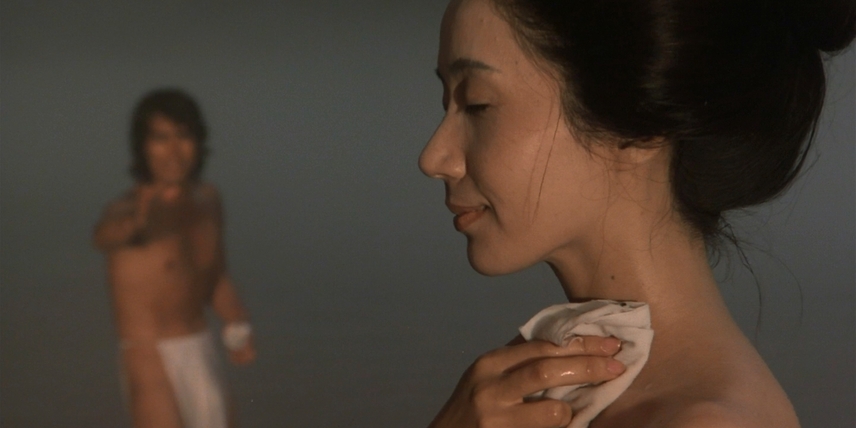
In the early 20th century, a blind girl named Orin (Iwashita Shima) is adopted into a school for goze: blind female minstrels who would sing to entertain Japanese communities. When she breaches the school’s rules by having sex with a man, she is expelled – and struggles to make a meagre living on her own.
Released in 1977, Ballad of Orin is one of a string of dour, miserable dramas directed by the late Shinoda Masahiro, who died earlier this year at the age of 94. Shinoda is a key filmmaker of Japanese cinema’s ‘new wave’, alongside Oshima Nagisa. While Oshima gained a great deal of international exposure through foreign co-productions like In the Realm of the Senses, Empire of Passion, and Merry Christmas Mr Lawrence, Shinoda never achieved such fame outside of Japan. That is reflected by the broad unavailability of many of his key works internationally.
His work is well worth tracking down. They often sit in contrast with the stylised nature of Japanese films that ran through the 1950s and 1960s, and replaced that aesthetic with a much darker, and particularly more cynical depiction of both contemporary and historical drama. I have been on a journey of Shinoda’s work for a couple of years now, as I manage to track down each of his films. He has expressed historical with a powerful political verve in Assassination (1964), reframed film noir with a black and dour touch in The Petrified Forest (1973), and then handled supernatural horror with a brutal impact and gendered focus in Under the Blossoming Cherry Trees (1975).
Ballad of Orin is largely missing the cynicism of those works, but it is certainly very bleak. Orin’s life is one of misfortune and tragedy. Each miserable incident compounds upon the next, dragging her inexorably further and further into ill health and poverty. It feels inevitable, and the only element to arrest that emotional weight is Iwashita’s spirited, resilient performance. She was a regular feature of Shinoda’s films, and indeed grew so close to the director that she married him in 1967.
Harada Yoshio plays an itinerant wander with whom Orin travels, and the two build a somewhat complex and understated romance. It represents one of many tough, rough-hewn characters that Harada played, and Shinoda’s screenplay with Hasebe Keiji allows considerable room for the character to unfold and play out.
It is hard to consider Ballad of Orin without also thinking of Mizoguchi Kenji’s widely regarded classic The Life of Oharu (1952). Not only both films cover the life of a fallen or abandoned woman – Orin a goze, Oharu a sex worker – but Shinoda actively apes Mizoguchi’s style through the use of long takes and a tight 4:3 academy ratio for the picture. He even co-opts Mizoguchi’s frequent cinematographer Miyagawa Kazuo who, while not responsible for The Life of Oharu, did direct photography on Mizoguchi’s Ugetsu, The Woman in the Rumour, Sansho the Bailiff, and others. The film looks tremendous, and captures the cultural uncertainties of post-World War I Japan very well.
The post-war setting – much of the story is set in 1919 – also enables Shinoda to capture and comment on a turbulent period in Japanese military history, where soldiers returning from war found themselves recommissioned – and others unwillingly conscripted – to fight the Russians in eastern Siberia. Facing hostile conditions, and tired of conflict, many soldiers chose desertion – an action that offended the well-established military sense of duty and honour, and was seen as a serious risk to public morale.
Ballad of Orin is miserable, yes, but also enormously powerful. Its slow, intimate story of injustice and misfortune is tenderly captured, and powerfully expressed. It is another strong example of one of Japan’s most talented – and most underrated – 20th century filmmakers.



 FictionMachine.
Leave a comment