Many years ago, I remember reading a quote by then-Mayor of Tokyo Suzuki Shunichi. Asked to explain why the Tokyo subway attacks of 1995 had occurred, he said ‘Japan is a strange country.’ It is a phrase that has lingered in my mind ever since: when watching Japanese popular culture, when reading Japanese literature, and when visiting the country in person. In my experience – and from my very Australian perspective – Japan does seem a strange place.
It is simultaneously an utterly familiar and ordinary place as well. People are people after all, and there is certainly far more in common between our cultures than there are differences. At the same time, specific elements of Japanese society do stand out, and peek from the margins. A few months ago I reviewed the documentary Johatsu, which depicted the phenomenon of people ‘disappearing’ from their lives due to regret or shame as well as the companies that professionally assist people in making themselves scarce. Some years ago I reviewed Ueda Shinichirou’s comedy Special Actors, which made fun of the real-life practice of hiring actors in real-life situations. Need a few extra mourners at a family funeral? Hire strangers to pretend to be the extended family. Feeling lonely at night? Hire someone to pretend to be your best friend. Rental family agencies have provided these services in Japan since the early 1990s, and form a useful tool in a culture that sharply divides private lives from public facades. If it seems weird, I suppose it is because those specific, comparatively unique elements of Japanese culture really do feel odd to us. Japan is, indeed, a strange country.
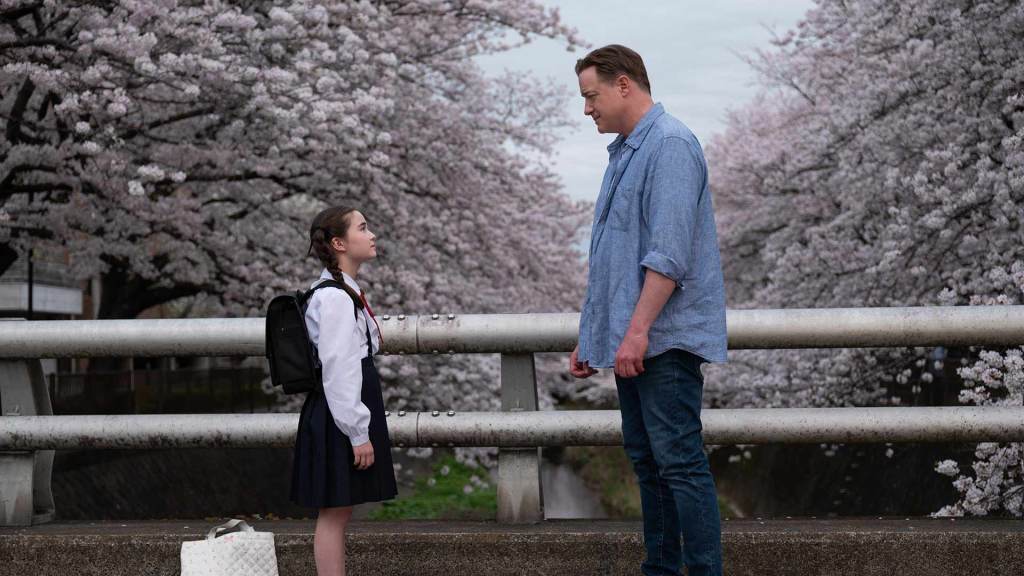
Rental Family approaches the subject matter not as broad comedy like Special Actors, but as a particularly sensitive drama. It uses protagonist Philip Vanderploeg (Brendan Fraser), a white American living in Tokyo, as a comforting viewpoint for an English-language audience to engage with Japanese culture and offer some form of explanation or context for it. Philip is an unemployed actor: he enjoyed some success when he first came to Japan, but is certainly struggling now. He is hired to masquerade as a closeted lesbian’s groom at a fake wedding, and this draws him into the rental family business.
The bulk of the film follows Philip’s second assignment: pretending to be the father of Mia (Shannon Mahina Gorman), whose single mother needs a husband to get her child into a prestigious school. Ostensibly this allows for many scenes of Philip and Mia developing a father-child bond despite the fake foundation of their relationship. It also allows Philip to question the morality of such fakery, and show the effects of a real friendship being compromised by its cold, constructed reality. It is fairly obvious going into the story that Mia will, sooner or later, discover Philip is not her father. The film’s concern is more with that subsequent emotional fallout than in surprising the viewer.
It generates decent character-focused drama, but it also acts as the film’s Achilles heel. The film begins with Philip questioning the value of rental family operations, and his Japanese co-workers assuring him he simply does not understand Japanese culture. It ends, on multiple story streams, essentially conceding that Philip was correct all along. His boss (Hira Takehiro) and his colleague (Yamamoto Mari) both change their position in relation to rental families, and in the former case the entire subplot seems motivated by an unconvincing “gotcha” twist rather than action stemming believably from character.
Other aspects of the film are more convincing. Mononymous writer/director Hikari boasts a keen visual sense and, with cinematographer Ishizaka Takuro, captures Tokyo’s innate combination of overcrowding and isolation in a haunting fashion. The performances are also universally top-notch. Fraser in particular inhabits such a vulnerable screen presence that he is perfectly cast in his role.
A secondary plotline sees Philip masquerade as a film journalist to help care for Hasegawa Kikuo (Emoto Akira), an elderly screen actor with dementia. It is a delightful subplot, rich in humour and satisfying drama, boosted in particular by Emoto’s superb acting. Frankly the storyline could sustain an entire feature on its own. Here, perhaps slightly truncated, it enriches an already satisfying drama.
It is a satisfying, enormously watchable film, and only frustrates around the edges. Viewers are likely to come away with a better understanding of Japan’s distinctive, complex culture than they had when they started.

 FictionMachine.
Leave a comment