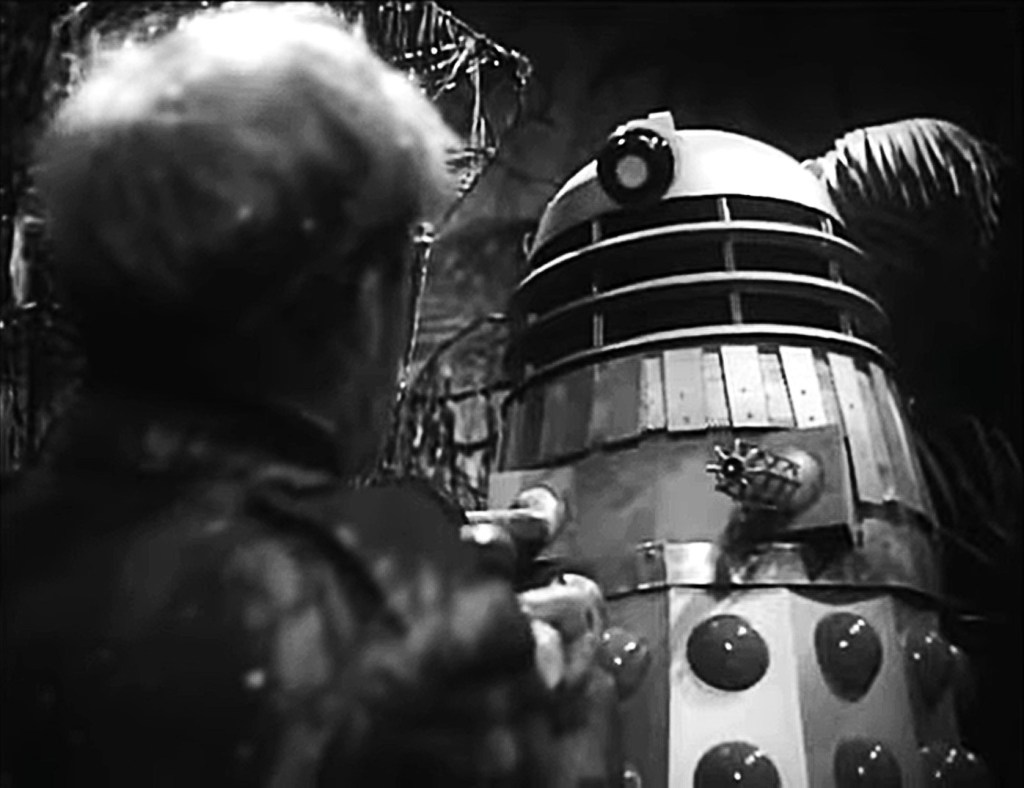
First broadcast 13 November 1965.
Most fans of the original series of Doctor Who are aware that during the 1970s the BBC destroyed many original tapes in their archives – seeing no future value in retaining them. Sadly the process left Doctor Who‘s early years riddled with missing episodes; decades of occasional discoveries of offshore film prints and other long-lost duplicates have filled many of those gaps, but many still remain. This year two more have been recovered: the first and third parts of the Season 3 12-part epic “The Daleks’ Master Plan”. For fans like me, who weren’t alive to see these episodes on their original broadcast, they effectively represent all-new episodes of Doctor Who. It is a rare treat when these lost episodes are found. I never tire of it.
It is especially exciting to get to see these two parts, because they come from the season that has proved the hardest to recover. They showcase a particular period in the series’ early years where a new producer, John Wiles, tried to aggressively reshape what Doctor Who was and the sorts of stories it could tell. It is a much darker, more violent version of the series that viewers of existing Hartnell era serials might remember. The first episode, “The Nightmare Begins”, is the first opportunity for modern-day viewers to see the short-lived companion Katarina (Adrienne Hill) and also marks the Doctor Who debut of actor Nicholas Courtney. Courtney famously played the character of Brigadier Alistair Lethbridge-Stewart in serials and episodes from 1967 to 1989 before making his swansong in the Sarah Jane Adventures episode 2008 episode “Enemy of the Bane”. Here he plays Space Agent Bret Vyon.
The episode begins immediately after the events of the previous one, “Horse of Destruction”. The Doctor (William Hartnell) and his travelling companion Steven Taylor (Peter Purves) have escaped the events of the Siege of Troy, however their friend Vicki has chosen to remain behind and Steven has been badly injured. In addition, they have unexpectedly picked up a passenger: a Trojan handmaiden named Katarina.
The Doctor lands the TARDIS on a jungle planet named Kembel, hoping to find medication that can save Steven’s life. While exploring, he is ambushed by Vyon – the surviving member of a rescue team sent after missing agent Marc Cory. Vyon is in a race to warn Earth’s authorities of the Daleks, who are present on Kembel and have killed his crew.
The tone of the episode is markedly bleaker and more suspenseful than one might expect. Director Douglas Camfield, well-regarded as one of Doctor Who‘s best, paces and develops the episode with an unexpectedly cinematic eye. Our first glimpse of a Dalek, emerging from the jungle foliage, is from an uncharacteristically low angle. I am struggling to think of another moment in Doctor Who where they were revealed as effectively.
William Hartnell spends the bulk of the episode by himself, and thus presents a marvellous performance as the original Doctor at his best. Much has been said and written about the arteriosclerosis that increasingly hindered his abilities – an acquired brain injury that led him to struggle furiously with his lines – but none of that is evident here. He is charmingly kind to Katarina, palpably offended when Vyon pulls a gun on him, and firmly resolute when he uncovers the presence of the Daleks. As fans we talk a lot about how Hartnell’s successor Patrick Troughton essentially defined the blueprint for the Doctor’s character, and I still believe that to be true, but in talking about that we do run the risk of undervaluing what an outstanding character Hartnell developed and performed.
Sadly Steven, a favourite companion of mine, spends much of this episode either delirious or unconscious. As noted above, however, this is our first modern chance to experience Katarina. It is honestly a slightly weird experience viewing her for the first time. Common wisdom among fans is that the character never worked, hence her rapid exit from the series in three episode’s time. Here at least she seems… fine? Pleasingly, while she is someone from a comparatively primitive culture, she is portrayed as an intelligent person. This is something Doctor Who has always been good at, with later companions Jamie and Leela as prime examples. I do wonder if maybe the creative team of the time simply grew regretful of their choice to introduce a companion from Earth’s history for the first time. Certainly no creative team attempted it again after Jamie’s departure in 1969.
This is an episode with great supporting performances. Admittedly it is a little difficult to fully accept Courtney as Bret Vyon, since he performs the role with an identical cadence to the much-more famous Brigadier. Kevin Stoney makes a strong first impression as the Earth system’s political leader Mavic Chen. Even the smaller parts are well-played and interesting.
The most overwhelming effect watching this rediscovered episode is in seeing just how epic it all is. There was a deliberate intent to mount something much larger in scale than Doctor Who had previously attempted, and already from episode 1 that scale is evident. Scenes cut away from Kembel to Earth – the first time the action was so vividly split across an entire galaxy. The pace is genuinely gripping for 1960s British television. There is also the case of the missing Marc Cory. In the context of the episode, it is just a throwaway name. For viewers at home, he is the lead character from a strange one-episode interlude broadcast five weeks earlier. On 9 October 1965 the BBC broadcast “Mission to the Unknown”, a single self-contained episode that did not feature the Doctor, the TARDIS, or his companions. Wedged between serials “Galaxy 4” and “The Mythmakers”, it must have seemed an odd little experiment at the time. Suddenly, with “The Nightmare Begins”, it is revealed as a prologue. Upon mention of his name, audiences already know his fate: he was murdered by the Daleks, having uncovered their plot to conquer Earth and then the entire universe.
Writer Terry Nation, who of course created the Daleks, was always one of Doctor Who‘s most frustrating writers. When he was playing his A-game his scripts were tremendous. When he was perhaps “phoning it in”, as the phrase goes, he would be terribly disappointing. It is a relief to see this episode at least sees him working at his best.
There is always a fear, when viewing old television for the first time, that it will not live up to its reputation, or that it will have unavoidably become dated and disappointing. Thankfully that is rarely the case with Doctor Who, and it certainly is not the case here. Dramatic, dark, ominous, and effective. Holy shit, this is good.

 FictionMachine.
Leave a comment