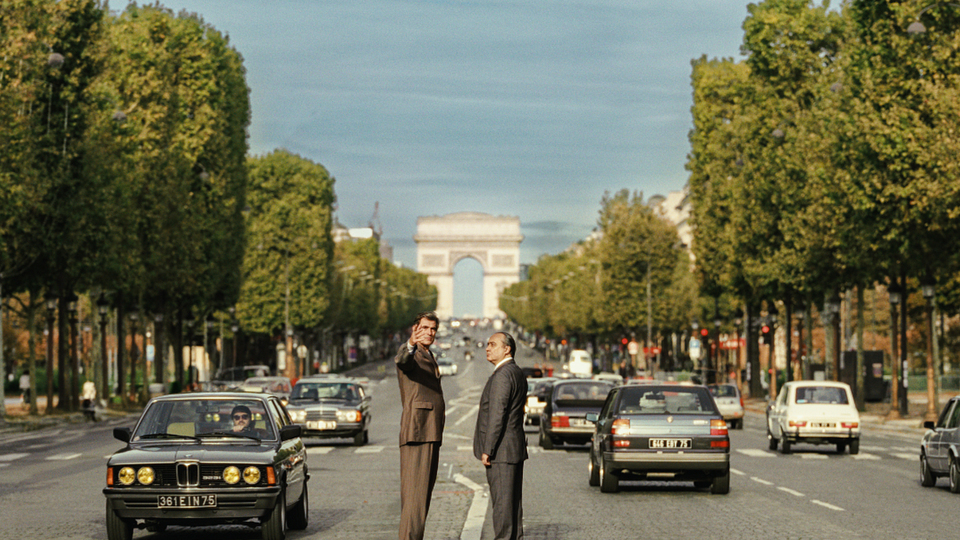
In 1982 French President François Mitterrand launched a design competition to invent an all-new monument for Paris, one that could sit alongside the Eiffel Tower and the Arc de Triomphe as a testament to the French nation and its culture. The winner was unknown Danish architect Johan Otto von Spreckelsen, whose ambitious 100-metre-wide glass and marble open-air cube was to signify a tribute to humanity and peace. The tumultuous seven-year saga from commission to completion was fictionalised in Laurence Cossé’s 2016 novel La Grande Arche, and that book has now been adapted by writer/director Stéphane Demoustier as the feature film L’inconnu de la Grande Arche (The Great Arch internationally).
Von Spreckelsen is portrayed onscreen by Danish actor Claes Bang, who learned French specifically for the film. His broken delivery matches the character wonderfully, interspersed with English and Danish, and forms part of an uncomfortable, seemingly quiet man thrown well out of his depth upon his arrival in Paris. Once the project is underway, with the assistance of government supervisor Jean-Louis Subilon (an excellent Xavier Dolan) and project manager Paul Andreau (Swann Arlaud), Von Spreckelsen reveals a shocking new side to his personality. Given the opportunity to realise his life’s work, he becomes obsessive, uncompromising, and difficult.
The resulting drama is genuinely absurd, and far less fictionalised that one might think. There is an immediate expectation of a punchline to the joke, only that punchline never quite comes. Instead it is a case of absurdism without humour, and it leaves much of the film as something ambivalent and uncomfortable. It also focuses so much of its time on the architectural project at hand. We see a little of Von Sprekelsen’s relationship with his chain-smoking wife Liv (Sidse Babett Knudsen), but 90 per cent of the time they are discussing the project. We see nothing of Subilon or Andreau’s private lives, nor that of Mitterand (Michel Fau). Instead the film is dominated by architecture, project planning, and endless and frustrating bureaucracy.
The film gets more downbeat as it goes as well, beginning to mourn the death of idealism, or the purity of a creative vision against seemingly tasteless financial decisions. By the time the story ends it has become positively melancholy. The characters never change, and the tone of Demoustier’s writing and directing does not shift, but the events drag the film as they occur, from lightly amusing to tense to mournful. It is all short in a largely hand-held, documentarian fashion, and uses a classic 4:3 Academy screen ratio to reflect its grounded 1980s setting.
From the outside The Great Arch seems a near-impossible sell: an absurdist French drama about architecture and politics does not sound outrageously entertaining. There is, however, tremendous merit in its quiet restraint, and the patience of its storytelling, and its strong, accomplished performances. It reveals a point of late-20th century French history about which I was entirely unaware, and thus become illuminating and captivating. It is a genuinely accomplished, original work.
The Great Arch is currently screening in Australia as part of the 2026 Alliance Français French Film Festival. Click here for more information.

 FictionMachine.
Leave a comment