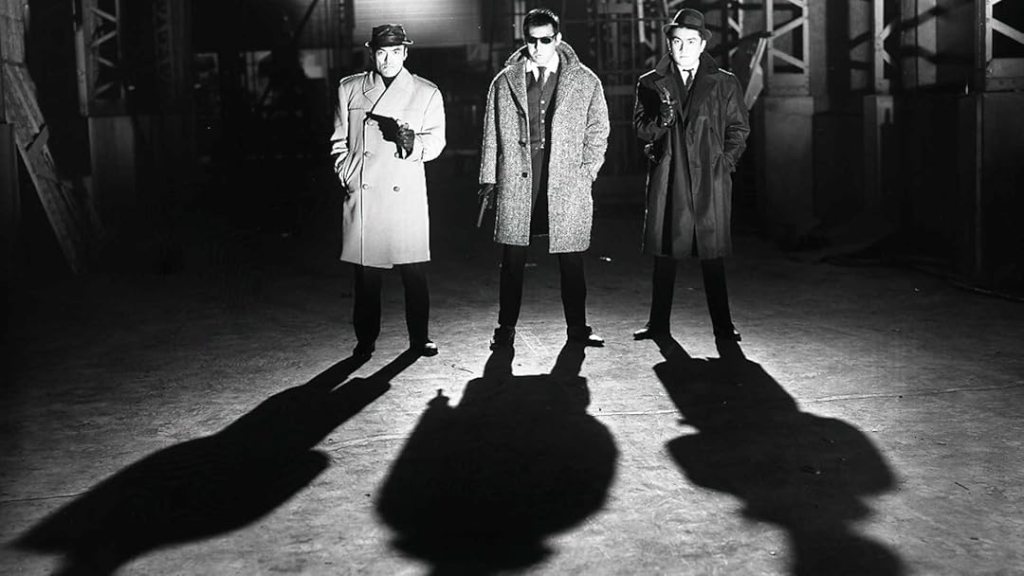
There are betrayals and double-crosses aplenty in Furukawa Takumi’s energetic crime thriller Cruel Gun Story, one of a string of noir-inspired pulp films produced by Nikkatsu Corporation during the 1950s and 1960s. The iconic elements of a Nikkatsu noir are all front-and-centre: the 2.35:1 ultra-wide aspect ratio, the moody black-and-white photography, and studio star Jo Shishido as a cool professional criminal.
Togawa (Shishido) is released early from prison in a secret arrangement to lead a 120 million yen heist of an armoured car. He is provided with a plan by his handler Ito (Umeno Yasukiyo), as well as a potential crew of four fellow criminals. When the heist fails to go according to plan, Togawa is forced to improvise – and his crew begin to take matters into their own hands.
There is a pace and an efficiency that tends to dominate Nikkatsu’s crime films, and it is very much in evidence here. While the films were all shot on tight schedules and limited budgets, directors were often given free rein in how they shot and shaped them. Some directors – notably cult favourite Suzuki Seijun – took that freedom further than where the studio was comfortable. Furukawa Takumi, whose 1956 drama Season of the Sun had been a major hit for Nikkatsu, adopts an approach that seems heavily indebted to Stanley Kubrick’s The Killing (1956) – not simply in story but also in style. It makes for a muscular, unrelenting film. The body count is high, and there is a strong sense of fatalism to its characters.
There is a point around the film’s climax where perhaps a few too many betrayals have occurred, and the narrative begins to sweat with too many allegiances and characters. While it does wobble a little at this point, to Furukawa’s credit it streamlines back down by the bloody conclusion.
Odaka Yuji delivers a decent turn as Togawa’s long-time friend and companion Shirai, and in the film’s second half the two make an enjoyable partnership. Shishido is in typical form in the lead, dressed in a variety of cool black suits and sunglasses and dominating every scene he is in. I have written before about Shishido’s plastic surgery: concerned he wasn’t getting the best parts in the late 1950s he paid to have his cheekbones cosmetically enhanced. The results were faintly ridiculous-looking, but one cannot deny they worked for him: he became one of the studio’s most bankable stars, and a go-to name for any assassins, thugs, or gangsters their films required.
I feel there is some mild credit due to Cruel Gun Story for incorporating female characters: the genre is typically very male-dominated, and so it is nice to see Kazuki Minako showcased as the criminal operative Keiko. Matsubara Chieko also appears as Togawa’s disabled sister Rie, but it is a far more passive and underwritten role.
Cruel Gun Story is a perfect example of a B-grade film doing exactly what is required of it. It does its job effectively, and represents a relatively disposable, enjoyable slice of criminal action.

 FictionMachine.
Leave a comment