I have noted before that the 1960s to the 1980s were a difficult time for Japanese cinema. Audiences were drawn away from movie theatres to television in the home, and glossy American imports tended to suck the oxygen straight out of the local market. As a result, if a domestic studio stumbled upon a hit it would exploit its success with a sort of panicky desperation. Long-running franchises became part-and-parcel of the industry. Toho would release an annual Godzilla picture, The Rambling Guitarist ran seven films in the space of three years, Zatoichi went 25 between 1962 and 1973, and of course Shochiku went to town on its much-beloved Tora-San series (whose Japanese title translates to It’s Tough Being a Man).
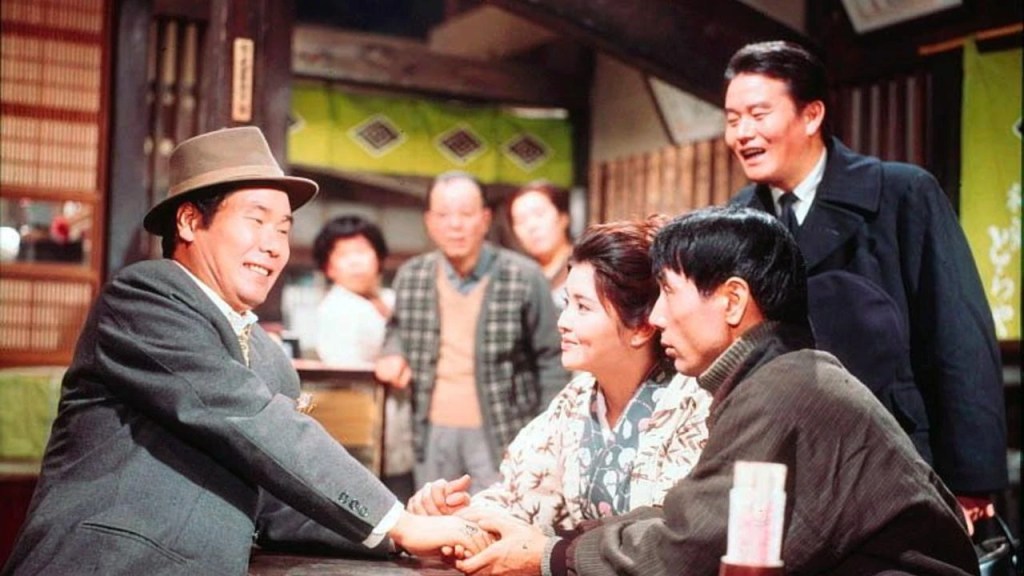
With both the first and second Tora-San films finding great success, Shochiku rushed a third film into production as soon as they were able. Tora-San, His Tender Love hit theatres in January 1970, two months to the day after Tora-San’s Cherished Mother. Yamada Yoji, who had directed and co-written the first two films, was busy preparing his drama Where Spring Comes Late (1970) and was replaced. While His Tender Love featured a Yamada screenplay (written with Kobayashi Shun’ichi and Miyazaki Akira), it was directed by Morisaki Azuma – one of only two Tora-San films out of 50 not to be helmed by Yamada.
This third adventure sees a potential marriage be arranged for Tora (Atsumi Kiyoshi), only for him to set the bride up with somebody else. He subsequently takes up a job working in an inn in Mie prefecture, where he sets up one young woman with a match while pining after another. He is, as always, well-intentioned but an idiot, and boastful but generally incompetent. There is a formula to these films, and while His Tender Love does offer some variations from the model established in films one and two it still hews fairly close to the model set up by Yamada Yoji.
Morisaki directs the film with a much more gregarious sense of physical comedy and slapstick, a direction that Atsumi ably embraces. It does up the film’s humorous sections from warmly amusing to occasionally laugh-out-loud funny, but it also blunts the more dramatic side of the film slightly. There is a small subtlety lost that makes this particular confection a little less rounded and impactful than the other two films.
In what is fast becoming the highlight of the series, the film again begins with Tora returning home to Shibamata, Tokyo, to visit his sister Sakura (Baisho Chieko) and his family. Baisho makes only a limited appearance this time around, but once again it is a venue for Morikawa Shin to excel at comedy as Tora’s awkward uncle Ryuzo. These opening sequences, that generally take up the first half hour of the 90-100-minute narrative, are a distinctive and particularly enjoyable aspect of the Tora-San franchise.
Perhaps not quite as good as its predecessors, Tora-San, His Tender Love is still a charming and wholly satisfying light comedy with touches of drama and a beautiful showcase for late 1960s Japan. In a lovely touch, the film climaxes at New Year’s Eve, with 1969 giving way optimistically to the 1970s. Into a new decade, Tora walks ever-on.
 FictionMachine.
Leave a comment