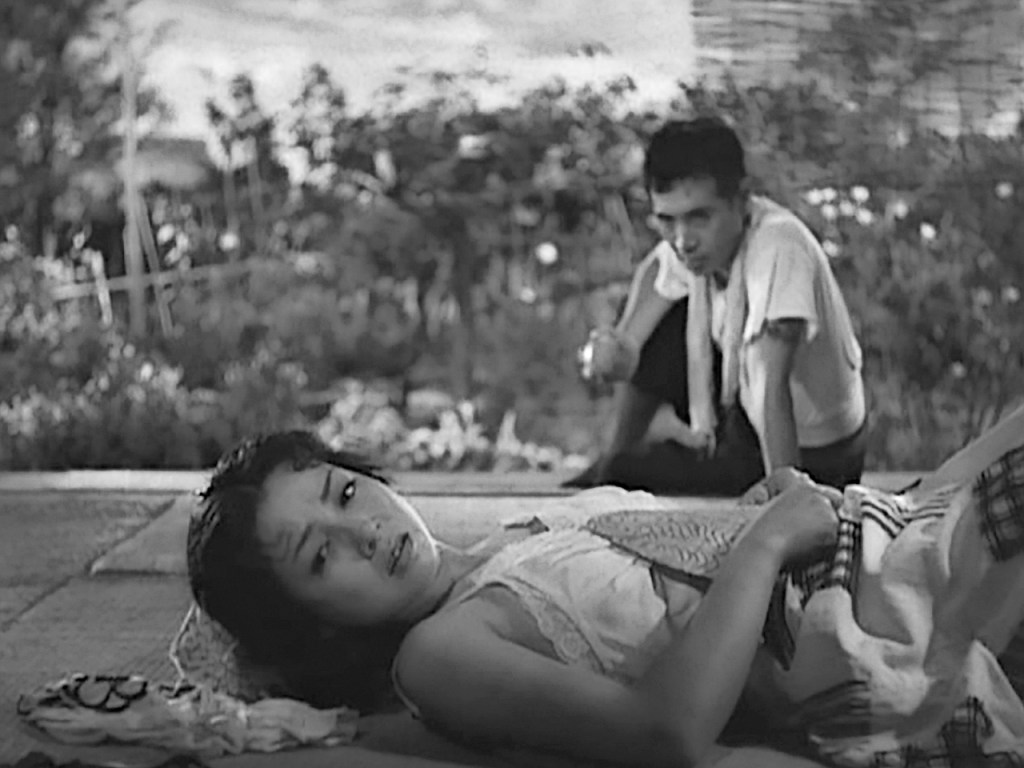
A rural couple have three adult children. Middle child Mon (Kyo Machiko) returns home pregnant from university, causing local gossips into overdrive and creating a minor scandal for the family. Older brother Inokichi (Mori Masayuki) is violently angry, lashing out at both Mon and the regretful student Kobata (Funakoshi Eiji) for their actions. Younger sister San’s marriage prospects are placed under threat by Mon’s actions.
Naruse Mikio maintains his over-arching interest in women’s affairs in Older Brother, Young Sister, a surprisingly bleak and effective family melodrama from 1953. In many respects it fits neatly into his broader oeuvre in the way that his female protagonists navigate their patriarchal environments. In other ways it is a genuine surprise; women’s struggles may be troubled and melancholic in Naruse’s world, but they are rarely this visceral, or so actively violent.
Parents Akaza (Yamamoto Reizaburo) and Riki (Urabe Kumeko) make a relatively meagre living in rural Japan. He works on the local rivers to construct rocky banks, but the government has started replacing the rocks with poured concrete – and that change is threatening his livelihood. Riki runs a local snack stand in the middle of a country road in order to help ends meet. Their youngest child San had benefitted from a good education and improved social prospects, but those advantages have been funded not by her parents but by older sister Mon instead.
It is clear that Mon, who left town for Tokyo some years ago, has been earning a living through sex work. This lifestyle has clearly backfired on her, and she returns home separated from her latest suitor and pregnant to boot. Her predicament is met with love and understanding by her mother and taciturn disapproval by her father. In the case of older brother Inokichi it leads to active hostility.
Inokichi is not simply a lout. He is a hypocrite and local lothario, rebelling against his own responsibilities while policing Mon’s. He is a strangely repellent character, and Mizuki Yoko’s screenplay pushes him in a much harder direction than is typical. Twenty years earlier, Naruse’s noted Apart From You (1933) focused on a son’s disgust at his mother’s geisha profession. With Naruse returning to very similar themes here, it comes across as much more potent and disturbing. Inokichi is not simply aggressive and unpleasant; he is actively controlling over Mon’s behaviour. He is almost entirely toxic, and the film spends a lot of time exploring the consequences of that.
The film also acts in part as a reunion for stars Mori Masayuki and Kyo Machiko, who had previously both co-starred in Kurosawa’s Rashomon (1950) and Mizoguchi’s Ugetsu (1953). Their third collaboration was a first for both them, working with Naruse Mikio, and for Mori it was the start of a vibrant period of collaboration in which he would work with the director another five times including in Floating Clouds (1955) and When a Woman Ascends the Stairs (1960). They clearly come to Older Brother, Younger Sister with a well-developed creative relationship, because those scenes between their characters jump off the screen. It is surprising that both actors would be among Japan’s most popular and acclaimed during the 1960s, and yet Older Brother, Younger Sister remains a relatively obscure work for all three.
Naruse Mikio is one of Japan’s strongest directors of the mid-20th century, and one of the strongest indicators of that is how even his less famous, sometimes actively obscure, works are capable of standing up just as effectively and dramatically as his most famous films. Older Brother, Younger Sister should be more widely seen, and more openly appreciated.



 FictionMachine.
Leave a comment