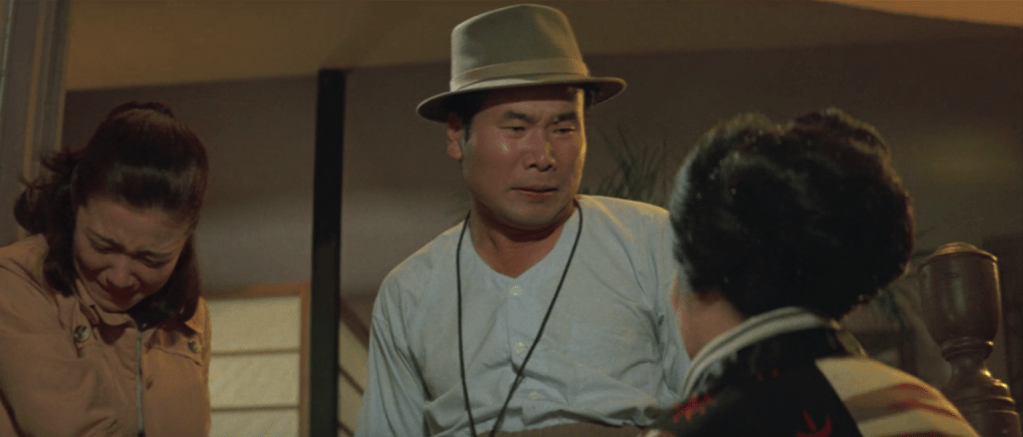
Yamada Yoji’s Tora-San, Our Loveable Tramp (aka It’s Tough Being a Man) was a hugely popular comedy hit in Japan. Spun off from a successful TV serial, the film opened in cinemas on 27 August 1969 and captured the attention and affection of both audiences and critics. Noted cinema magazine Kinema Junpo gave the film five stars.
How popular was it? By November of the same year, just three months later, the Shochiku studio had a sequel in theatres just to capitalise on its success. Tora-San’s Cherished Mother reunited star Atsumi Kiyoshi and writer/director Yoji Yamada for a second story about boorish and ignorant street peddler Kuruma Torajiro (Atsumi) falling out with his family and chasing a romance guaranteed to fail. The first Tora-San was a wonderful and hugely enjoyable comedy. What is remarkable about Tora-San‘s Cherished Mother is that despite its truncated production and rushed release, it is actually the stronger film of the two. The comedic elements are funnier, and it carries an unexpected and effective seam of drama right through it.
Tora returns home to Shibamata only to immediately leave his family in a huff as soon as he arrives. He subsequently stumbles upon his childhood school teacher Tsubouchi, and is romantically struck by his now adult daughter Natsuko (Sato Orie). It is Tsubouchi who encourages Tora to track down and reconnect with his long-absent mother (Miyako Chocho), and soon Tora and Natsuko are off to Kyoto to track her down.
Tora-San is famously the world’s longest-running movie franchise with the same lead actor, and while the first film was envisaged as a self-contained story the sequels all follow a very similar narrative. There is a comfortable formula to each sequel, and to a large degree that formula is solidified here. Each film tends to spend its first half hour in Shibamata, with Tora making a nuisance of himself until some misfortune or misunderstanding leads him to leave in irritation. Tora then travels to another part of Japan – in this case Kyoto – where he falls in love with an attractive young woman (referred to by Tora-San fans as the film’s “Madonna”) who finishes the film in love with somebody else.
In this case the Madonna is played by Sato Orie with an enormous amount of warmth, likeability, and personal agency. She treats Tora like a childhood friend while he blindly begins to assume romance is in the offing, and by the film’s end is matched with another man in a manner that is obvious from her first scenes. With comedy, seeing the events coming often makes them funnier, and that is certainly the case here.
Tora’s crusade to find his mother is amusingly developed, but surprisingly secondary to the central relationship of the film: Tora’s rekindled friendship with his old teacher. It generates comedy for sure, but is also surprisingly dramatic and adds an entire layer of drama to this film that was not present in the last one. As Tora and his family – sister Sakura (Baisho Chieko), aunt Tsune (Misaki Chieko), and uncle Ryuzo (Morikawa Shin) – were already introduced in the previous film, there is more room here to play with the new and supporting characters.
Atsumi Kiyoshi is, of course, a wonderful comic performer at the film’s centre, and if there is a single reason for the franchise’s durability over the decades it is surely him. Despite the obstacles in his way, the disappointments and frustrations, and his own relentless foolishness, Tora remains an optimistic character from beginning to end. His misadventures run endlessly from here.
 FictionMachine.
Leave a comment