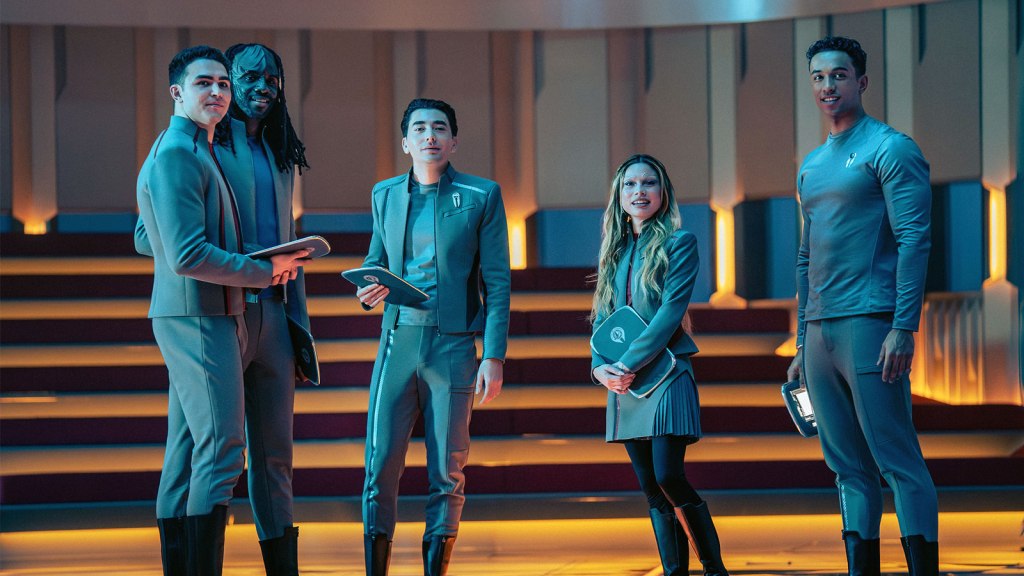
First broadcast 26 February 2026.
In October 1990 Star Trek: The Next Generation broke new ground for the series with an episode titled “Family”. Written by Ronald D. Moore and directed by Les Landau, the episode focused on Captain Jean-Luc Picard coming to terms with the emotional damage caused by the events of the preceding two-parter “The Best of Both Worlds”. It was an unprecedented moment for the series, since it was the first case where one episode was devoted to character development in the wake of another and a significant shift for Star Trek from the self-contained adventure format of the 1960s to the character-based semi-serialised narratives of the 1980s and 1990s. The episode remains one of all-time favourites.
I was reminded of “Family” when watching “The Life of the Stars”, the eighth and latest episode of Star Trek: Starfleet Academy. The episode, which was written by series creator Gaia Violo and Jane Maggs, and directed by Andi Armaganian, is also an exploration of trauma and emotional damage in the wake of an earlier episode. Like “Family”, it is a particularly strong and effective hour of television. Indeed it seems the better episode of the two, and not just the best episode of Starfleet Academy to date but possibly one of the all-time greats for the whole 60 year franchise.
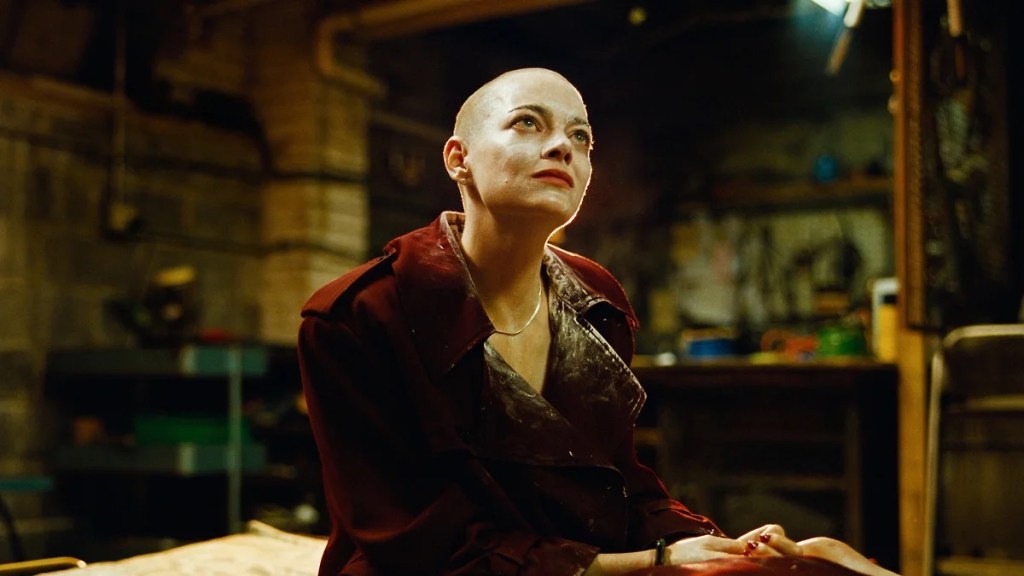
In the wake of the Miyazaki incident, cadet morale is at a low ebb, and class cohesion is failing. In an attempt to rebuild the Academy’s mood, Captain Ake (Holly Hunter) turns to third-year instructor Sylvia Tilly (Mary Wiseman) who puts the core cadets through an unexpected and unwanted theatre course. Tarima (Zoë Steiner) returns, physically recovered from her coma but still reeling from the emotional damage. Sam’s (Karrice Brooks) glitches in the aftermath of the Miyazaki mission grow too great for the Doctor (Robert Picardo) to fix, leading him and Ake to take her back to her home world of Kasq.
It is honestly difficult to express the strengths of “The Life of the Stars” from a plot synopsis alone. A description along the lines of “the cadets learn about Our Town” sounds remarkably dull for a science fiction drama, and yet Violo and Maggs’ script manages to use Thornton Wilder’s 1938 play as a springboard to explore the cadets’ trauma and grief, the broken relationship between Tarima and Caleb, the reason behind Sam’s wounds, and the 32nd century emotional state of the Doctor that has been rolling along since the series pilot. It does all of this with a remarkable poetry, emotional realism, and a smart awareness of both Starfleet Academy and Star Trek‘s history.
I was never a fan of Lieutenant Tilly back in Star Trek: Discovery; I believe I may have described her at the time as “grating”. Gifted with a much stronger script and a few years of character development, and she is a welcome and hugely effective guest character here. The problem was never with Wiseman herself, of course, who offers a predictably warm and bright presence here. I hope she makes further guest appearances as Starfleet Academy goes on.
While there is a closer focus on Tarima’s grief, the episode finds space for the other regular characters to express their own upset and emotional baggage. It all feels remarkably grounded and realistic for Star Trek to be honest, which resonates with a key early scene of Ake, Reno (Tig Notaro), and Tilly sharing a drink together and discussing the cadets’ progress.
The episode somehow manages to find time for some thoughtful and intelligent science fiction as well, with Ake and the Doctor accompanying Sam to her home planet of Kasq in an attempt to repair her programming. The connection between Sam and the Doctor, teased several times this season, finally comes to fruition. It is a beautifully composed and directed series of scenes, exploring the effects of memory and experience, and the consequences of living for centuries when your memories cannot ever fade. Somehow the shadow of Thornton Wilder even falls here, with “Our Town” improbably becoming an illuminating parable on the life of an artificial intelligence in the 32nd century.
This is smart stuff, and emotionally powerful too. It juggles the most unlikely of elements with an astonishing creativity and, more impressively, a remarkable sense of grace. If these are heights Starfleet Academy can reach, the future of Star Trek seems to be in the safest of hands.
 FictionMachine.
Leave a comment