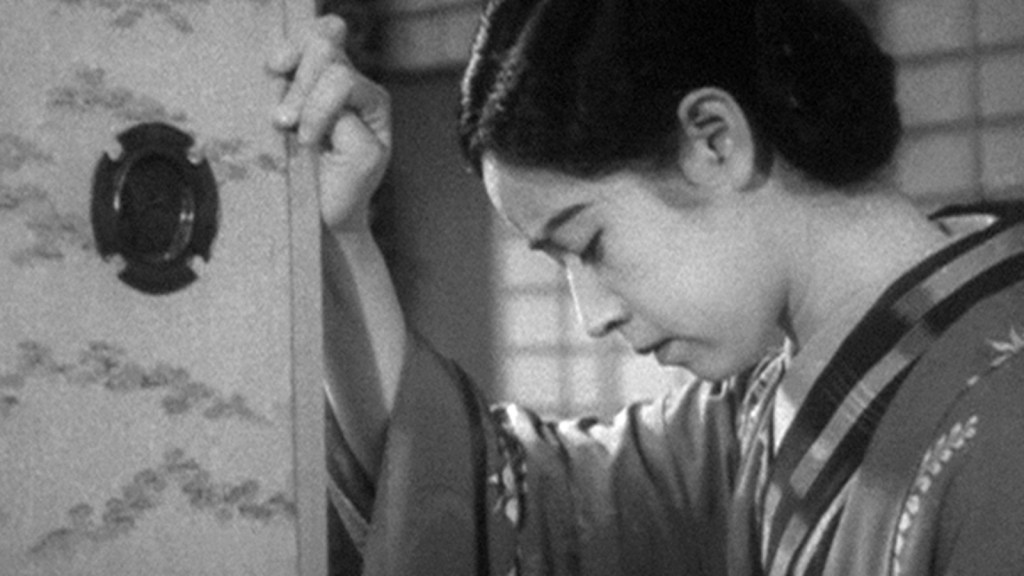
Naruse Mikio’s No Blood Relation (1932) is the second-oldest of the director’s films known to exist. It is his earliest feature-length work that can be seen. It is a vibrant, emotional melodrama with surprisingly active camera work and a modest sense of social commentary on early 1930s Japan.
Successful movie star Tamae (Okada Yoshiko) returns to Japan after finding fame and fortune in Hollywood. She plans to reclaim custody of her daughter Shigeko (Kojima Toshiko), whom she abandoned as a baby six years earlier. Shigeko’s father Atsumi (Nara Shinyo) has since remarried, and his second wife Masako (Tsukuba Yukiko) has adopted Shigeko as her own child. When Atsumi’s business interests collapse, however, the question is raised over where will Shigeko find the most secure future?
Naruse’s film is uncharacteristically fast-paced and energetic. It begins with a purse-snatching and an amusing con on the police and the public, as if the film was going to be a crime-based comedy. Instead it is full-blooded family melodrama, as most of Naruse’s later works would tend to be. The film is assembling with a series of clever matching shots to link scenes, as well as surprisingly mobile tracking shots across scenes or towards key characters. Japan sustained production of silent films for much longer than other countries’ cinemas, and one of the results is that films like No Blood Relation, produced in the early 1930s, use camera techniques that foreign viewers more commonly associate with early talking pictures. It creates a striking, unintended effect.
The film is solidly performed by its cast. The most interesting character among them is Atsumi’s mother Kishiyo, played by Katsuragi Fumiko. She lives in Atsumi’s home, and is well accustomed to his wealth. When his businesses go bankrupt, Kishiyo sees her traditional comforts evaporating. She subsequently sides with Tamae in pulling Shigeko away from her father, in the hopes that Tamae’s wealthy lifestyle will extend to her. It is open to question whether Kishiyo’s motives are purely selfish, or if she genuinely believes Shigeko will be better off with her biological mother. Naruse thankfully keeps things relatively ambivalent, and it is ultimately up to the viewer to decide.
There seems to be some comment here on Japan’s society and economy within Naruse’s films. Typically he foregrounded character and emotion in his films ahead of politics, but here he seems to express opinions on the changing role of women and Japan’s economic depression of the time. In the two years leading up to No Blood Relation‘s release, the Japanese economy had collapsed as a result of its trade relationship with the USA – which was deep in its own depression at the time. This is reflected in the failure of Atsumi’s company, and his need to move his family to a new, lower-class home in the suburbs.
At the same time Tamae is represented very much as moga, the Japanese woman of the early 1930s who sought financial independence and copied Western women’s fashion and comparative freedom. Tamae is presented as an antagonistic figure in Atsumi and particularly Masako’s story. Despite being Shigeko’s biological mother, Naruse makes it clear through his film that the child belongs with Masako. It actively articulates that a parent is defined not by biology but by action; by raising Shigeko for six years, Masako is a more authentic mother than Tamae is. A traditional Japanese family – even an impoverished one – is preferable to American-style wealth and glamour.
There is always an appeal in watching a great filmmaker’s earlier works to understand how their personal aesthetic and technique developed over time, but in the case of No Blood Relation there is also a briskly paced family drama to be enjoyed in its own right. It offers insight into pre-war Japan as well as tells an entertaining story.



 FictionMachine.
Leave a comment