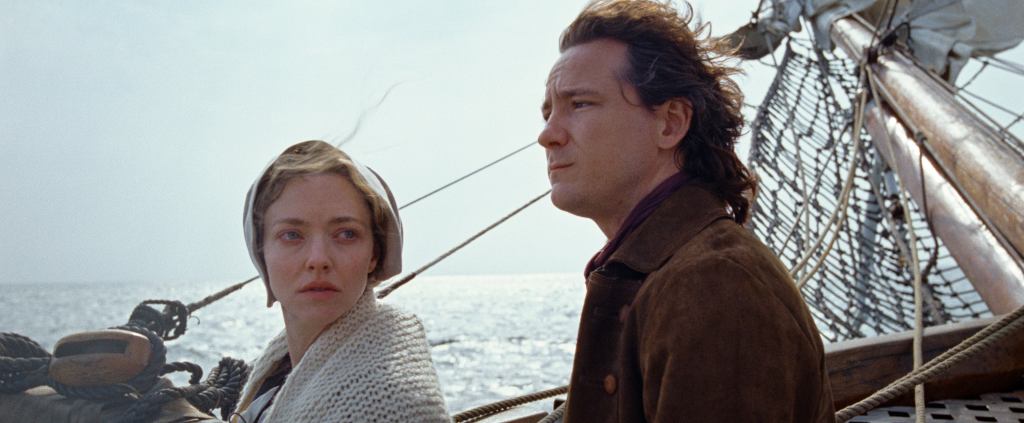
To cut the the chase: I personally found The Testament of Ann Lee somewhat over-long, and felt an overriding sense of ambivalence about why it was a story in need of telling at all. Despite this I cannot fault its artistic merits, its elegantly presented musical score, or writer/director Mona Fastvold’s visible talent in bringing Ann Lee’s life to the screen. Wide praise for star Amanda Seyfried is also entirely justified; when other critics and reviewers write phrases like “career-best”, they are entirely on the money. I am happily filing this one under “not for me”. There is a genuine chance that it may absolutely be a film for you.
Ann Lee (Seyfried) is a young woman in 18th century Manchester whose religious fervour leads her into a religious community that engages in wild shaking dances and shouts of joy during worship. Further experiences of an unhappy marriage and children that die in infancy lead Ann to a leadership role in her church, and ultimately to leading her followers to the United States of America to proselytise their beliefs.
This is not simply an 18th century biographical film. It is also a musical, with Oscar-winning composer Daniel Blumberg adapting real-life Shaker hymns and spirituals for the film’s artistic purposes. While the songs absolutely qualify the film as a musical, to describe it as such risks leading audiences to anticipate some Broadway-like work in form or structure. Instead the songs help to immerse the viewer into the film, and the strange religious fervour that dominates Ann’s life.
The historical settings are beautifully realised, and the film impeccably designed. Aside from Seyfried’s truly astonishing lead performance, there is a host of praiseworthy performances going on. Lewis Pullman is excellent as Ann’s loyal brother William. David Cale is brimming with comic delight as Shaker patron John Hocknell. Thomasin Mackenzie is absolutely splendid as Ann’s closest ally Mary Partington, adding yet another strong performance to a growing list of them. (I still maintain that, sooner or later, Mackenzie is going to be an Oscar winner.)
Strange, then, that ultimately it all seems so curiously empty. Fastvold’s film does a fantastic job of immersing the audience into a world of religious bliss, at least aesthetically, but I do wonder how successful it is in immersing the audience in the mind of Ann Lee herself. The character enters the film boasting an already-firm religious mania, and continues expressing it for well over two hours, and the film ends with her beliefs never really challenged nor even shaken. One exits the theatre understanding what happened to Ann over the course of her life, but rather ignorant of what might have gone on inside her head. Such little development really brings the length of the film into sharp relief: I think it is, regardless of its other merits, too long and languid for its own good.
It is tremendous to see a film constructed with such dedicated attention on art over commerce – this is always the case – but there is the lingering question on how much it was developed with an audience in mind at all. As a work of arthouse cinema this is hugely impressive stuff, and a tremendous showcase of Fastvold’s talents. If one is seeking a satisfying narrative or an exploration of character, however, this simply does not seem to be the right film to see.
The Testament of Ann Lee opens in Australian cinemas on 26 February 2026. It has also been screening as part of the Europa! Europa! Film Festival. For more information on that, click here.

 FictionMachine.
Leave a comment