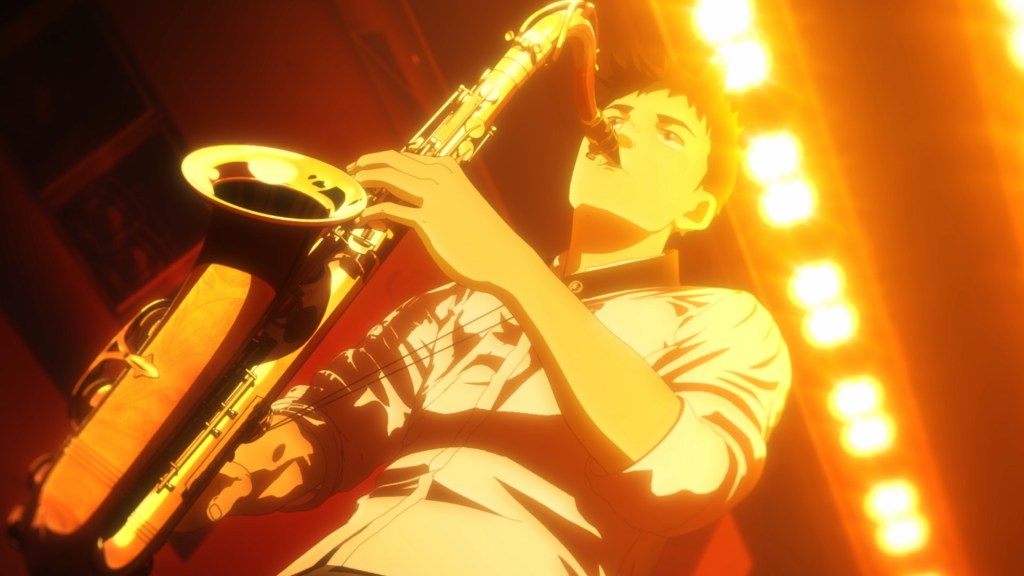
Tachikawa Yuzuru’s Blue Giant is a perfect example of using the medium of animation to express emotion that simply would not be possible in the same way via live-action. This 2023 anime feature was a sizeable local hit in Japan, and received a brief theatrical release in the USA. Here in Australia it seems its potential audience is not even aware the film exists; there has been no theatrical window, no streaming sessions or online rentals, and no blurays or DVDs. To call that a shame would be to under-emphasise the sheer quality of Tachikawa’s film. This is world-class animation, and bona-fide five-star cinema, and we are currently missing out on it.
Something that seems to mark Japanese animation as distinct to most other countries and cultures is the breadth of subject matter it seems willing to cover. American animation seems largely focused on anthropomorphic animals and fantasies. In recent years I have watched anime films dedicated to whisky-making (Komoda: A Whisky Family, 2023), teen debate clubs (From Up on Poppy Hill, 2011), and Shakespeare’s Hamlet (Scarlet, 2025). Blue Giant is a film about jazz: its appeal, the techniques, and the jazz bar culture of modern-day Tokyo. It does it with style, a pleasing sense of energy, and without succumbing to the condescension and overwhelming smugness that often plagues Americans films about the genre.
18-year-old saxophonist Miyamato Dai (Yamada Yuki) moves to Tokyo in the hope of breaking into the city’s jazz scene. Along with pianist Sawabe Yukinori (Mamiya Shotaro) and aspiring drummer Tamada Shunji (Okayama Amane), Dai sets up a new band JASS with the goal of one day performing at the city’s most legendary jazz bar.
Blue Giant‘s masterstroke is a vivid synesthetic representation of not just what music sounds like, but of how it feels. As base representation of live music, Tachikawa’s film jumps from hand-drawn animation to CGI – so as to more accurately represent characters playing their instruments. At the same time it opens spectacular opportunities for moving the virtual camera around the scene. Ordinary scenes of dialogue, or the characters’ everyday lives, have a standard look familiar to anime features in general. When the music begins, the visuals as good as pop off the screen.
The use of CGI is only the surface level of how music is represented. As each player engages in furious improvisations, the film’s visual aesthetic jumps between styles, levels of abstraction, and colour schemes. It embraces the possibilities of animation in a manner few animated films actually manage. When not inspiring psychedelic imagery with flair the music is inspiring memory and flashbacks, emphasising its emotional impact. The film’s narrative is a familiar and relatively simple one. Its creative focus, however, is on character and emotion. On that level it is a hugely impressive achievement, setting it up comfortably as one the decade’s best animated features to date.
A film about jazz is naturally blessed with an excellent musical score by popular musician Uehara Hiromi. Her energetic and eclectic compositions have gone a long way to ensuring Blue Giant‘s success in Japan, and is rightfully an integral part of the film.
There are criticisms one could level at the plot, chiefly regarding the three leads’ personal journeys through the film. Is Dai’s “100 per-cent all the time” play style believable? Is Shunji’s progression from amateur drummer to professional realistic? Does Yukinori suffer appropriate penance for his hubris? In the end these complaints seem minor when compared to the impact of Blue Giant‘s core concerns. This film reflects, interprets, and celebrates jazz like nobody’s business.
 FictionMachine.
Leave a comment