Ozu Yasujiro’s The Only Son – his first talking picture – is an efficiently composed, modest gem. It tells a short, simple story but tells it very well. One can see the artist that peaked with 1953’s Tokyo Story already at work on an impressive level, and 90 years after its original release it is still an emotionally resonant and effective work.
Iida Choko plays O-Tsune, a widow and single mother in Nagano Japan who devotes her savings to ensure her son Ryosuke gets a complete education and move to Tokyo to find work. Years later, and working an impoverished job at a silk factory, O-Tsune travels to Tokyo to see how her son is doing – only to find him in a low-paid teaching job with a wife and baby O-Tsune had no idea about.
Ozu had already made 33 films during the silent era, so while The Only Son is the director’s first talking picture his general directing style and visual aesthetic has already been well-defined. The low-height static angles, the “pillow shots” between scenes, and the idiosyncratic 180-degree camera cuts and direct address dialogue are all in evidence here. Really the only key difference between this and the post-war dramas that would signify his most accomplished works is a lack of emotional depth and a slight tendency towards melodrama. It is the mark of a great filmmaker that even his more mediocre works stand well above the best films of many of his contemporaries.
Iida Choko performs the film’s central heart and soul: a woman who has sacrificed her own happiness to ensure her son’s success, only to discover he has failed to reach the heights for which she had planned. Iida was a regular collaborator with Ozu, appearing in several of his silent films including Days of Youth, I Graduated, but… (both 1929) and Tokyo Chorus (1931). She would subsequently work for Naruse Mikio, Gosho Heinosuke, and Kurosawa Akira, among others – nearly always as working-class mothers and grandmothers.
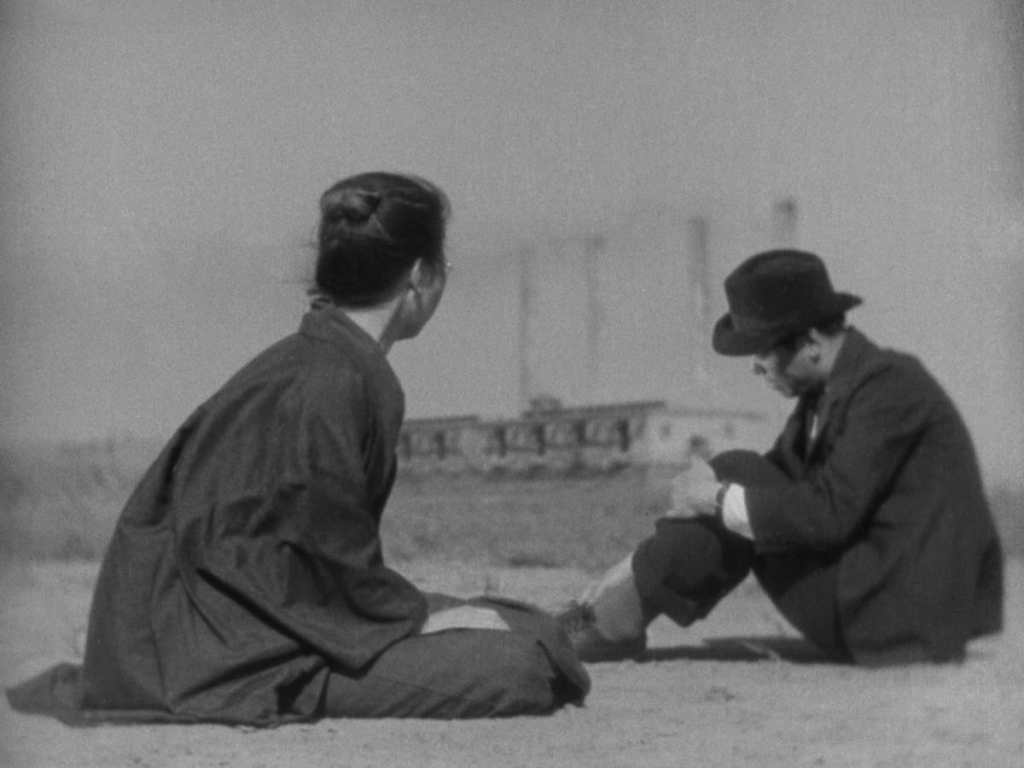
She certainly represents working-class concerns in The Only Son, working in a factory and struggling to make ends meet, and desperately hoping her son will escape the poverty that she has faced all of her life. It is a representation of pre-war Japan in microcosm, where the mass industrialisation of the Meiji and Taisho eras have left much of the population in limbo or flux: their old ways of life gone, and their new circumstances poorer and less certain. There is a key scene in which O-Tsune and Ryosuke (Himori Shin’Ichi) sit and talk near his rented house. In the background, a massive incinerator complex blazes day and night, destroying Tokyo’s ever-growing mass of garbage.
The film’s focus is on family, as Ozu’s films generally were, and specifically on the troubled relationships between parents and their children. Their conversations with and reactions to one another feel real, and feel heartfelt, and even if they tend a little to the melodramatic, they uniformly ring true. That truth rings the loudest in the film’s perfect final scene: O-Tsune finally on her own, with no one to lie to and no excuses to make. It is pitch-perfect.




 FictionMachine.
Leave a comment