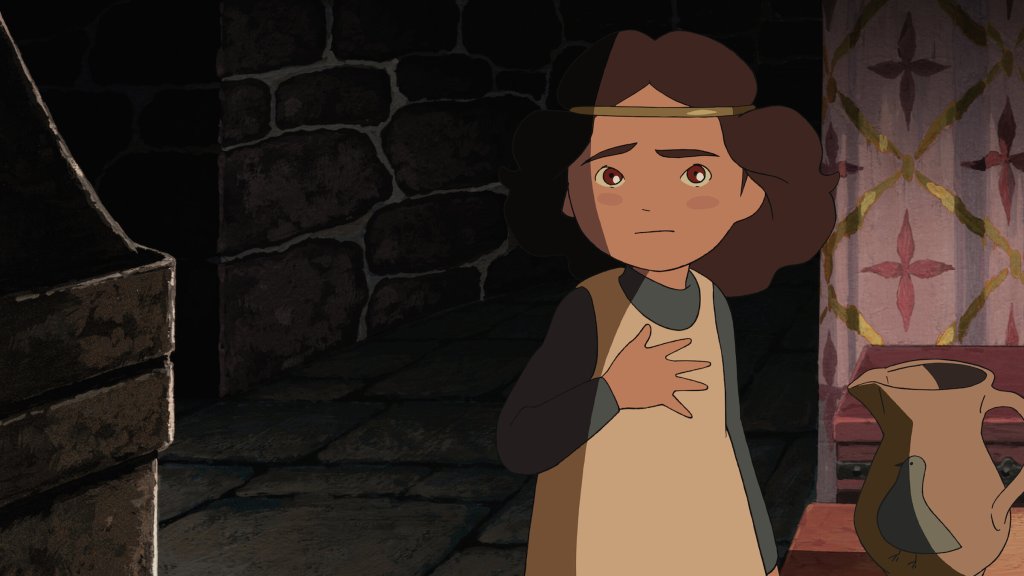
Japanese animation in 2001 was comprehensively dominated by Miyazaki Hayao’s Spirited Away, a gargantuan hit that broke box office records and became an international sensation. Released with less fanfare, and partly flying under the radar with global audiences, was Katabuchi Sunao’s Princess Arete. Based on Diana Coles’ 1983 novel The Clever Princess, the film told a different sort of fantasy adventure with a different sort of young female protagonist. 25 years on – and with Katabuchi having moved on to the likes of Mai Mai Miracle and In This Corner of the World – it is a film well worth re-visiting and appreciating.
The comparisons to Spirited Away are not entirely superficial: before making his directing debut with Arete Katabuchi was assistant director on Miyazaki’s Kiki’s Delivery Service (1989) and had even worked as a script writer on the pre-Ghibli television series Sherlock Hound (1984). As such he brings with him a very Ghibli-esque sensibility to Princess Arete. The similarities are not visibly in the film’s distinctive art style, but they are peppered through its general tone, its narrative, and its approach to character.
The film revolves around Arete, a young princess whose hand in marriage has been promised to whichever knight brings home the most impressive or powerful magical artefact. While her father obsesses over each treasure that is presented to him, Arete is more interested in breaking free from her tower chambers, meeting the common folk of her kingdom, and researching the ancient history of her lands. When a powerful wizard arrives at the castle demanding Arete as his wife, the princess faces a much more dangerous imprisonment than the one she currently endures.
Something that is immediately striking about Princess Arete is how much of it is confined to a variety of castles, gloomy prisons, and ruins. While initially that makes it seem like the gloomy locations would inspire a gloomy film, it instead puts a stronger highlight on the key characters. Arete is the classic ‘princess who rescued herself’, boasting a strong personal drive, cunning intelligence, and a delightful shortness of patience with her patriarchal romantic suitors. Other key characters are also well developed and entertaining, including the sorcerer Boax and his transformed frog servant Grovel.
There is some fascinating world-building placed into the background. What initially appears to be a very medieval European setting is revealed to have something of a post-apocalyptic feel, with a long-lost generation of magicians and witches seeming more like science fiction than fantasy. The film utilises a very simple art style, in which the characters are rendered with less focus on detail and more on their physical movements. It is an aesthetic that grows on the viewer, and becomes more appealing as it goes. There is a touch of Studio Ghibli about the film’s general look, but also other Japanese sources such as Tamori Yohsuke’s PopoloCrois.
Princess Arete found popularity in Japan upon release for its strong central character and feminist themes, which is not a surprise. It also tells a wonderful fantasy story with a rich sense of wonder and a patient, gentle delivery. It is a small animated gem, waiting for rediscovery – as well as new audiences to find for the first time.

 FictionMachine.
Leave a comment