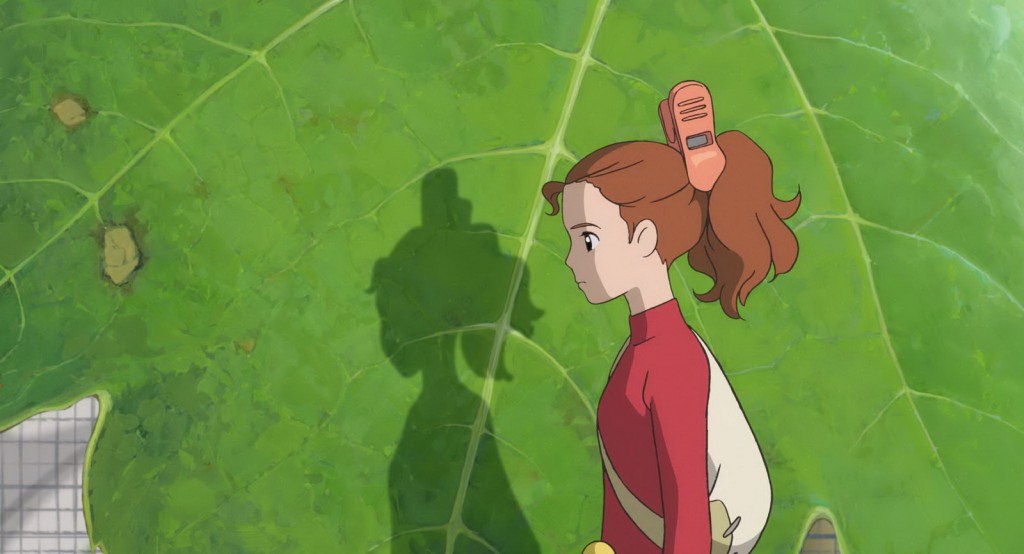
There is always a problem for Studio Ghibli productions that are not directed by co-founder Miyazaki Hayao, which is that they suffer by comparison. After all, Miyazaki is arguably the greatest director of animated films in history. Literally any other director can deliver the best work of their entire career, and it will still fail to stand up against the master at his best. If a director works for another studio or production company, they at least have the space for their work to be evaluated on its own merits. If they work for Ghibli itself, and there’s no escaping being measured against the best.
Pity, then, poor Yonebayashi Hiromasa, who made his directing debut on Ghibli’s Arrietty (titled The Secret World of Arrietty in some markets). The film adapts the popular children’s novel The Borrowers by Mary Norton, with a screenplay by Miyazaki himself. It is a confident, beautifully composed, and hugely entertaining work, but without quite reaching the creative peaks of My Neighbor Totoro, or Kiki’s Delivery Service, or Spirited Away, it cannot help but feel like a second-string work. That is unfair to Yonebayashi; while Miyazaki’s fingerprints may be all over the film’s aesthetic, it very much finds its own identity, pace, and tone. This is truly superb animated filmmaking.
Arrietty is a Borrower: a tiny person living between the walls of a two-story countryside house. What she and her parents need, they secretly pilfer from the giant world upstairs – from whom they strictly keep their presence secret. When Arrietty is accidentally discovered by a boy named Sho, it sparks an unconventional friendship but puts her and her family in great danger.
There is a slow, gentle style to Yonebayashi’s film. It lacks the sense of whimsy that can often highlight Miyazaki’s works, and instead offers a slightly more grounded and realistic sense of emotion. It is less funny, but more thoughtful. It is a style that Yonebayashi repeats for Ghibli – albeit less successfully – in his 2014 film When Marnie Was There. The emotional core of Arrietty is the friendship that develops between her and Sho, and anything that does not inform or develop that friendship is excised from the narrative. The result is a more focused picture, and an unexpected sense of calm. It helps forge Arrietty‘s identity as a film, distinct from its studio stablemates.
The animation is clean and distinguished, with character designs following the general house style. Cécile Corbel’s musical score is a particular highlight to the film; she remains the only non-Japanese composer to work on a Studio Ghibli production. The vocal performances are strong and effective no matter which dub you prefer: in addition to the original Japanese dub, there are separate UK and American versions depending on the distributor. The UK dub benefits from some very strong vocal talent, including Olivia Colman, Mark Strong, Saoirse Ronan, and Tom Holland. (The Japanese dub gets Shida Mirai, Otake Shinobu, and Miura Tomokazu.)
Arrietty marks a confident directing debut, and remains a distinctly appealing entry in the Ghibli canon. Even as an acclaimed international hit, it still feels just a little bit underrated; but that’s what you get when you’re working in the shadow of the world’s best.

 FictionMachine.
Leave a comment