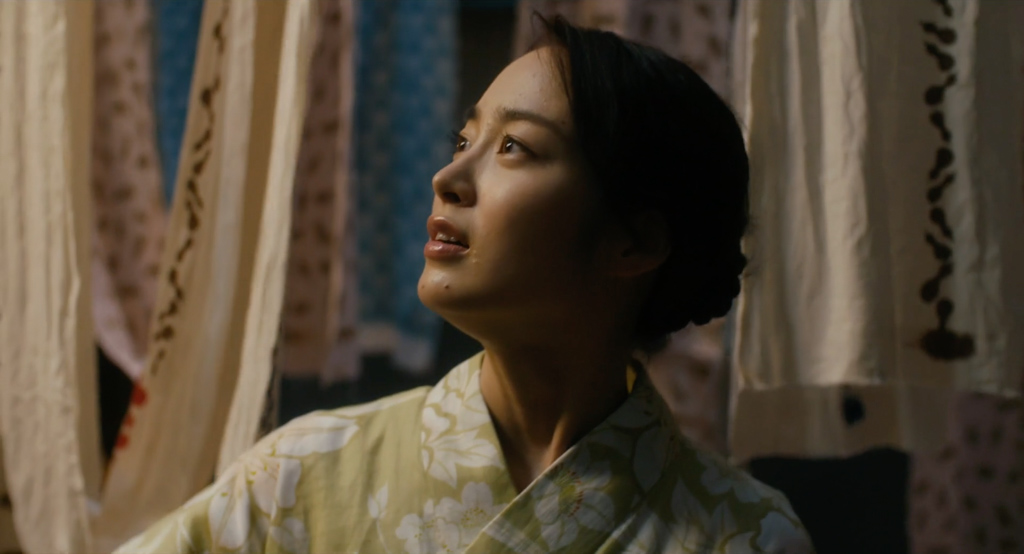
Hatsumi (Asakura Aki) is a 27-year-old former school teacher, who has left education to work at a soba restaurant. Her insular life is interrupted when she runs into a former student – now working as a lounge singer – as well as a local artist with romantic intentions.
Contemporary Japanese cinema is awash with these kinds of modestly budgeted, intimate character dramas. Indeed, there are so many of them released each year that it often takes real innovation for any individual film to stand out from the crowd. In the case of Nakagawa Ryutaro’s Summer Blooms, despite a wealth of other qualities, that innovation simply does not seem to be there. The result is a film that will entertain fans of the genre while making no sort of long-term or broader impact at all. This is forgettable comfort cinema: an entertaining watch while it’s playing, but easily dismissed once done. For English-speaking audiences the film is streaming on Amazon Prime, but it seems unlikely many viewers have even noticed it is there.
The film’s first act is framed around a secret. Hatsumi continues to receive letters in the mail from an ex-boyfriend of three years ago, which clearly cause her some sadness and regret. The story behind the letters is not difficult to guess, and while it does lead to an enjoyable third act it does not seem the mystery can sustain the film for an entire hour and a half. More interesting in the film’s earlier parts is Kawasaki Yoriko as Kaede, the former student who reconnects with Hatsumi in a cinema before ingratiating herself into Hatsumi’s life. She soon reveals herself to be running from an abusive relationship, and the tension between her self-centred motives and what seem like genuine affections for Hatsumi make her the film’s most interesting character. She is marvellously played by Kawasaki too, with an energy that belies her more constrained and anxious co-stars.
Miura Takahiro plays Totaro, a local artist dyeing his own hand towels for an exhibition. He is a regular customer in Hatsumi’s soba restaurant, and awkwardly desires to date her. His fumbling attempts at romantic overtures feel believable and quite a bit endearing, and it is to the film’s credit that the burgeoning relationship does not play out as smoothly or predictably as it often does in these sorts of works.
Summer Blooms is a tonic for viewers who live for quietly understated Japanese character dramas, and enjoy seeing the cultural and physical context of modern Japan. Less enthused aspects of the audience can overlook the film without regrets. It is a decent example of the form, but it is a form about which one can very easily tire. If you think you’ll enjoy it you will. If you are less certain, there is a good chance you can skip this particular example of angst-ridden, manners-driven, romance.




 FictionMachine.
Leave a comment