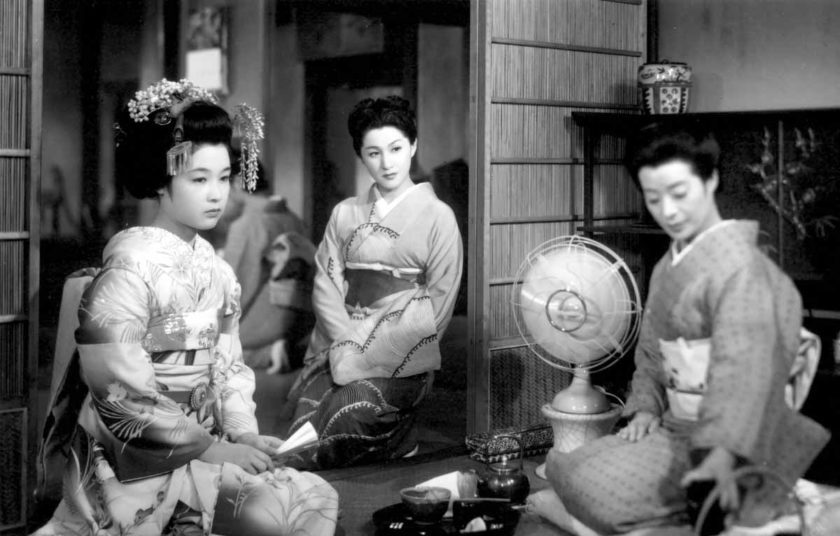
One can always rely on Mizoguchi Kenji, Japan’s mid-century master of the social conscience and the long take, to turn his focus to the plight of working women in a patriarchal society. A Geisha seems a solid case in point: released in 1953 to a post-war audience, it focuses on the travails of two geisha in then-contemporary Gion, Kyoto. Mizoguchi showcases the glamorous side of this entertainment business, and then digs into the unwanted seedy underbelly that belies that dream.
The international image of geisha has been distorted in recent decades by a series of misunderstandings and assumptions. First of all, they are entertainers and not sex workers. Each performer is trained extensively in singing, musicianship, and dance. They are also skilled in conversation and hosting parties, traditionally for a male clientele in tea houses and dedicated venues. There was potentially great social status in being a geisha, as well as a rare opportunity for non-married women to earn their own money.
Mizoguchi’s film, which was written by Yoda Yoshikata and based on a novel, follows 16-year-old Eiko (Wakao Ayako). Her mother has died, her father has abandoned her, and her lecherous uncle threatens to abuse her. She apprentices herself to Kyoto geisha Miyoharu (Kogure Michiyo) in the hopes of finding security, status, and wealth – and Miyoharu invests generously in making Eiko’s dreams come true.
An underlying wrinkle comes to derail both women’s hopes. While a geisha does not have sex with her customers, a geisha with a patron – a wealthy man who underwrites her lifestyle – sometimes does. When both Eiko and Miyoharu are faced with a choice between patronage or destitution, personal honour may become less important than survival. There is a richness in the film’s characters, and a relatively bleak storyline for them to inhabit, but all in all A Geisha is a 1950s melodrama through and through. Such films were hugely popular at the time, and Mizoguchi directs this one with a firm eye on its commercial prospects as much as he does on its social relevance.
Wakao Ayako has an immediate presence and star quality, and it is no surprise that she subsequently worked with several top directors including Ozu, Ichikawa, and Masumura. The best performance, however, comes from Kogure Michiyo. Hers is the stronger character arc, with more observed detail and emotional depth. She gives a sympathetic portrayal, one which accentuates and ably delivers the overall themes of the film.
The film is shot using Mizoguchi’s trademark long takes and melancholic tones. The various geisha characters are superbly dressed and made-up, and inhabit well-staged and arranged sets and locations. Like Mizoguchi’s output generally, it is a subtly attractive work. In many respects one can consider A Geisha the middle part of a loose geisha trilogy, coming as it does after Mizoguchi’s Sisters of the Gion (1936) and before Street of Shame (1956). The director carefully hollows out the geisha dream, and replaces it with sacrifice, turmoil, and sadness. It is all rather tragic, but effectively so – and gripping to watch.
 FictionMachine.
Leave a comment