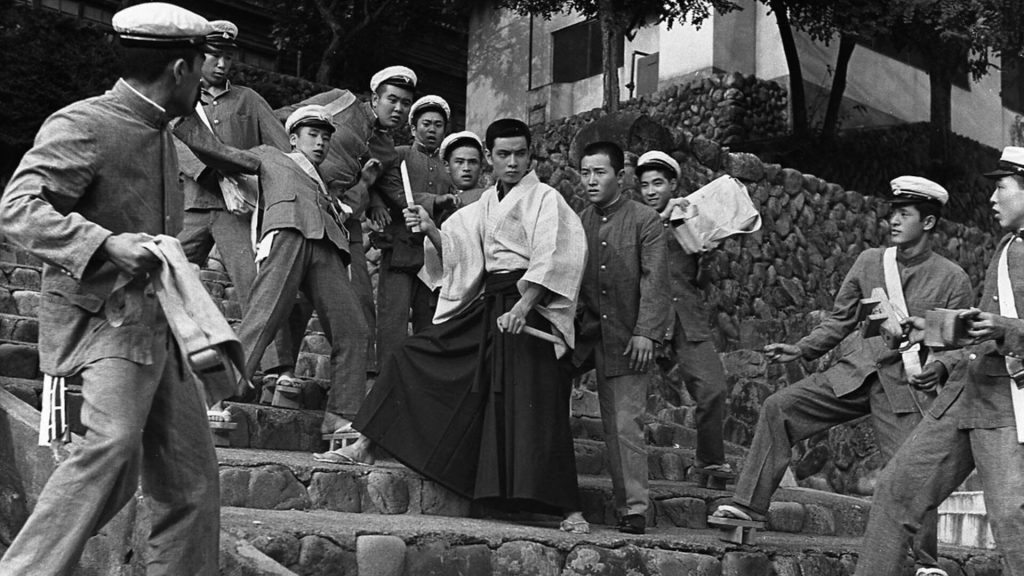
Konno Togo (Yamauchi Ken) is the brash and rebellious son of a Taisho-era noble Japanese family. Expelled from one school due to an affair with a teacher’s daughter, he is dispatched from Kobe to Yokohama at his mother’s behest for a fresh start at a new academy. In between continuing his wayward activities and fighting the self-appointed student morals enforcers, he falls in love with Emiko (Izumi Masako) – the daughter of a local doctor.
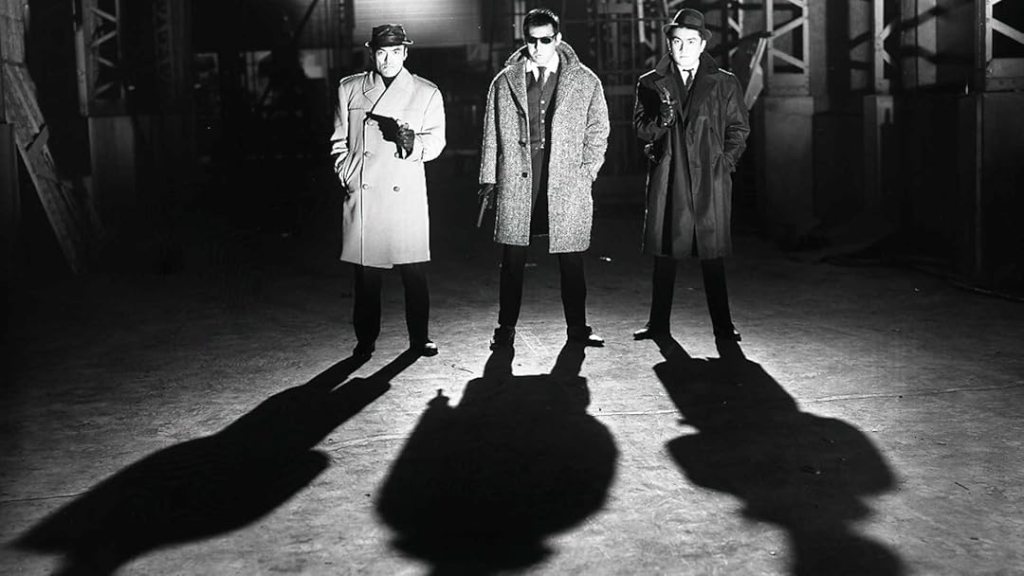
Director Suzuki Seijun is celebrated now as a progressive and boundary-pushing filmmaker of 1960s Japanese cinema. At the time he was much less positively regarded, innovating aggressively in a series of films for the Nikkatsu studio until they finally pushed him out entirely. The Incorrigible, also known as The Bastard, is a transitional work for the maverick director. It comes after his ground-breaking Youth of the Beast (also 1963), but is – all in all – a much less progressive and challenging work. This is effective but relatively standard Japanese melodrama of the time: well shot and performed, but somewhat unimaginative.
Japanese films of the period typically look excellent, thanks to a combination of stark black and white photography and a particularly wide 2.35:1 aspect ratio. It enables even the most formulaic of dramas to appear more dramatic and exciting, and captures the period detail and architecture remarkably. The early 20th century setting adds the benefit of much historical texture. A rising sense of anti-intellectualism is driving local culture sharply to the right, while the balance between traditional Japanese clothing and western attire is still rather contentious. Togo insists on wearing the formal dress of his social class for much of the film, rather than the foreign-looking uniforms of his classmates. His habit of buying and reading literature positively scandalises them: there is no room for art it seems in new century Japanese society.
The love affair between Togo and Emiko seems obviously doomed from the outset, since nobody but them is in any way approving of their friendship. Both actors play their romance with an emotional honesty and a large amount of sensitivity. The screenplay, a somewhat over-familiar affair based on the memoir of Kon Toko, hardly innovates – the weight of the film thus lies on the actors’ shoulders.
Suzuki’s career largely rested among contemporary dramas and surreal crime thrillers, so it is a fascinating exercise seeing him handle such a romantic kind of historical drama. As with all celebrated directors, it is often the less well-regarded and unconventional works that prove the most illuminating. There is a strong visual sense here, and an effective execution of a commonplace genre, that emphasises just how unusual his later, more striking, works would become.

 FictionMachine.
Leave a comment