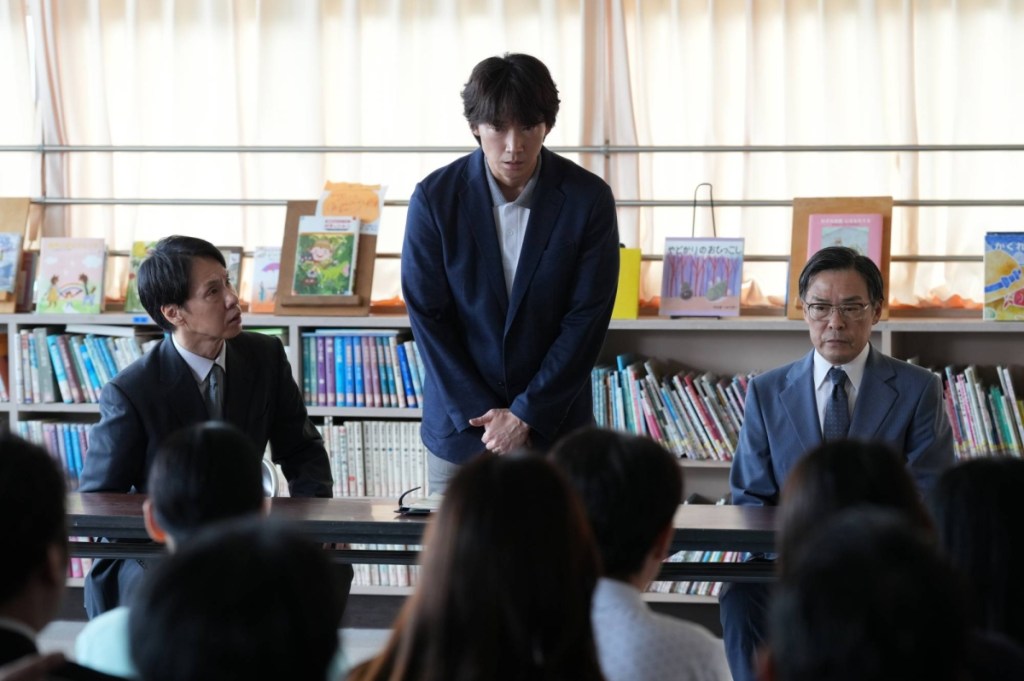
In 2003 accusations that a Japanese school teacher bullied one of their students to the point of near-suicide, an ensuing court case over the incident, and a best-selling book by Fukuda Masumi all became a national sensation – boosted, and to a large degree made significantly worse by, Japan’s prurient news media. That story has now been adapted as a legal drama by director Miike Takashi. For fans of Miike’s legendarily confronting genre works – internationally he still remains best known for Audition (1999) – it might disappoint. For fans of courtroom debate and Rashomon-like uncertainty, it is pretty effective stuff. It also serves as an uncomfortable showcase of crime and punishment in Japan: how the media reports on it, how the accused are treated by the public at large, and how a social drive for order and calm can often do terrible harm.
Teacher Yabushita Seichii (Ayano Go) is accused of bullying, verbally assaulting, and physically abusing his young student Himuro Takuto (Miura Kira). When Takuto’s mother Ritsuko (Shibasaki Ko) arrives at the school to complain, both the administration and Yabushita himself are quick to apologise. When Ritsuko then launches a costly lawsuit, Yabushita immediately changes his story, denying the charges despite enormous pressure from the media, his school, and the broader community.
There is an odd structure to Sham, which spends its entire first act showcasing the genuinely horrible behaviour of a teacher towards his student. It is relentless and cruel, and – when it comes to his physical assaults – pointedly upsetting to watch. Then in the second act, events are played out again and showcase an entirely different story. There, Yabushita is innocent of wrongdoing, and appears to be the victim of a strange attempt to illegally coax out a huge financial settlement. A third act, primarily confined to the courts, sorts out truth from lies and reveals which of the two lead characters to believe.
The structure feels odd because it does not foreshadow events by signalling to their audience that they are going to see two sides of the story. Instead enough time is given to fully investing the audience in Yabushita’s guilt that, when the narrative suddenly switches back to an alternative take, it is initially quite difficult to take the teacher’s protestations seriously.
The performances here are very strong, with key characters playing two versions of their personality and behaviour. The production values are slickly achieved – as is regularly the case with Miike’s more mainstream works – and it is ultimately a very comfortable film to watch. Its key flaw is in its resolution: after doing such a fine job of unbalancing the viewer and bringing each character’s testimony into doubt, everything is distilled down to a final proven truth. That seems rather a shame, since after doing such exceptional work making his audience suspicious and confused Miike simply puts their minds at rest with a tidy, closed conclusion. It is this lack of an open ending that weakens the final film. It is effective enough, and very entertaining, but it is never going to be remembered alongside the director’s more famous works.

 FictionMachine.
Leave a comment