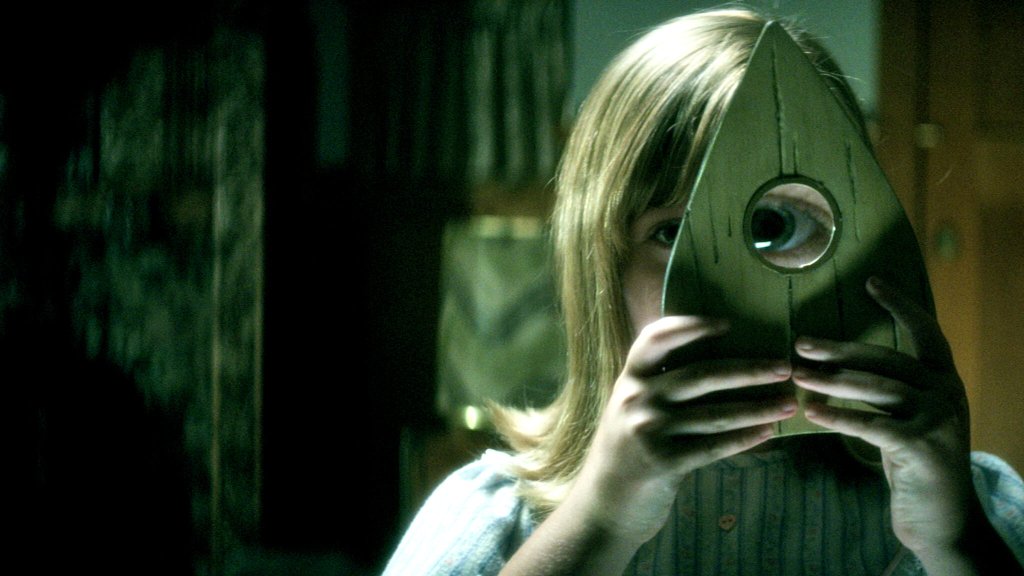
I am usually a fan of Mike Flanagan, whose excellent horror adaptations have included the Netflix series The Haunting of Hill House (2018) and the underrated Shining sequel Doctor Sleep (2019). I also enjoyed his 2013 original horror film Oculus, which despite some flaws indicated a strong developing talent. It has taken me a while to get to his 2016 film Ouija: Origin of Evil, although I had read it was a significant improvement over the 2013 film to which it was a prequel.
That recommendation, in itself, was true: the original Ouija was a tiresome and hackneyed film without much to recommend, and Origin of Evil is certainly a more creatively inspired and solidly constructed work. Despite the improvements, it is still an underwhelming and rather ordinary movie. I did not feel as if my time as a viewer was wasted, but I find I am in no hurry to promote it to others. There are many much better supernatural thrillers out there, as well as much better Mike Flanagan films.
Elizabeth Reaser plays Alice, a single mother and widow who is struggling to get by as a professional medium. Her act, of course, is fake, and aided and abetted by her daughters Lina (Annalise Basso) and Doris (Lulu Wilson). Looking to find a means of enhancing her act, Alice buys a Ouija board game – only to find an otherworldly spirit has taken hold of her younger daughter.
That Origin of Evil bears an onscreen credit to Hasbro for the rights to the Ouija board is a dead giveaway that this is not going to be a particularly inspired work. It simply fails as a convincing set-up for horror, and for what little atmosphere or inspiration the board supplies Alice may as well have purchased a copy of Crossbows & Catapults instead. Take it out, and a particularly derivative and uninvolving possession story remains intact.
By the film’s third act, there is an odd delivery of rather more interesting back story. It is dumped via monologue, indifferent to the old adage of ‘show, don’t tell’, and is a stereotypical case of ‘too little, too late’. It seems the result of two problems: one being an overall sloppy narrative structure, and the other being an apparent hesitancy to push the film too far from being suitable for a teenage audience. There is a valuable place for age-appropriate horror, and it is a space Hollywood has typically not been good at occupying, but the lack of originality here kills this particular attempt.
Performances, which also includes Flanagan regular Henry Thomas, are competent without ever feeling interesting. As it’s written, Lulu Wilson feels a few years too old for her nine-year-old character. Co-star Parker Mack – as Lina’s teenage boyfriend – feels weirdly out of place. A post-credits scene links the film back to its predecessor, but really the whole piece feels self-contained. This is not a bad film per se, but there is little doubting it is a particularly ordinary one.
 FictionMachine.
Leave a comment