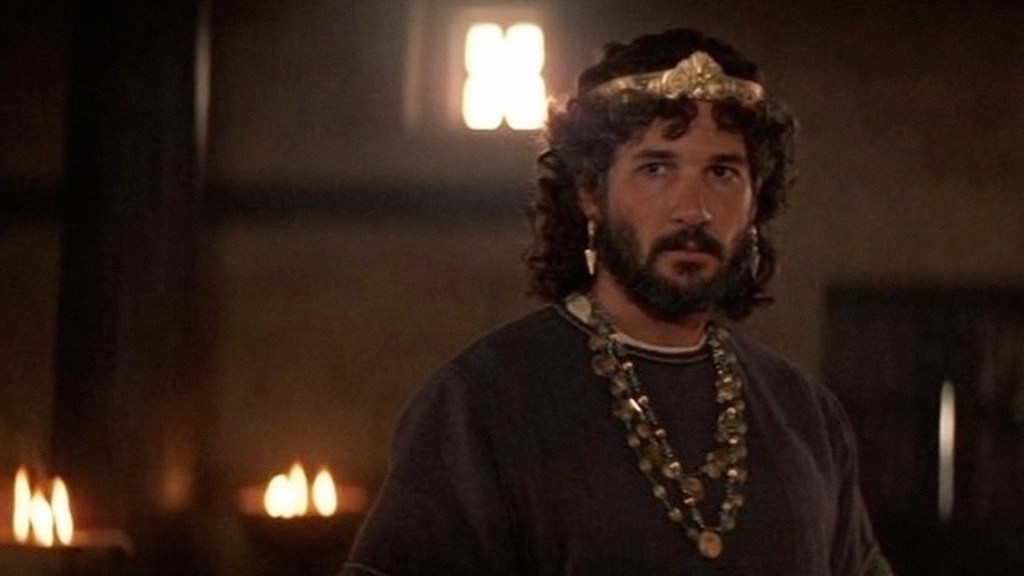
Bruce Beresford’s 1985 Biblical epic King David is often held up as one the 1980s more egregious Hollywood failures, failing to secure a commercial audience nor find favour with critics of the time. I have always felt it to be rather underrated. There is no doubting that it is a flawed work, but when it works it positively shines, and certainly never deserved the widespread drubbing that it received. To a large degree the film feels a victim to the popular culture that preceded it, and at the same time it seems to prefigure better, similar works in the future.
The film stars Richard Gere as David, destined to be the second king of the Kingdom of Israel but hounded by the jealous first king Saul (Edward Woodward). The story is derived from the Jewish Tanakh. Its historical veracity is, for the purposes of the film, somewhat irrelevant to me. I am a sucker for religious epics, and their themes and stories, while remaining largely agnostic in my daily life.
The screenplay, credited to James Costigan and Andrew Birkin (The Name of the Rose), certainly seems packed with stirring events: wars, inheritances, prophecies, and destiny all abound. It takes a long-distance path through David’s entire life – from his youth to his deathbed – with a particular focus on how he and other key characters resist the draw of fate and then consistently fall to it. The structure is decent, but its page-to-page execution has flaws. A reliance on narration pulls the viewer out of its immediacy, and reduces passionate events and confrontations into a rather dry account.
Australian filmmaker Bruce Beresford, who came to King David in the wake of his acclaimed American debut Tender Mercies (1983), presents events with a matter-of-fact style and a more loosened, relaxed delivery than was the trend in earlier religious epics. On the one hand it works brilliantly, transforming thinly drawn, iconic characters into real fleshed-out people. He enables their various quirks, flaws, and personalities to have real depth and emotional consequence. Unfortunately the approach winds up as a double-edged sword in some respects. The blunt, contemporary delivery – once combined with the period costuming – resembles the last time Biblical story was told this way: Monty Python’s Life of Brian (1979). That satire’s keenly observed mockery of genre conventions is like a hand grenade to the genre, making multiple scenes – and any shift towards stereotypes – difficult to treat seriously. It is also difficult to watch scenes of the Ark of the Covenant without thinking of Spielberg’s Raiders of the Lost Ark (1981), which prominently featured the artefact in cinemas just four years earlier. (I am relatively certainly, despite them both being Paramount productions, that King David uses its own prop.)
At the same time, if one can keep Python out of their head for long enough, Beresford’s grounded, humanist approach to religious characters clearly works. In many ways it prefigures Martin Scorsese’s treatment of similar material in The Last Temptation of Christ (1988), and also resonates with Pasolini’s neo-realist The Gospel According to St Matthew (1964). It strikes me as the most sensible approach for a realist medium like cinema: our own feelings cannot necessarily resonate with the divine, but everybody has experience of human nature.
Richard Gere gives a solid performance as David, but by virtue of having the only prominent American accent in the film he tends to stand out in negative ways. For decades Hollywood has trained audiences to expect English accents in period films, even if – as is the case here – the characters would not have spoken English at all. Edward Woodward, in avoiding this issue by virtue of his natural accent, makes a stronger impression as Saul and is a powerful and very charismatic antagonist.
King David is far from perfect, but it is also far from terrible. It received a relatively unfair reception at the time. A new bluray edition, recently released by Australian label Imprint Film, will hopefully go some way to restoring the critical balance.


 FictionMachine.
Leave a comment