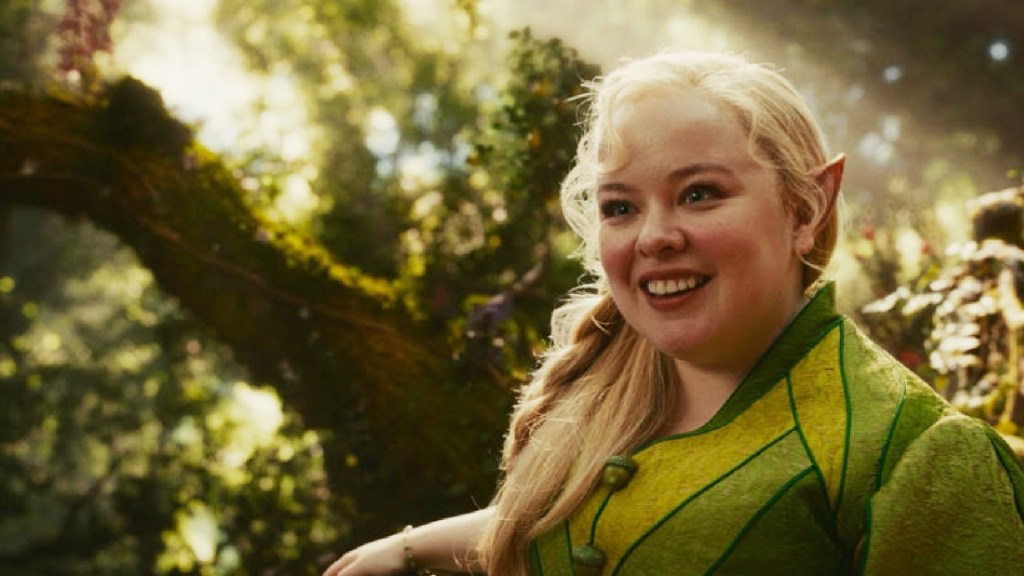
Clearly riding on the back of the hugely successful Paddington films, The Magic Faraway Tree represents another attempt to translate classic British children’s literature to the big screen. In this case, Enid Blyton’s perennially popular trilogy of fantasy novels that have been consistently in print since the first volume was published in 1939.
Siblings Joe, Beth, and Fran are uprooted from their high-technology city lifestyle by their parents (Andrew Garfield and Claire Foy) and deposited into an unwanted life in the English countryside. There they are introduced to the elusive Magic Faraway Tree, and share a series of adventures with its eccentric magical denizens.
I grew up, as I suspect many people in the British diaspora did, on a steady diet of Enid Blyton novels. Her various literary series including The Famous Five, The Secret Seven, Noddy, and others as good as taught the Commonwealth to read. Many of them received successive film and television adaptations over the decades. The Magic Faraway Tree has, until now, not shared in that success, with only a brief 1997 animated series to its name. Now there is a lavish and surprisingly faithful film version hitting cinemas, and if I was still four years old this would be the must-see event of 2026.
The film comes with a script by Simon Farnaby and direction by Ben Gregor. Farnaby is an excellent choice, having co-written and co-performed the TV comedies Horrible Histories, Ghosts, and (crucially) Yonderland, as well as the feature films Paddington 2, Wonka, and Paddington in Peru. It is a tremendous adaptation, both honouring the original works while finding a strong balance of child and adult-friendly humour. It does not reach the heights of Paddington 2 – what does? – but it does present an excellent all-ages fantasy comedy for the upcoming school holidays. Quality family cinema is thin on the ground, particularly of the non-animated variety, and The Magic Faraway Tree deserves every success.
In adapting nearly 90-year-old books, it is understandable that certain adjustments and edits have been made. In this case the film has remained remarkably faithful to Blyton: the key revisions to bring things up to date are identical to those already implemented in modern editions of the book. Siblings Jo, Bess, and Fanny are now Joe, Beth, and Fran, and the villainous Madame Slap is now Madame Snap – with a beautifully self-aware scene openly addressing the shift. Joe and Beth have also been swapped in age; a minor adjustment that improves the character relationships. Billie Gadsdon is a charming Fran, co-stars Delilah Bennett-Cardy and Phoenix LaRoche are no slouches either as Beth and Joe.
Andrew Garfield and Claire Foy bring a lovely sense of warmth as the siblings’ parents. It is often a thankless task playing the grown-ups in a children’s fantasy, but Farnaby’s script gives them some proper material with which to work. The more enchanted variety of characters are wonderfully played and authentically designed, and represent a nostalgic rush to anyone who grew up with them: Nicola Coughlan as Silky, Nonso Anozie as Moonface, Dustin Demri-Burns as the Saucepan Man, and a particularly funny Oliver Criss as Mr Watzisname. There is also a wide array of small supporting roles and cameos for the actor-spotters, including Rebecca Ferguson, Lenny Henry, Simon Russell-Beale, Michael Palin, Mark Heap, Jennifer Saunders, and Hiran Abeysekera.
There is a delightful absurdist streak running through the film, and if it has a key weakness it is that it fails to embrace that absurdism enough. The film seems at its strongest when it reflects Farnaby’s work with the Horrible Histories team, and more of the same would have greatly enhanced an already quite delightful work. All the same, this is the good stuff: rock-solid, rich with appeal, and amusing to children and adults alike.
 FictionMachine.
Leave a comment