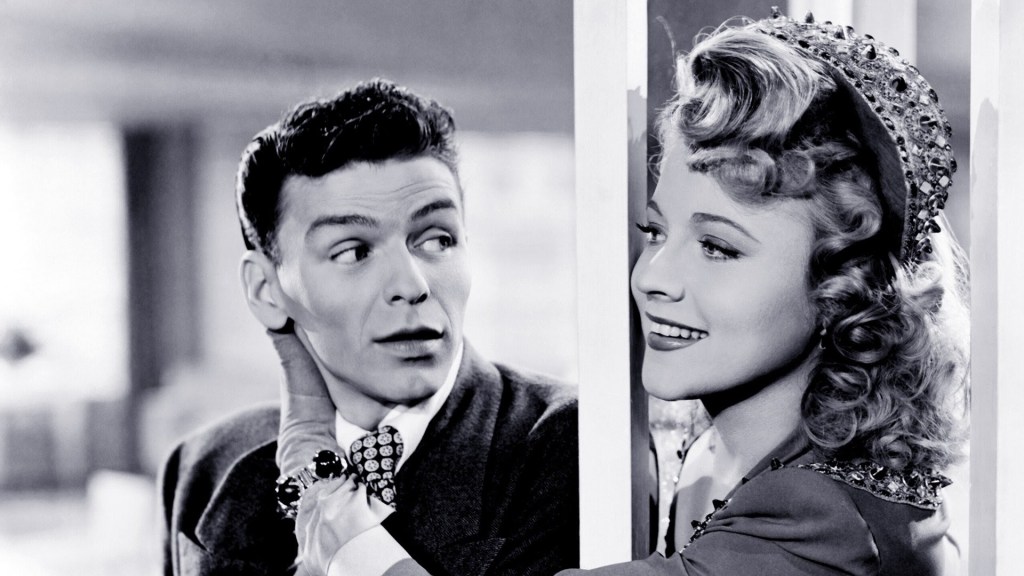
After making a decent impression with audiences in Higher and Higher (1944), Frank Sinatra re-teamed with RKO Radio Pictures and director Tim Whelan to take the lead for the first time. Step Lively, also released in 1944, is a musical remake of the Marx Brothers comedy Room Service (1938). At only six years younger than the film it is remaking, it is a film under great pressure to succeed on its own merits. That it fails to do so is why I strongly suspect most readers have never heard of this film before – despite being Sinatra’s debut as a lead actor.
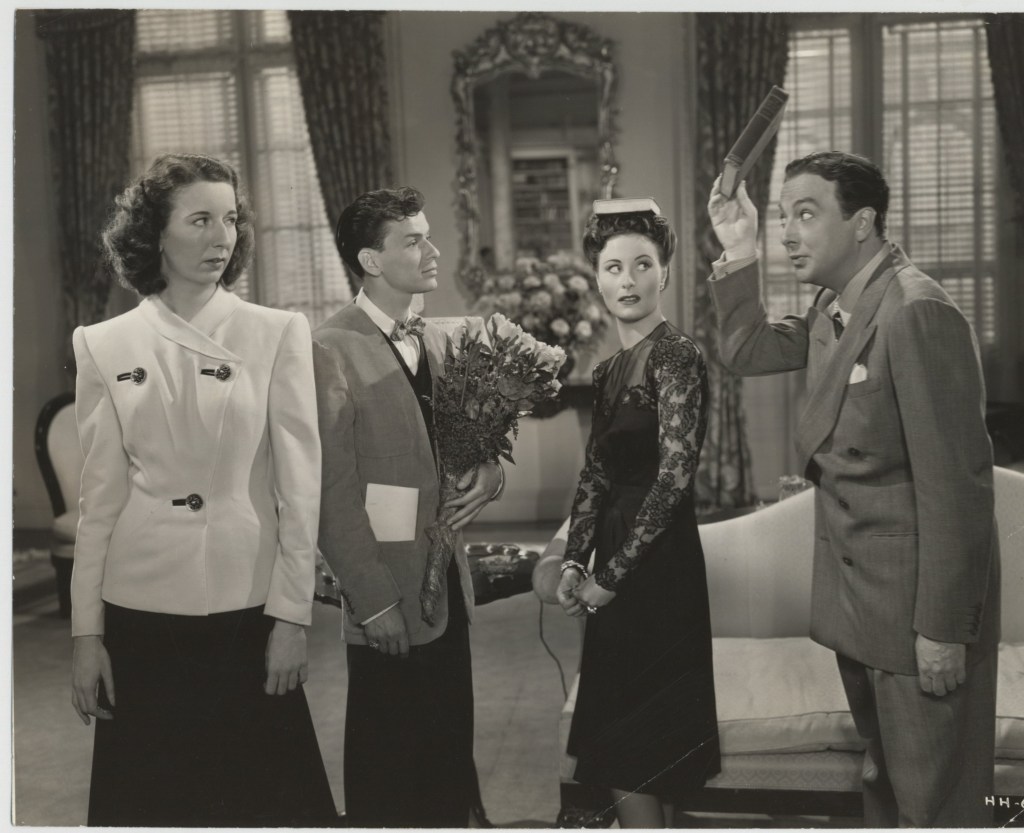
Unprincipled theatre producer Gordon Miller (George Murphy) is attempting to mount his latest production while defrauding his hotel manager brother-in-law (Walter Slezak) out of free accommodation and meals for his entire cast. When playwright Glenn Russell (Sinatra) arrives in town to find out what has happened to his play – which Gordon convinced Glenn to invest in despite never staging it – Gordon think he has found the perfect star for his new musical venture.
There is a very quick way to review Step Lively, which is to note that it is a musical comedy where the songs are unmemorable and the comedy isn’t funny. George Murphy is no substitute for Groucho Marx. Sinatra, while a sensational singer, can only perform the songs that are given to him. Female lead Gloria DeHaven is game and appealing, but does not get much agency or things to do.
There are two particularly grating parts to the film. The first is that everybody keeps shouting all of the time, as if their key direction from Whelan was that the jokes would be funnier every time if they were recited faster and more loudly. It creates a rather frantic, breathless sensibility where subtlety does not exist and comic timing has been thrown out of the window. The pacing was a problem with Whelan in Higher and Higher, but the volume is a new problem and an absolutely comedy-killer.
The second grating element is the character of Gordon Miller. There is a long, rich tradition of fraudsters and rogues in Hollywood comedy, and plenty of examples where such characters can misbehave and show off some sort of ultimate integrity or charm. Miller is granted none of this. He lies to his investors, and he lies to his talent. He relentlessly and unashamedly manipulates strangers, friends, and family to achieve his own ends, and there is no noble goal in the end or any sort of come-uppance or justice for his criminal behaviour. George Murphy does not provide much charm himself, and seems content to let the screenplay fail to do the heavy lifting all on its own.
The musical sequences are relatively ordinary: no one is a particularly gifted dancer, and the climactic theatre show relies more on simple visual effects than interesting stage work. It even gets moderately racist for one particular number, which is often par for the course for old cinema. Here there is nothing to compensate or draw the viewer’s attention.
As for Sinatra, he has presence and charm. He is still being cast as a rather unconvincing ‘good guy’, without the more late night rakish charm that he would perfect in years to come. In Sydney, Australia, this film caused a riot when it premiered; a couple of hundred Sinatra-haters turned up at the Empire Theatre to harass and intimidate his fans. Sadly that incident is almost certainly the most interesting thing about Step Lively. It is unfunny, underwhelming, and dull.


 FictionMachine.
Leave a comment