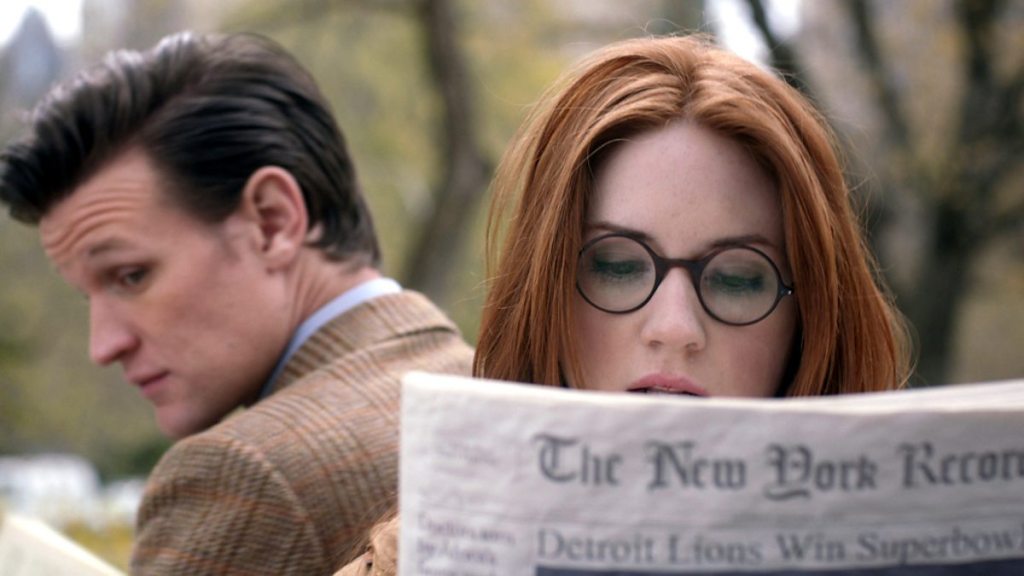
First broadcast 29 September 2012.
This is a review of two episodes of Doctor Who. One of them is extraordinary, a collection of brilliant ideas that rank among the very best the series has ever had. They comprise great science fiction and great horror. Put into the right narrative, and these ideas might even have made one of the best-ever episodes. Sadly this is a review of two episodes, and the other is the episode that was actually made. “The Angels Take Manhattan” contains many moments that are brilliantly conceived and staged, but there are also parts that simply do not work. The end result is maddening and frustrating, and one of the most obvious examples of how 21st century Doctor Who struggles to fit into self-contained 45-minute episodes.
The Weeping Angels, introduced back in the 2007 episode “Blink”, were the first – and, to date, arguably only – new series monster to hit the sort of public attention and pop culture status enjoyed by the Daleks and the Cybermen. Their appeal rested in their basic premise: a statue when you looked at it would turn into a fanged homicidal creature when no one was looking. It was in essence the schoolyard game “What’s the Time, Mr Wolf” (aka “Grandma’s Knock”) transformed for science fiction. No wonder younger viewers enjoyed them so much; they were hand-built to be playground game.
The Angels’ second storyline, 2010’s “The Time of Angels”, did a fair amount to water down their effectiveness. In “Blink” all they did was zap their victims back in time a few decades, and feast on the resulting energy. In “The Time of Angels” there was a lot less time zapping and a lot more snapping necks: scary, certainly, but also something of a rule break that damaged the Angels’ purity. Here in “The Angels Take Manhattan” there is a genius progression of the Angel’s original purpose: kidnapping people, zapping them back in time, and then imprisoning them in a hotel so that you can zap them back all over again. It is a brilliant development that builds logically upon Steven Moffat’s original premise, and what is more it is the perfect blend of science fiction and horror that so often represents Doctor Who at its best.
Had Moffat’s script stopped there, it could have been fantastic. Unfortunately he also incorporates cherub-like baby Angels that fail to serve a narrative purpose, River Song (Alex Kingston) pointlessly in hard-boiled detective mode, and most egregiously of all the Statue of Liberty reimagined as a giant Angel.
The last one is genuinely goodwill-breaking, and impossible to take seriously. Each successive time I have revisited the episode the stupider it has felt, and sacrifices so much decent material in the name of a goofy moment. There is no logical way that the idea works, and no real purpose in the story to it happening. Nick Hurran does his best directing it all, but he’s working against some pretty dreadful stuff.
Of course the episode also waves goodbye to Amy (Karen Gillen) and Rory (Arthur Darvill) after two-and-a-half seasons in the show. That makes them the longest-running companions of the new series to this point, and their departure leaves a big gap to be filled during Season 7’s back-end some months later. It is a decent departure: emotional and well-developed, with none of the abrupt, narratively weak elements that typified companion exits in the old series.
It is all such a frustrating mixture of the very good and the fairly bad. From here, Season 7 takes a break – 2012 Christmas special notwithstanding – before returning in “The Bells of St John” in March 2013.
 FictionMachine.
Leave a comment