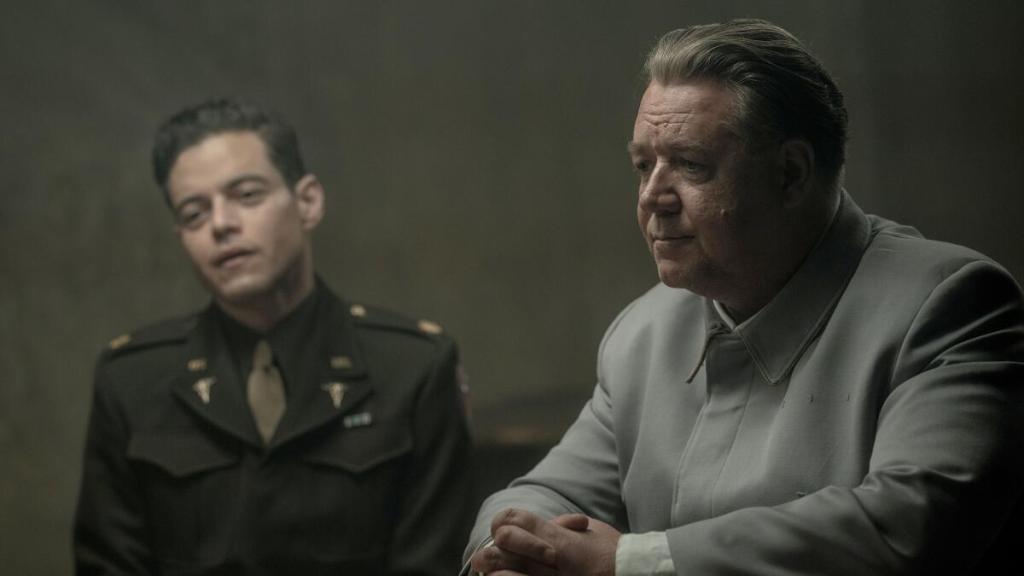
James Vanderbilt, who wrote the screenplay to Zodiac (2007), has now written and directed the historical drama Nuremberg (2025). It actually makes a lot of sense, and I feel one can sense both films are by the same hand. Both are long, serious films about terrible people doing terrible things, and both possess characters looking for something for something mythic and evil but simply find banal human nature instead. Comparing Nuremberg to Zodiac does the former film few favours, since Zodiac is honestly a rare five-star masterpiece of 21st century and Nuremberg is “merely” very good – but it is very good and deserves to find a large audience.
In the immediate aftermath of World War II American psychiatrist Douglas Kelley (Rami Malek) is assigned to conduct psychological tests on nearly two dozen former members of the Nazi high command, to determine if they are fit to stand trial for war crimes. While preparations are ongoing for the unprecedented Nuremberg war trials Kelley finds himself drawn to Hermann Göring (Russell Crowe), the narcissistic second-in-command of the entire German government.
This is not the first film made regarding the Nuremberg war trials, and I have no doubt there will be others in future. 30 years ago this sort of showy, star-studded prestige drama was commonplace, but with American cinema having long since bifurcated into very expensive films and very cheap ones Nuremberg now feels like something of a rare delight.
The film centres on Russell Crowe’s showy and flamboyant performance as Göring, which is well-matched to the slightly heightened and theatrical tone of Vanderbilt’s screenplay. To be honest there is nothing too surprising in Göring’s one-on-one debates with Kelley; simple rock-solid theatre played out between Crowe and a capable, appealing Malek. The real highlights of the film largely come in the small details: a running thread about sleight-of-tricks, Michael Shannon drinking from Richard E. Grant’s teacup in court, and a superb pre-climactic monologue by Leo Woodall. It is in the smaller, more intimate moments that Nuremberg excels, and which drag it from competent-but-common courtroom drama to something a little more complex and insightful.
Midway through the film, viewers are exposed to genuine documentary footage of Nazi concentration camps; the same footage screened to the real participants of the Nuremberg trials in 1945. It is palpably confronting footage, and very difficult to watch, and does raise the question of whether such scenes should be incorporated into what is ultimately a work of popular entertainment. Personally I am of the opinion that such blunt, direct representations of the Holocaust are not just acceptable but necessary: we should never allow it to be sanitised, softened, or otherwise diminished by skirting the full horror of what occurred. Viewers should, however, be aware that the footage is there as it is deeply upsetting to watch.
It also aggressively reshapes the film’s attitude to its villain, Reichsmarschall Hermann Göring. At first he seems almost mythic in stature, and the subsequent inclusion of his loving wife (played well by Lotte Verbeek) and daughter goes to unexpected lengths to humanise him. Scenes from the concentration camps snap the audience forcibly into Göring’s nature as a genuine monster. By the film’s end he is all of those things, but most of all Vanderbilt positions him as an ordinary person – and that is the ultimate lesson of his film. The Nazis did monstrous, inhuman things, but they were still humans – ordinary, banal, and ultimately pathetic. We could all, if pushed enough or enticed sufficiently, be Nazis. It’s a potent lesson, and considering the current events around the world, a timely one as well.

 FictionMachine.
Leave a comment