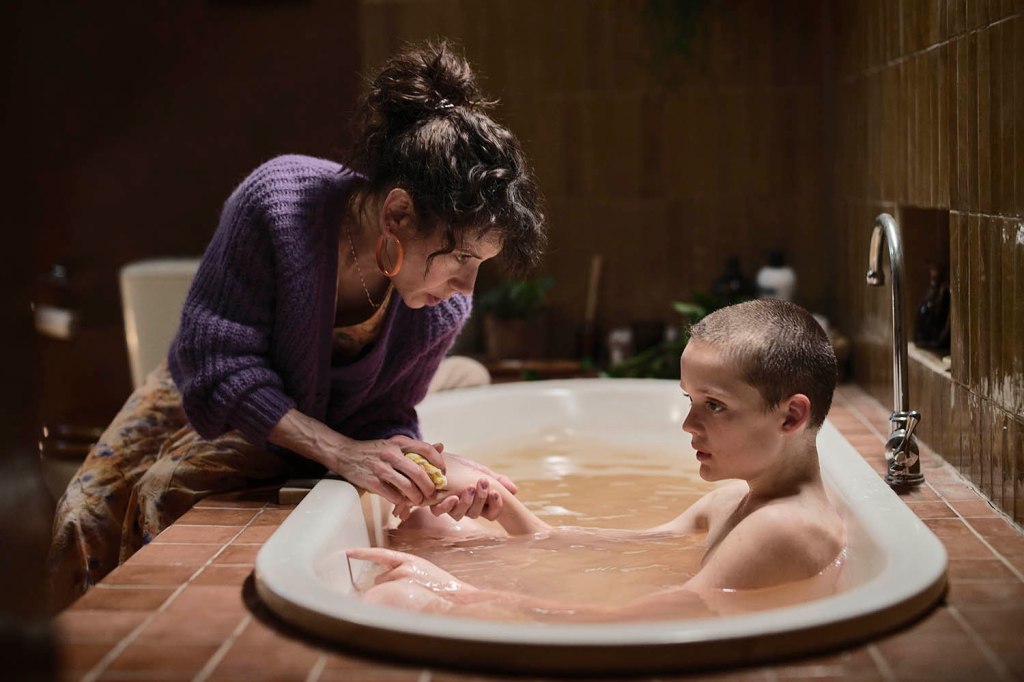
Danny and Michael Philippou’s sophomore horror film Bring Her Back (2025) suffers quite a touch of “difficult second album” syndrome. It is rich with concepts, innovatively staged and shot in places, and grounded with some strong lead performances. At the same time it is plagued by a few maddening narrative and performance choices, and lacks the crisp clarity of its predecessor Talk to Me (2022). In its own right it is decent enough; as a follow-up to a wide international success its only recourse is to disappoint.
When their father unexpectedly dies, orphaned step-siblings Andy (Billy Barratt) and Piper (Sora Wong) are moved into foster care with gregarious counsellor Laura (Sally Hawkins). The longer the stay, however, the stranger their new home becomes due to Laura’s increasingly erratic behaviour and the disturbing nature of her non-verbal existing foster child Oliver (Jonah Wren Phillips).
It takes a while for Bring Her Back to settle down from a string of short, low-context introductory scenes, and that has an effect of putting the story slightly off-balance for the first act of the film. It is somewhat difficult to make sense of the multiple prologues, or to get answers to obvious questions during this introductory phase. When things start to develop in unsettling ways, there has not quite been enough time for the audience to settle into Andy and Piper’s situation or to accept Laura as a trustworthy character.
Barratt and Wong play their roles decently and are immediately sympathetic and believable. It is a credit to the Philippous that they cast a vision-impaired actor (Wong) as a blind character, and that they subsequently give that character with disability a strong sense of purpose and identity. They also utilise her blindness to accentuate some of the film’s more suspenseful moments; it is a great example of how to properly incorporate such a character sensibly into a film.
Sally Hawkins plays Laura with a very convincing Australian accent, and a heightened sense of delivery. The former is impressive; the latter makes the character something of a struggle. There is a long history of mentally disturbed mother figures in horror, and not all depictions have been positive. Hawkins is not helped by the film’s screenplay, which forces the character toward some rather unconvincing behaviours. In a more over-the-top sort of a film, she may have worked a little better. Sadly in this particular set-up she feels more exaggerated and silly than anything else.
Her slightly cartoonish portrayal jibes in particularly against the more confronting moments of horror. Key scenes of bloody violence are visceral and confronting, and seemingly intended the make the viewer physically flinch from disgust or alarm. The key problem with Bring Her Back is that it seems intent on becoming different styles of horror movie at the same time; the bleaker, harder-edged stuff works brilliantly, but other parts do not meet the same standard. The jump from one to the other weakens the finished work.
Bring Her Back is ultimately satisfying to watch in broad terms, but it suffers repeated small failures that prevent it from succeeding completely. It is another worthwhile addition to Australia’s growing library of screen horror, but compared to Talk to Her it simply fails to fulfil its potential.


 FictionMachine.
Leave a comment