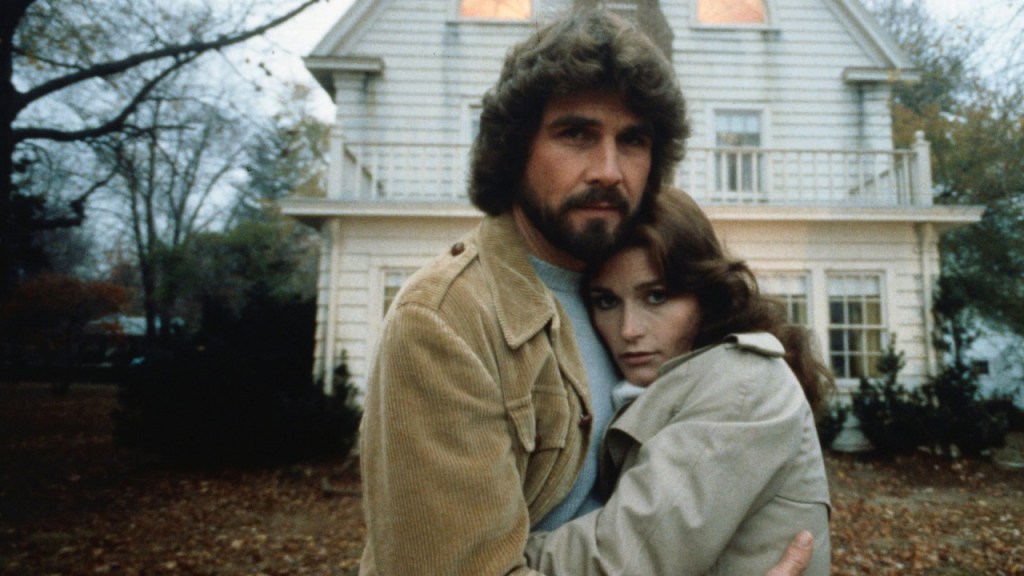
It is true that, in late 1974, 23-year-old Ronald De Feo shot and killed his family inside their home in Amityville, New York. What is almost certainly not true is that the Lutz family, who moved into the house a year later, were actually tormented by an evil presence that forced them to leave in the middle of the night and never return. Their claims were detailed in Jay Anson’s book The Amityville Horror in 1977, and it was adapted into an independent film in 1979. The film capitalised heavily on the ‘based on real events’ schtick upon release, in much the same way the 21st century Conjuring franchise would later do (the Amityville house even turns up in The Conjuring 2).
Ignore the silly attempts at faking a true story, and Amityville is an effective and oftentimes scary haunted house thriller. It features rock-solid performances as well as effective direction by Stuart Rosenberg, and it influenced a whole generation of similar horror films. It also derives as much as it inspires, taking as much of its form and style from Friedkin’s The Exorcist (1973) as it does from Anson’s book.
George (James Brolin) and Kathy Lutz (Margot Kidder) and their three children move into a large waterside home in Amityville. Within days of their arrival they are afflicted by illness, are witness to supernatural phenomena, and George begins to act in weird and antisocial ways. Meanwhile Kathy’s priest Father Delaney (Rod Steiger) struggles against invisible forces to warn the family of the impending danger to their lives.
Many, including horror author Stephen King, have noted Amityville‘s constant concern about money, the cost of buying a house, and other financial stresses. The film was released during a cost of living crisis in the USA, and does seem – intentionally or otherwise – to reflect growing social concerns through a horror lens. The film also rides a decade-long wave of religious horror, notably preceded by The Exorcist and The Omen (1976), and reflects a broader social anxiety about the shape of the American family and the role of organised religion – particularly Catholicism – in guiding it. Rod Steiger presents a passionate and emphatic presence as Father Delaney, and it is somewhat innovative that his story largely runs separate to the Lutz’s for the majority of the film.
The horrors of the De Feo house are, by comparison to later haunted house films, rather underplayed. That works to the film’s benefit, turning it into a gradual slow burn of phenomena rather than a shock-a-minute extravagance. The film’s best moments of horror play out more effectively as a result. Lalo Shifrin’s musical score is atmospheric and effective, and aids in the film’s general sense of realism. The Lutzes feel like real people, and the various shocks and scares are largely modest enough for an audience to almost believe they might have happened.
A long string of sequels and unofficial cash-ins followed, cemented the Amityville haunting as an iconic part of American horror film. One can point to its influence over a range of films, notably The Conjuring but also Poltergeist (released three years later), House, and all of their various sequels. Even The Blair Witch Project (1999) exploited the whole “based on a true story” motif for marketing purposes.
The publicity – not to mention a general disdain for horror among 1970s critics – muddied the waters regarding The Amityville Horror, and arguably prevented it from being judged on its own merits at the time. Subsequent audiences have reclaimed it as a minor classic, which may be over-egging things somewhat, but it is all-in-all an effective and very watchable supernatural thriller.

 FictionMachine.
Leave a comment