Kiah Roache-Turner has comfortably established an impressive niche as Australia’s resident source of pulp genre entertainment, by directing a string of films including Wyrmwood (2014), Nekrotronic (2018), Sting (2024), and now shark-war mash-up Beast of War (2025). Each film takes good advantage of modest budgets to produce the kind of popular fare we haven’t really seen in Australia since the tax break driven heyday of the 1980s.
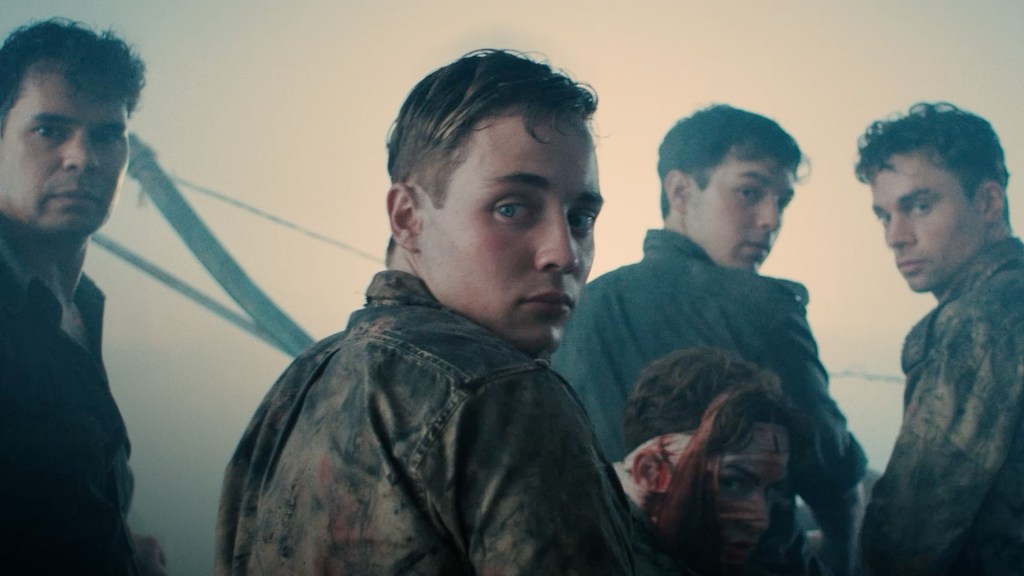
In Beast of War, an Australian warship is sunk in the Timor Sea during the Second World War. The survivors band together on the floating wreckage and wait for rescue, but they are soon targeted by a rogue great white shark. The concept is simple, easy to sell to an audience, and it unfolds in a brisk and efficient 83 minutes. This is a film that does precisely what it claims to do, which is an approach I will always appreciate.
Mark Coles Smith shows off a genuine matinee idol vibe as Leo, an indigenous soldier in the Australian armed forces. The film uses the character as its viewpoint throughout, and the thriller framework allows the film to offer up the experience of Aboriginal servicemen – there is a lot of racism and prejudice, as one might imagine – in the context of populist entertainment. While foregrounding the character gives the film a distinctive texture, it does sit well behind the main purpose: blood, gore, and suspense at the hands of a monstrous great white.
It is a tremendous great white as well, with clever photography and a surprising amount of physical puppetry to bring the animal to life. Movies about humans menaced by sharks are a dime a dozen these days, and in a crowded market Roache-Turner should be commended for doing such an effective job. Part of the trick in writing and directing these sorts of limited location survivor thrillers is knowing how to get the most varied action out of such a confined environment, and in this regard Beast of War succeeds as well.
There is a solid supporting cast here, who help enliven events with an unexpected amount of humour and a strong Australian flavour. It is these modest additions throughout the film – the war-time setting, the humour, the innate Australian-ness – that help to make the difference. Beast of War tells a very familiar story with a lot of familiar techniques and moments, and this is where each small innovation can make a difference. Pulp, in the end, is rarely about what is done. Instead its success almost always relies on how it is done. Roache-Turner ensures there is plenty to enjoy here, over and above the vicarious thrills of watching characters avoid being eaten.
Films like this are rarely going to win widespread critical acclaim, or be showered with awards. They have a crucial role in Australia’s film landscape, however, because they ensure local content remains seen in cinemas and more often on streaming platforms. This is enjoyable B-grade entertainment with a distinctive local flavour. There have been plenty of shark movies in recent years, but none that have felt quite like this one.




 FictionMachine.
Leave a comment