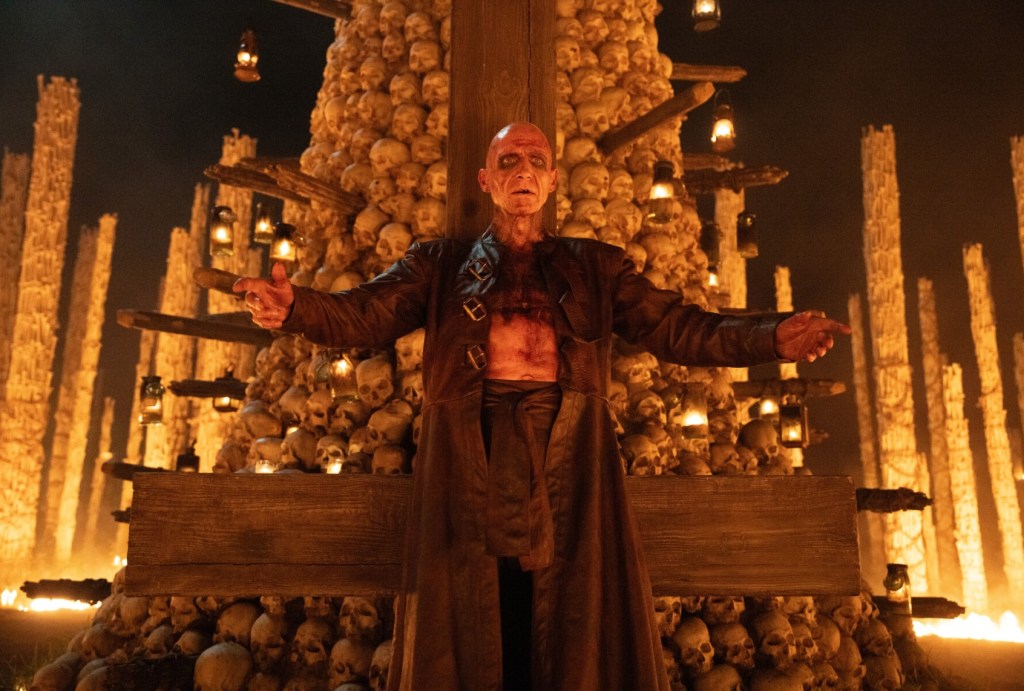
Nia DaCosta takes over from Danny Boyle to direct The Bone Temple, the direct sequel to 2025’s 28 Years Later. This new film could not exist without last year’s effort, and yet it improves on it in pretty much every respect. There is still a final instalment to be made and released, but for now this is the best of the entire 28 Days Later franchise. If DaCosta was not already on your radar of directors to follow, she absolutely should be now.
28 years after the rage virus decimated the United Kingdom, Dr Ian Kelson (Ralph Fiennes) continues to live a solitary life near the Scottish coast. Through encounters with a rage victim that he has named Samson (Chi Lewis-Parry) he grows closer to discovering a treatment – and perhaps even a cure. Meanwhile young runaway Spike (Alfie Williams) is trapped within a gang of murderous outlaws, led by the maniacal Sir Lord Jimmy Crystal (Jack O’Connell).
One of the recurring themes of the 28 Days Later franchise has been the human tendency for violence and cruelty whenever the guard rails of social order break down. It is evident from the very first film in the series, which features Christopher Eccleston as the leader of a rogue group of soldiers who have freely resorted to rape and murder to keep their morale in shape. In the sequel 28 Weeks Later we see the military firing on civilians, and in The Bone Temple we finally see this violent behaviour reach a particularly brutal extent.
Sir Lord Jimmy Crystal is a masterpiece of villainous characters. A child when civilization collapsed, half-remembered detail of his youth have mingled with growing mental illness to create a riveting monster. The son of a parish vicar, he now claims to worship the devil while styling himself after 20th century entertainer and monstrous paedophile Jimmy Saville. He commands a small group of bizarre wig-wearing teenagers, each then deeply damaged in their own way, and conditioned and bullied into horrifying acts of torture and murder. Their actions go far beyond the horrors of the infected, and The Bone Temple goes to surprising lengths to re-envisage the infected as genuinely tragic victims. Jack O’Connell is tremendous as Jimmy Crystal, and his work is even more impressive when you compare it to his turn as an entirely different style of villain in Ryan Coogler’s Sinners (2025).
O’Connell’s performance is one among several outstanding examples in the film. Ralph Fiennes continues to demonstrate his status as one of the UK’s most talented and accomplished actors, and shapes Dr Kelson into a brilliant combination of humour and sorrow. Chi Lewis-Parry is excellent as the powerful, largely non-verbal Samson. Alfie Williams continues his strong work as Spike from the previous film. Erin Kellyman and Emma Laird both deliver huge creative dividends among Jimmy’s nightmarish gang of killers.
The film runs a tremendous line in corrupted and broken nostalgia, with characters referencing half-or-entirely forgotten pop culture from before civilization’s collapse. Popular music plays a surprising and integral part too, in a manner best seen for yourselves – particularly in the film’s astonishing climax. It is a powerful and immediate method of showcasing just how society has fallen apart, and arguably more effectively than the lacks of cars or trains, or a functional government.
The original 28 Days Later was essentially a shameless riff on John Wyndham’s The Day of the Triffids. 28 Weeks Later was an apocalyptic thriller. 28 Years Later traded in post-apocalyptic drama. Now The Bone Temple, more than anything else, trades in tragedy. It presents a mournful picture of what has been lost, what was forgotten, and what might never be found again. I’m sure it is no coincidence that it centres on Kelson’s massive ossuary of bones. In the hands of DaCosta and writer Alex Garland, this film transcends the original format and narrative thrust of the 28 Days Later series. It is powerful, exceptionally well-crated cinema.
 FictionMachine.
Leave a comment