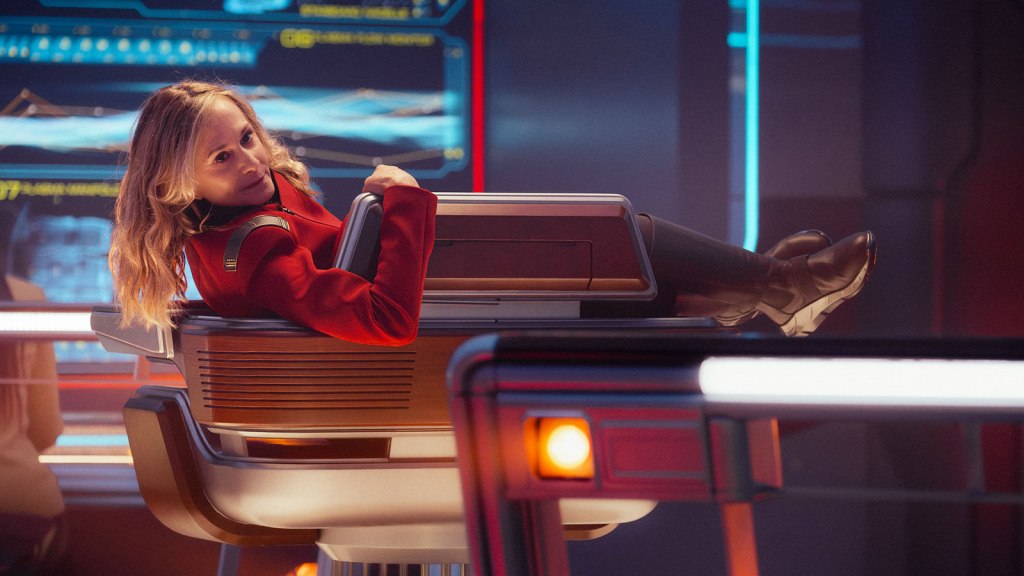
First broadcast 15 January 2026.
It is quite the revelation to realise that Starfleet Academy, which premiered this week on streamer Paramount+, is the twelfth series iteration of Gene Roddenberry’s Star Trek. It is even more surprising when you realise that, despite the franchise celebrating its 60th anniversary this year, half of those 12 series premiered in the past eight-and-a-half years.
This latest iteration is essentially a follow-up to Star Trek: Discovery, which ran for five seasons between 2017 and 2024. That series concluded in a far future setting of the 32nd century, and it is here that Starfleet Academy kicks off. The galaxy is still recovering from an epoch-ending disaster known as the Burn, but legendary space force Starfleet is on the mend and reopening its San Francisco academy for business for the first time in a century.
Starfleet Academy was mentioned all the way back in the original Star Trek. It was first mooted as a location for a prequel film back in 1989, following the tepid audience response to Star Trek V: The Final Frontier. The idea always seemed to have inevitable limitations: a young cast, a largely Earthbound setting, and a much lower sense of importance compared to proper Starfleet vessels out on duty.
To the great credit of creator Gaia Violo and producers Alex Kurtzman and Noga Landau, some very clever ideas have overcome a lot of these limitations. The post-disaster setting is a master stroke: there is an urgency to training new recruits because Starfleet is so short on personnel and the galaxy of the 32nd century is so politically unstable. That also ups the sense of importance: the cadets’ activities matter more because they are much more likely to get pulled into service. Finally – and this is the real killer idea – the physical Academy complex is a literal starship that lands in San Francisco, and then takes off into space for training missions. It is ridiculous, and rather silly, but importantly it is knowingly silly.
The more light-hearted tone is refreshing to watch as well. It benefits from having a sense of humour as well as generally fun tone. Is it perfect? Definitely not, but it is always nice for a series to actively want its audience to have a good time.
There are already some immensely likeable characters on offer, starting with Holly Hunter as Captain Nahla Ake. Hunter is something close to a national treasure of American cinema, and it is remarkable that Paramount and CBS Studios managed to lure her into a science fiction series like this. She plays her character with a warm and irreverent edge – I’m already adoring the way she perches in her captain’s chair – and a distinctly different approach to her various predecessors.
Robert Picardo returns as Star Trek: Voyager‘s emergency medical hologram, clearly much older and a little wiser. It is a pleasure to see him back. Gina Yashere plays half-Klingon half-Jem Hadar first officer Lura Thok, who has promise but needs to lower her energy levels somewhat for the long term. Similarly over-the-top is Paul Giamatti as the gregarious space pirate Nus Braka, who gets to be just a little more fun than Thok and therefore less in need of toning his act down.
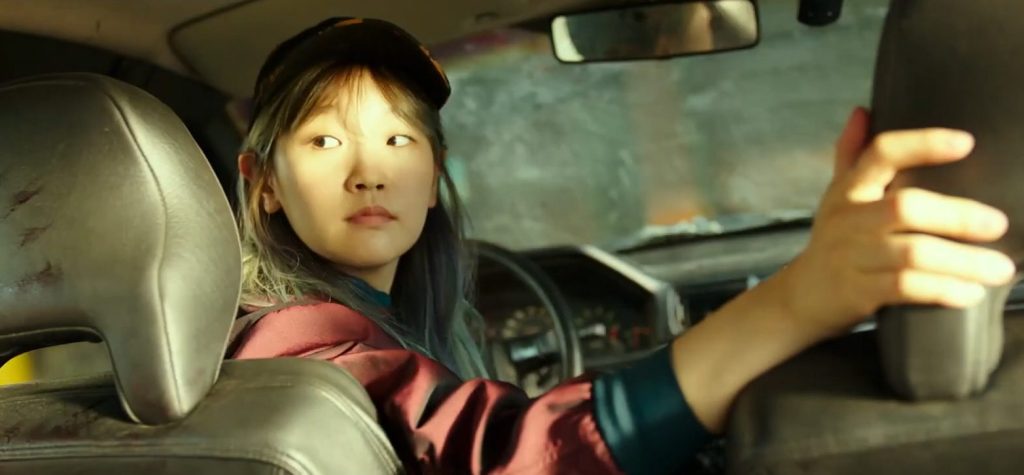
I think the cadets themselves were always going to be the more difficult proposition, and from one episode it is rather difficult to tell how each of them will work out. Hopefully each will get time over the forthcoming season to better establish themselves. One thing is for sure: they all do swear a lot more than previous Star Trek characters ever did. I think it is intended to make the series feel a little edgier. In practice it feels like old-school BBC children’s drama Grange Hill, where every attempt to give its characters an edge came off as rather naïve and sweet. It really does make you want to ruffle the cadets’ hair.
Production values are, of course, well-budgeted. The series design work is of a very high standard. Long-term fans of Star Trek will likely adore the various franchise references and details (check the academy’s honour wall to see what happened to Ensign Harry Kim), which for the less obsessive simply add a lot of intricacy and colour.
The purpose of a first episode is to introduce the concept and the characters, and entice the viewer to watch the second episode. While Starfleet Academy does struggle a little with that middle requirement, it certainly seems a success on the other two. I really hope it keeps its sense of fun.
 FictionMachine.
Leave a comment