Alex Garland is one of my favourite filmmakers at the moment, whether through his own films or his multiple screenplays for other directors. Of all the science fiction and horror films coming out this century, Garland consistently seems one of the most interesting. Whether through 28 Days Later, Sunshine, Dredd, Ex Machina, Annihilation, Civil War, or others, he seems to regularly present interesting ideas in very interesting ways.
Men (2022) is almost certainly his most divisive film to date, which to an extent is a polite way of describing something largely disliked by audiences. To an extent Garland is to blame for this: saddled with a needlessly provocative title and an apparent sheen of egregious ‘mansplaining’, the film comes close to writing its own negative reviews. Life for the modern woman is depicted as a patriarchal nightmare of mistrust, blame, and obsessive stalking. The film ostensibly reeks of a middle-aged man wisely nodding, offering up a literally naked portrayal of sexual harassment as if any woman watching does not already know anything he is going to say. It is a common criticism of Men, and to a large extent an understandable one. At the same time it also seems a partially limited one, since it’s reasonably clear that what Men appears to be and what it actually is are two different things. I came to Men for Garland’s strong reputation, but I stayed for the eerie and effective folk horror.
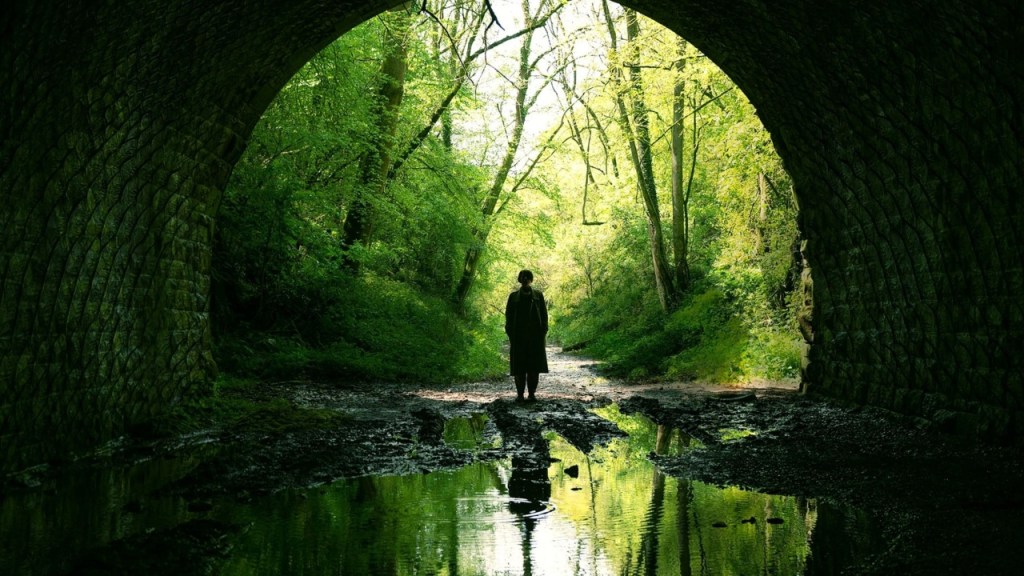
Harper Marlowe (Jesse Buckley) books herself into a spacious country house in Herefordshire. To a large degree it is a place for her to recover following the sudden death of her husband James (Paapa Essiedu). Over the following days, however, Harper’s planned respite is interrupted by a series of increasingly confrontational encounters with an weirdly similar group of local residents.
Men seems, in some ways, a companion piece to Garland’s 2018 science fiction film Annihilation. It seems to share some of that film’s particularly queasy and less explicable qualities. It also seems to share a debt to filmmaker Andrei Tarkovsky. If Annihilation can be considered Garland’s response to Tartovsky’s Stalker (1979), then surely Men is his response to Solaris (1972), and its protagonist being haunted by their dead spouse.
Men is a particularly subjective film, never leaving Harper’s side as she slowly meets and interacts with a growing array of toxic strangers. They are notably all played by the one actor – Rory Kinnear – and each seems a more complex and subtle evolution of the other. It starts with a naked homeless man, silent and confronting, and then develops through a teenage boy, a priest, a police officer, and then personified by Geoffrey: Harper’s affable, irritating landlord for the week, whose awkward innuendo and artificial chivalry hides a deeply sour resentment.
Of course beyond Geoffrey there is James, Harper’s recently deceased husband, played insidiously and effectively by Paapa Essiedu. In James, affection and love is twisted into a weapon. His own depression is distorted into emotional assaults and blackmail. There is a lingering question over the entire film: how did James die, and was it an accident or an act of suicide? While Men is superficially decorated with a patina of male toxicity towards women, its core strikes me more as a woman’s journey to free herself from her own misplaced guilt. By recognising first naked male aggression (literally, in this case), and then its more developed and masked variations, Harper can finally draw the line from its most base form to James’ own manipulative behaviours.
Garland makes potent use of the Green Man; a historical figure that has, over time, become co-opted as a fertility figure. The homeless man’s transformation over the course of the film into Green Man form accentuates his sexually assaultive nature – by the climax he is effectively a walking erection. The use of folkloric elements pulls Men firmly into folk horror territory, of course, and correspondingly confirm its horrors as more symbolic than literal. Garland also incorporates the Sheela Na Gig figure – a grotesque carving of a woman with an open vagina, historically seen as a ward against evil – in opposition to the Green Man. It is effective, evocative stuff.
Jesse Buckley is superb as Harper, delivering a character with both intelligence and fragile blend of stubbornness and self-doubt. Paapa Essiedu walks a similarly smart line with James, playing an archetype that is sadly all too easy to recognise. As for Kinnear, his performance varies based on the character he is playing. Geoffrey is perhaps a little too comical to work effectively, while the creepily vain priest is wonderfully expressed.
Ultimately Men fails to stand up to the quality of Alex Garland at his best, but it is a much more effective work than I think its detractors believe. There is some marvellous surreality within the film’s climax, combined with a superb European arthouse aesthetic from cinematographer Rob Hardy. It is a valuable addition to England’s strong, ongoing tradition of folk horror.
 FictionMachine.
Leave a comment