First broadcast 20 April 2025.
Oh yeah, that valley. Let’s take a walk through it. Let’s take a long, detailed, spoiler-filled walk.
It seems a safe bet that “Through the Valley” is the episode upon which the second season of The Last of Us pivots: not only does it provide the sort of climactic action that one expects from a season premiere or finale, it also redirects the entire narrative course of the series overall. The Last of Us can be divided into two based on events here. There are the things that happened before it, and there are the clear things that must logically follow it to come. It seems a cliché to state that ‘things will never be the same’, but at the same time it is evident that nothing can be the same for its lead characters Ellie (Bella Ramsay) and Joel (Pedro Pascal).
The bulk of the episode consists of a mass invasion by the fungus-infected dead of the fortified town of Jackson, Wyoming. It is a nightmare scenario with a high death toll on the residents, all manner of desperate defences and sieges, and plenty of edge-of-your-seat suspense and tension. One can tell the new season is adapted from the videogame sequel The Last of Us Part II, because as with the season premiere “Through the Valley” showcases an all-new and particularly dangerous variation of infected for the characters to face. The series is levelling up.
The episode also goes to great lengths to convince its audience that Joel’s brother Tommy (Gabriel Luna) is going to die; if one is familiar with the sorts of foreshadowing and action beats that it employs, it seems inevitable. That he improbably survives initially seems an enormous relief. It quickly becomes obvious that the entire sequence was a misdirect. It is a superbly staged and impressively scaled misdirect, but a distraction nonetheless. It is remarkable that writer Craig Mazin and director Mark Mylod go to such lengths to stage such unprecedented action here, purely to pull the rug out from the audience someplace else.
While Jackson goes up in flames, Joel and Dina (Isabela Merced) are tempted to safety by the freshly encountered Abby (Kaitlyn Dever). They have no idea who she is; the audience knows she has pledged to kill Joel in revenge for his murdering her father. Abby’s circumstance was introduced in the previous episode, and it develops here as what seems further set-up for the season to come: a core revenge plot between her and Joel.
And then Abby beats Joel to death.
I’m not sure there is a prior equivalent to this in serialised drama. There have been plenty of series that have killed their lead characters, usually during season finales or occasionally premieres. There have been cases – Game of Thrones and Blake’s 7 among them – where a lead has been unexpectedly written out, and the focus shifted to other characters. For a series to up-end almost its entire premise over the course of an hour, leap-frogging what was expected to be years of narrative to hit an all-new status quo, the only prior example that comes to mind is Alias‘ masterful “Phase One”. That episode unexpectedly played out a series finale halfway through its second year, leaving the audience scrambling to adapt to an entirely new presence. Here in The Last of Us, the story of survival has abruptly ended, replaced with a story about revenge.
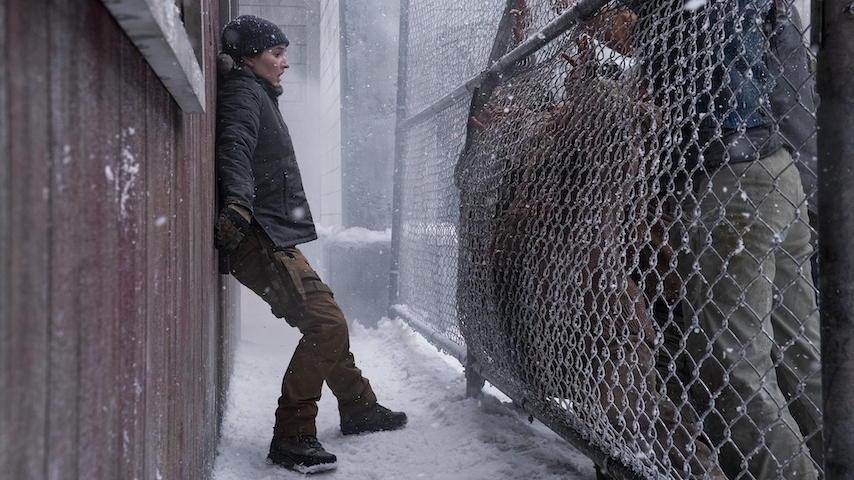
It is important to note just how ambivalently the episode undertakes this as well. Early scenes actively encourage the viewer to sympathise with Abby. She survives some incredibly tense moments of horror – a sequence involving a chain link fence rivals the best in horror cinema from the past year – and indeed gets saved by the very man she had pledged to kill. Drama convention leads us to assume that at some point during the season Abby is going to reevaluate or even forgive Joel.
She does not. Instead she kills him – and not cleanly. She blows off a knee with a shotgun, and beats him half to death with a golf club. Then, with a traumatised Ellie screaming at her, she stabs him in the neck and lets him bleed to death. This is not a tidy, forgiveable murder. This is torture and cruelty, guaranteed to make the audience hate the character forever. And after she seemed like a sympathetic character. The Last of Us is setting and breaking traditional rules within a single episode. The result is not drama, but trauma.
The acting here is tremendous. The tension and the shock can be unbearable. It is directed and photographed with a strong cinematic sense. It is a superb act of manipulating and defying audience expectations. Wherever the second season goes from here, it seems it will be worth the risk simply to deliver this episode. It is brilliant, harrowing stuff.
 FictionMachine.
Leave a comment