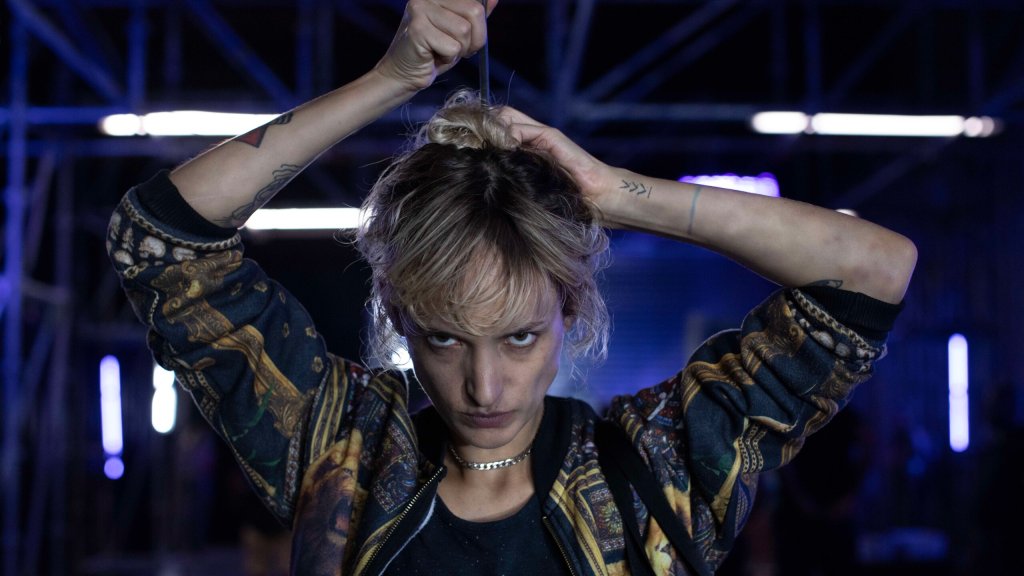
In Julia Ducournau’s Titane (2021), a serial killing car model (Agathe Rousselle) falls pregnant to a Cadillac before impersonating the long-missing son of a steroid-addicted firefighter. If that sort of premise does not intrigue you, I am not sure why you even bother to watch movies.
Ducournau’s earlier feature Raw (2016) was one of the most accomplished and striking directing debuts I have ever witnessed. This follow-up perhaps does not quite match it in terms of overall quality, but it does certainly make a bold impression. It starts neck-deep in French extremity – furious energy, sex and violence, transgressive provocation – and then pivots over 108 minutes into unexpected tenderness and warmth. It drives its audience to identify with monstrous behaviour, and to sympathise with the unsympathetic.
Rousselle plays Alexia, who after a childhood car crash had a titanium plate installed in the side of her skull. As an adult she fetishizes the cars she helps to promote, while her cravings for human intimacy seem to result in horrifying murders. On the run following her latest violent spree, she assumes the identity of missing person Adrien Legrand – and is soon taken in by Legrand’s traumatized father Vincent (Vincent Lindon).
Put aside the ostentatious displays of nudity and gore, and Titane becomes a heartfelt drama about broken people desperately struggling to find intimacy in a cold, unfeeling environment. It is beautifully played by its two leads, who succeed in drawing audience sympathy from the most unlikely and surreal of set-ups. While the film’s situations seem increasingly absurd on paper, they are played out with a remarkable honesty. Supporting performances are universally excellent, including former Raw star Garance Marillier as well as Laïs Salameh and a particularly strong Myriem Akheddiou.
Agathe Rousselle gives her acting debut here in a role that is challenging for all manner of reasons, and makes the most extraordinary of impressions. Ducournau undertook a long search to find an actor with the specific qualities she desired for Alexia; she did not simply make the perfect choice – she has directed them brilliantly as well.
This is a film rich in symbolism, as well as some quite confronting moments of body horror as Alexia’s mechanical baby begins to grow inside of her. One could rattle off a list of potential influences on Titane, including David Cronenberg, Gaspar Noe, and Tsukamoto Shinya, but to dwell too heavily on Ducournau’s debt to their films would under-value the potent treatment of the themes that she brings by herself. She is drawing arresting and complex ideas out of challenging material, and that has – in just two features – made her one of the most interesting filmmakers of the French extremity. It’s a gift she seems to share with her contemporary Coralie Fargeat (Revenge, The Substance) who has done much the same thing in much the same space of films. Jump back a quarter century to directors like Claire Denis (Trouble Every Day) and Catherine Breillat (Romance, À Ma Soeur!) and there seems a palpable argument that it is women filmmakers who are making the most accomplished work out of a challenging cinema genre.
 FictionMachine.
Leave a comment