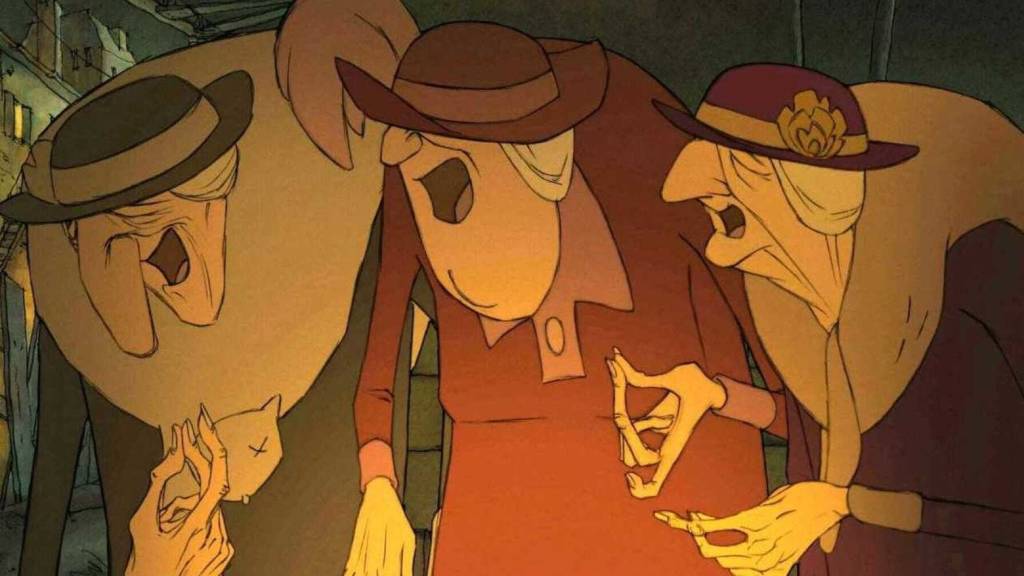
When her champion cyclist grandson is kidnapped from the Tour de France by the French mafia, the elderly Madame Souza embarks on a trans-Atlantic odyssey to rescue him from the city of Belleville. This mostly dialogue-free animated feature, The Triplets of Belleville, marked the feature debut of French animation director Sylvain Chomet. 22 years after its original release it remains an absolute delight: in equal measures absurd, charming, strange, and unsettling.
Chomet adopts a visual design for his film that feels largely inspired by the fluid, free-form animation of the 1920s and 1930s, typified largely by the silent shorts produced by Walt Disney. From this basis he extends the aesthetic out in all manner of grotesque and deformed ways, with more than a passing resemblance to British artist and animator Gerald Scarfe. At one extreme, Chomet’s designs are genuinely heart-warming and rather sweet. At the other, they are quite palpably distorted beyond the viewer’s comfort. Much of the film charts its course somewhere the middle, and the result of the mixture is something very amusing and unexpectedly disturbing as well.
Of course as one artist is inspired by earlier works, other artists get inspired in turn. A great deal of Chomet’s design work is reflected in the popular Japanese videogame series Professor Layton, and in its subsequent animated film spin-off Professor Layton and the Eternal Diva.
Madame Souza is accompanied on her journey by a faithful but elderly family dog, whose own semi-senile flights of fancy add their own delightful stream of diverting dream sequences. She later encounters the titular “Triplets of Belleville”: three popular singers from decades past now living an impoverished retirement in a city apartment. They are both a comedic and a musical delight, even if their dietary habits seem to border on the nauseating.
The film is as close as can be to a silent film, while still retaining the odd sound effect or incidental line of dialogue. It is a great innovation, since it not only reflect the silent cinema roots of Chomet’s animation style, but also emphasises the level of physical comedy. The resulting work is effective and funny for viewers any language, and helped make Belleville an international hit when it was released.
There is a surfeit of imagination working behind the scenes to bring Belleville to life, whether the dog’s sporadic dream sequences, the extraordinary rendition of Belleville itself – a bloated mixture of French Canada and New York – or the wonderfully idiosyncratic climax through the city streets. More than 20 years after the fact, it still feels entirely unique and refreshingly original. Even Chomet’s subsequent feature The Illusionist, which dives far deeper into French comic Jacques Tati for inspiration, seems to chart its own course. It leaves The Triplets of Belleville as something truly one-of-a-kind.
 FictionMachine.
Leave a comment