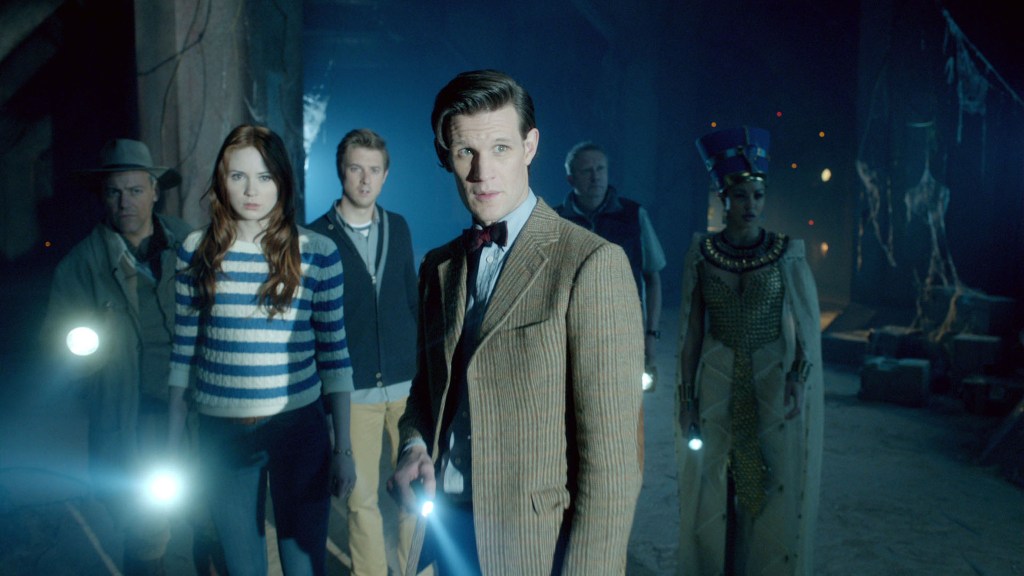
First broadcast 8 September 2012.
Talk about doing what it says on the tin: “Dinosaurs on a Spaceship”, the second episode of Doctor Who‘s seventh season, is a glorious exercise in the absurd. Written by Chris Chibnall and directed by Saul Metzstein, it takes a silly premise, adds even more silly elements, and then makes the audience cry over the death of a triceratops. It is a perfect example of why Doctor Who remains my favourite television series of all time. It is a rare television drama format in which you can do anything. In one jam-packed 45 minute narrative the viewer is offered tidal-powered spaceships, argumentative robots, a big game hunter, dinosaurs, Queen Nefertiti of Egypt, a 24th century Indian space agency, and a time-travelling alien. It is all presented with a combination of comedy, family affairs, bleak tragedy, and unexpectedly dark drama.
Its writer would eventually replace Steven Moffat as executive producer and showrunner, and as a result “Dinosaurs on a Spaceship” now also functions as a taste of what Doctor Who would be like during its 11th to 13th seasons. High concepts, drama, and whimsy all blended into one breezily enjoyable package. There are, of course, fans that deeply disliked “Dinosaurs on a Spaceship”, but it is important to acknowledge that those fans are wrong.
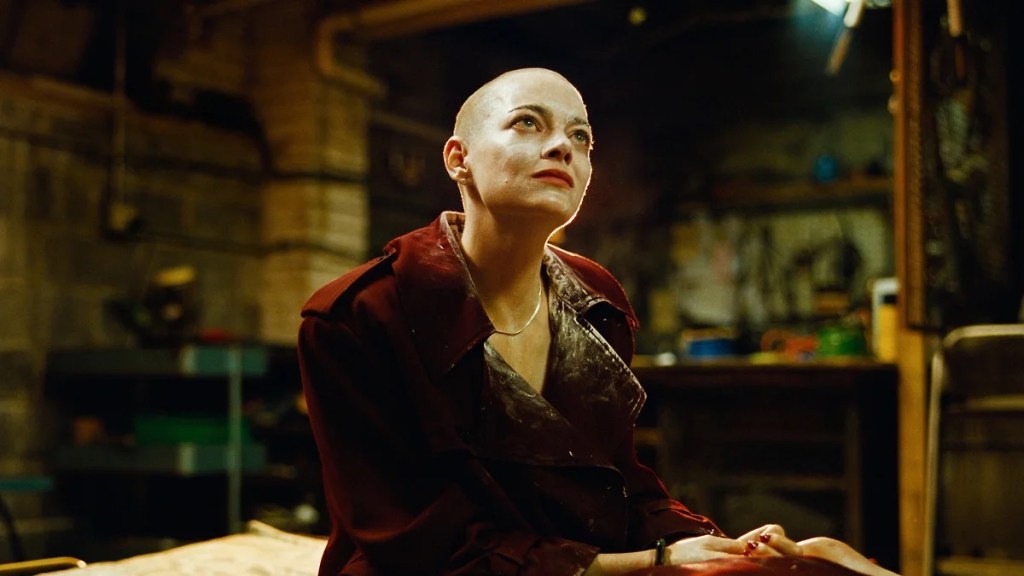
An unwitting new companion for the Doctor this episode is Rory’s befuddled father Brian (Mark Williams). He provides excellent comedy value, as well as a rare opportunity for the series to explore Rory a little via the relationship with his father. It is a tremendous episode for guest performances, however: David Bradley makes for a genuinely despicable villain as the smuggler Solomon, Riann Steele gives a great performance as Queen Nefertiti, and Rupert Graves is amiable – if a little tiresome – as big game hunter Riddell.
When the episode does dark, it genuinely plumbs some quite unexpected depths. Solomon turns out to not simply be a hissable villain – he is genuinely loathsome and unsympathetic, in a manner that Doctor Who honestly does not present all that often. It also offers a far more serious version of Matt Smith’s 11th Doctor. We have seen the Doctor kill his enemies many, many times, but it is still reasonably rare for him to do it such a deliberately murderous fashion.
This is the second episode in a row to pursue such a high concept ‘blockbuster’ angle on Doctor Who, and Season 7 will come to be largely defined by such self-contained, visually ambitious instalments. It certainly helps to shape this truncated first half of the season – just five regular episodes in 2012, but each of them shaped and presented like its own mini-movie. Of the five, this is almost certainly my favourite.
 FictionMachine.
Leave a comment