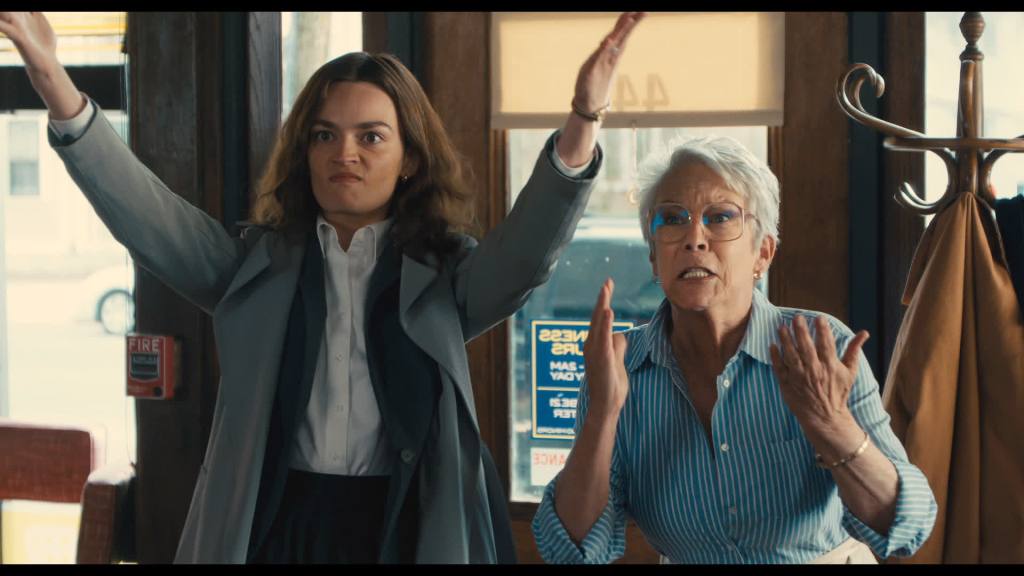
For a while there I honestly thought James L. Brooks had directed his final feature with 2010’s How Do You Know. Yet here we are, 15 years later, and the 85-year-old filmmaker has returned with the idiosyncratic, politically-themed comedy Ella McCay. I am a huge fan of his earlier work, notably his astonishing 1983 debut Terms of Endearment, 1987’s Broadcast News, and 1997’s As Good As It Gets. To even have the opportunity to see another film of that calibre is something to treasure. In a 42-year career, after all, he has only directed seven films. What pressure that creates for the seventh.
One should not be so critical as to dismiss Ella McCay as an absolute failure, although in most respects I think it does fail. In the moments where it shines, it seems spectacular. It is, however, the proverbial ‘curate’s egg’: some elements are great, but they do not occupy the whole picture. When all of it is framed between its opening and closing titles, it does not seem to work at all. When the time comes to assess Brooks’ entire career it will not be dwelled upon for more than a cursory mention.
Emma Mackey plays the titular Ella, lieutenant-governor of an unnamed American state, who is thrust into the limelight when the governor (Albert Brooks) accepts a promotion to the Federal cabinet. Over her first three days in office, she must juggle gubernatorial duties with an unwanted father seeking a reconciliation (Woody Harrelson), a mentally unwell brother (Spike Fearn), and an overly ambitious husband (Jack Lowden).
Ella is evidently an idealist, but she also is demonstrably someone without human intelligence. Several times she is shown to ramble on in meetings and political speeches, to the point where her audience is either deeply resentful or has literally fallen asleep. She also does not act to make things happen, instead she passively allows every event to occur around her. Almost every crisis she faces during the film is caused by a man. Almost every solution comes by Ella electing to lose something. Perhaps Brooks was aiming for some form of commentary on women in positions of power, but if so the message is muddled and rather depressing.
There are two key highlights, in actors Jamie Lee Curtis and Julie Kavner. The former plays Ella’s supportive and rather funny aunt, and she plays it with a perfect touch of warmth and humour. The latter, who also breaks the fourth wall as the film’s irascible narrator, makes a welcome return to live-action cinema after more than a decade off-screen. Kavner and Brooks go way back, of course – all the way to 1970s sitcom Rhoda, which Brooks produced and in which Kavner co-starred. In recent decades most of her time has been spent playing the voice of Marge in The Simpsons, and that has largely been the audience’s loss. She is a wonderful actor, although relying on her to narrate Ella McCay does seem a brave choice given how over-familiar the audience is with her voice.
Ella McCay‘s faults are manifold, including a weirdly unsympathetic protagonist, a number of wasted actors including Kumail Nanjiani and Woody Harrelson, a strangely twee Hans Zimmer score, and an overall approach that feels a few decades out of date. When good scenes hit, usually due to Brooks’ skills with dialogue, they are delightful. Those scenes feel as if they are few and far between.

 FictionMachine.
Leave a comment