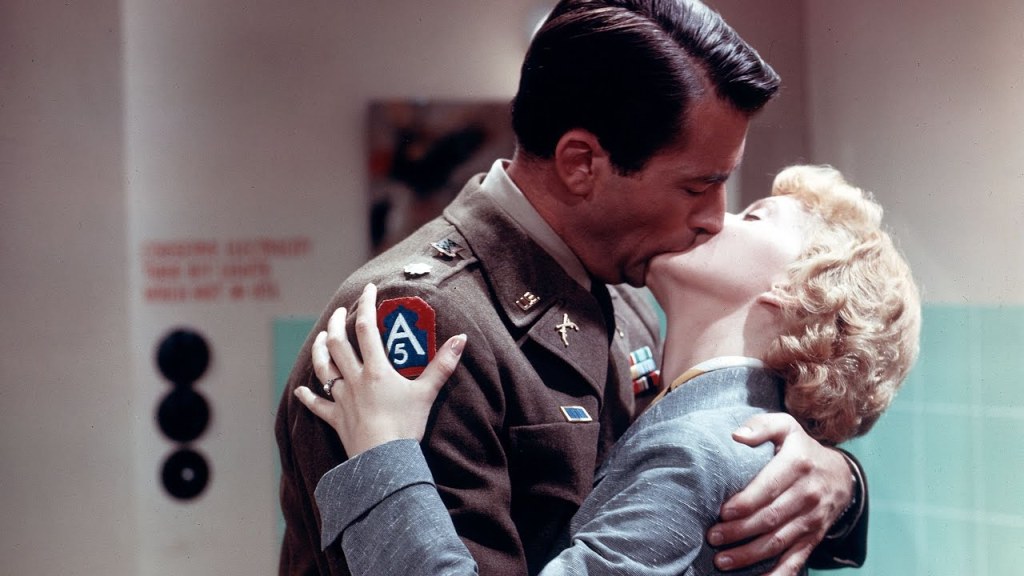
To summarise, and thus save valuable reading time: good concept, good cast, and weirdly listless direction. Fans of star Gregory Peck or Cold War thrillers might get a small thrill from 1954’s Night People, but truth be told this is not a very good movie.
An American soldier is kidnapped off the street in West Berlin and held hostage by Soviet forces. While the provost marshal for the American sector (Gregory Peck) works to free the hostage, the young man’s politically influential father (Broderick Crawford) arrives to take matters into his own hands.
The basic concept for Night People is great, and holds an enormous amount of dramatic potential. For Lt Col Steve Van Dyke (Peck) recovering the lost soldier is a delicate operation requiring back channels, informants, Soviet liaisons, and covert prisoner swaps. For the rich and powerful Charles Leatherby (Crawford) it means paying whatever ransom the Soviet captors happen to have in mind. It inevitably complicates a carefully strategized operation, and brings Leatherby and Van Dyke into direct confrontation.
Both actors have superb sense of presence, suggesting an immensely watchable battle of wills. Supporting characters, including Anita Björk as a glamorous source within the East German government, promise still greater volatility, diplomatic machinations, and political intrigue. It all seems a perfect set-up, with a strong story by Jed Harris and Tom Reed. Sadly the screenplay by W.R. Burnett and Nunally Johnson is not so impressive, broadly adopting a ‘tell-don’t-show’ approach that leaves the finished work short on incident but high on portent. The script takes pains – repeatedly so – to emphasise the danger and untrustworthy nature of the Soviet authorities, but then never actually follows the attitude up with dangerous incidents or untrustworthy developments. What is left over for the audience is surprisingly simple and direct.
Johnson also directs the picture, and it is here that everything appears to fall apart for Night People. The film is almost entirely shot in relatively banal medium shots, without much in the way of evocative long shots and virtually no close-ups at all. The approach cuts any dramatic tension off at the knees, since it winds up looking more like old-fashioned television than cinema. What seems particularly odd is that the film was shot in the ultra-wide Cinemascope format (2.35:1), which usually guarantees a certain level of visual impact. Here the format is simply wasted. The pace also seems rather leaden, leaching out suspense and artificially lowering the stakes for its lead characters.
Peck gives his all throughout, with a bold and heightened character that he clearly enjoys playing. Sometimes he’s amusing, and sometimes he’s even unintentionally amusing – his climactic punching someone unconscious is hilarious and appalling – but at all times he remains innately watchable. Despite this, Night People is still a pretty bad movie.


 FictionMachine.
Leave a comment